



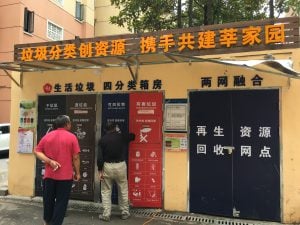
Zheng Shaoqian, 25, works for a games studio in Shanghai. Her daily trip to work now includes dropping two or three bags of rubbish off at the waste collection point in her apartment block. She’s been sorting her waste for a couple of weeks now, but she still doesn’t like the monitoring. “I can’t get used to it. It’s like they’re checking my work every time I throw something away,” she said.
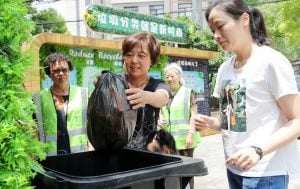
Since waste sorting became compulsory in Shanghai on 1 July, all of the city’s millions of residents have had similar experiences. People’s reactions have ranged from cynical to positive. Some even see the new system as a business opportunity.
Bins are in short supply
For many ordinary residents like Zheng, the first thing to do was buy clearly labelled bins to sort waste into. Both bins and binbags have seen a marked increase in demand. Data from online shopping site Tmall shows a 30-fold increase in searches for “waste sorting bins” in June, with sales up five-fold. Of those orders, 85% were in Shanghai. Short supplies have forced some retailers to ration sales.
The bins on sale are mostly plastic. The top ten search results for “waste sorting bins” on ecommerce giant Taobao are all plastic, with some selling over 100,000 units a month.
Factory bosses are talking of “goldmines”. According to media reports, one plastics manufacturer in an industrial zone in Taizhou, Zhejiang province, stopped production of all other products to concentrate solely on waste sorting bins. Taizhou is known for its plastics manufacturing, consuming 600 million tonnes of raw plastic annually, a tenth of the national total.
People are shredding leftovers
Food waste from the kitchen, also known as “wet” waste, is one category that has to be separated under Shanghai’s new rules. Many residents regard this as a problem. Such waste rots quickly in Shanghai’s hot summers. Miss a collection time and you’ll likely suffer foul smells and flies. Waste disposal units, which shred food waste into pieces small enough to be flushed down the sink, have been selling well on ecommerce sites.
A promotion on 18 June on JD.com saw these shredders sell more in half an hour than in all of 2018. These sudden bestsellers were mostly made in the United States and cost between 1,000 and 5,000 yuan (US$145 and US$727). With one of these fitted to your sink, you can flush food waste down the drain, saving yourself the trouble of carrying it to the collection station.
But some users have been blocking up their pipes. Drains in Chinese homes are not designed to be used with these units. They tend to have horizontal runs of pipe, making it easy for the food waste to get trapped.
In addition, China’s urban water treatment plants may not be able to cope with the extra load. Zheng Jianping, head of Shanghai’s Landscaping and City Appearance Bureau, recommends against using waste disposal units. In an interview, he said food waste can create substances such as methane, and disposal via the drains will increase river pollution.
New online services are springing up
If throwing out your rubbish is too much hassle, you can now pay someone else to do it for you. Xianyu, a Taobao platform for selling secondhand goods, now has users offering to deal with people’s rubbish for between 50 and 400 yuan ($7 and $58) a month.
Ele.me, a food delivery site, will collect rubbish for 12 yuan a time, though customers have to do the sorting first. The site only offers to make sure it’s thrown away at the correct time and place.
“There’s no reason not to do that now and then, but it’s not a regular option,” said Zheng Shaoqian, who plans to use these services only if she’s working late or has something urgent on.
Software telling you what waste goes in which category have also been acquiring lots of new users. China’s two major mobile payment platforms, Alipay and WeChat, have launched mini-programmes embedded into their apps, complete with augmented reality recognition and photo and voice search. Four hundred different types of waste are said to be covered.
Some shares are booming
Shanghai’s new sorting system has even affected China’s stock markets. According to Eastmoney.com, 55 companies saw their share prices rise thanks to the changes, with most increasing by more than 10%, and four seeing a 45% or greater increase.
But not all the sought-after firms are benefiting from the waste-sorting boom. The Hanyu Group, a pump manufacturer, saw its share price rise by the daily limit three days in a row, until it issued a statement on 2 July saying increased sales of its waste disposal units would have a negligible impact on its performance, and reminding investors to exercise caution.
Other firms have tried to jump on the bandwagon. With food waste now being separated out, the remaining dry waste can be incinerated at lower temperatures thanks to reduced moisture content. On 3 July, the Konka Group announced that its subsidiary, Econ Technology, is preparing to enter the incineration business.
Although the excitement on the stock exchanges is now beginning to fade, there’s no doubt that waste sorting has opened up a new market with great potential. Its scale ranges from tens of billions to a trillion yuan, according to different estimates. The Oriental Wealth Securities Research Institute predicts that waste disposal will reach a market size of more than 196 billion yuan ($28.5 billion). State-run news agency Xinhua is more optimistic, suggesting the market could exceed the trillion yuan mark ($145.5 billion). This huge new market will develop rapidly as the Shanghai model is promoted throughout China.



![The Amarnath cave and the market near the shrine. Besides the market, there is a large langar (food canteen) which provides food to the pilgrims during the day; and dinner for those who stay at the site for the night [image by: Athar Parvaiz]](https://dialogue.earth/content/uploads/2019/07/1-1-300x199.jpg)