China has never been daunted by big engineering. The Great Wall, the Grand Canal and recently the Three Gorges Dam all testify to an almost habitual pursuit of projects involving enormous scale.
Small wonder that many people India see it is as inevitable that China will divert the Yarlung Zangbo for its thirst-ridden cities in the north. This idea is made even more spectacular, given that this siphoning will literally involve taking the waters in a hop-jump-skip equivalent over the upper reaches of three other mighty rivers: the Salween, the Mekong and the temperamental Yangtze.
And even when this unforgiving route is overcome, the flows of the Yarlung Zangbo that have not already evaporated will then still have to be pumped, dropped and shuffled across a whole set of connecting channels, tunnels and sprawling pipelines before finally gushing from turned taps in Beijing.
For many, understandably, this kind of engineering is between implausible and impossible. But can one confidently conclude that a desperately thirsty China is beyond such great, grand and gigantic imaginations about water?
Officially, the Chinese government intends to move 38 to 48 billion cubic metres of water annually from its southern rivers for populations in the north, through the unambiguously titled scheme, the South-North Water Transfer Project. But should these ambitious water diversions unequivocally hold for trans-boundary rivers as well?
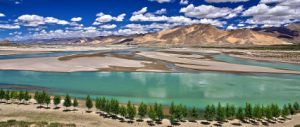
One of China’s major trans-boundary rivers is the Yarlung Zangbo, which after entering the Indian state of Arunachal Pradesh, opens up majestically within the Assam valley to become India’s “moving ocean”, the masculine Brahmaputra. Later on, these flows briefly meander as the Jamuna in Bangladesh before entirely folding into the Ganges River, near Goalundo Ghat.
One river stringing three nations is inescapably a natural geo-political muddle. Anyone, for example, pinching flows can send political ripples and cross-border anxieties. Added to this, the hydrological processes of this complicated fluvial regime – comprising innumerable tributaries, bifurcations and branches – remain little understood.
As yet, the vast mosaic of ecological niches and fluvial habitats of the Yarlung-Brahmaputra-Jamuna system has not been credibly studied in terms of its environmental webs and linkages. Ironically, the lack of knowledge on the river’s flora, fauna and intricate ecological relationships has failed to humble those shaping a vibrant discourse over water security for the region. If anything, ignorance seems bliss in this case; efforts have focused on ascertaining and intensely debating quantifiable flows.
In other words, the environmental qualities of the Yarlung-Brahmaputra-Jamuna have been conveniently ignored. Instead, it has become a river of volumes, compiled as numbers, as averages and as simple statistics.
And herein lies the Chinese water conundrum for Indian diplomacy and its non-traditional security strategists. If negotiations are reduced to ascertaining who is entitled to how much of the volume of water, the game might, in fact, be lost in a single move.
Thus far, the Indian side seems to be fashioning a two-point emphasis: constructing a dialogue for “sharing benefits” from probable hydro-electric projects on the Yarlung-Brahmaputra stretch; and developing a mutually agreeable format for exchanging hydraulic data.
The strategy, however, rests too much on hopes and expectations about reciprocal goodwill. Moreover, China’s imperatives or ability to realise kilowatts and cusecs (a measure of flow rate) do not, in any sense, provide compelling urgency for regional cooperation. Flow data, similarly, even when transparent and accessible, can only be read against the grain of several other imponderables.
And most critically, can such water arrangements, even if concluded as a treaty, be contained as a specific deal between India and China? That is, can India’s understandings with China be prevented from an interpretative spill over into existing water treaties, or significantly trouble other delicately poised discussions over trans-boundary rivers in the region? After all, India held the upper riparian position on previous major treaty negotiations: the Indus Water Treaty with Pakistan in the 1960s; and the Ganges Water Treaty with Bangladesh in the 1990s.
Upper riparians have an unstated advantage in the creation of hydraulic facts and can carry their topographical strength into concluding any arrangement. But clearly, in the case of the Yarlung Zangbo, India is in the weaker position, and bargains with China over a likely water treaty will put Indian negotiators in a technical context that for the latter, at least, entirely lacks historical precedence.
Put differently, the Indian side will need to develop a new language game which, above all else, provides a novel architecture for discussions that are based on an entirely different set of hydraulic concepts and categories.
Interestingly, cutting such a fresh path will be a lot easier than pursuing an intense, dogged and grinding exchange over contested river flow data. Since the 1990s, a dramatic scholarly turn has occurred in several social science disciplines with the theme of water as a central narrative. A range of publications in anthropology, sociology and history, have decisively altered our understanding of river management and hydraulic control.
An issue of the journal Nature in 2010 highlighted the urgency for an “integrative water approach” to strike a balance between human resource use and ecosystem protection. In effect, hydraulic and riverine habitat diversity have to be sustained if human consumption requirements are to be met in the long term.
It is imperative that Indian water negotiators harness this fresh research. Lazy arguments that continue to evoke nineteenth century quantitative hydrology and twentieth century large-dam monumentalism are most likely to fail.
Indian negotiators can make a more meaningful case by discussing the strong interconnections between hydraulic diversity on the one hand and livelihoods and intricate social dependencies on the other — rather than emphasising statistical simplifications about river flows.
Rohan D’Souza is assistant professor at the Centre for Studies in Science Policy, Jawaharlal Nehru University.
This article was first published on January 1, 2012, by Hindu Businessline. It is used here with permission.
Homepage image by Rita Willaert