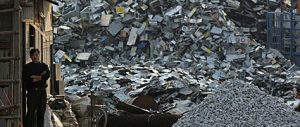
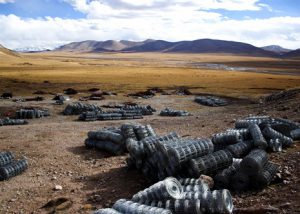
China is the major hub of the international textile industry, exporting US$200 billion worth of textile and apparel products in 2010 – accounting for 34% of global exports.
It’s provided cheap T-shirts and other clothes to people around the world but at a huge environmental cost, in particular water pollution.
The scale of the problem that still exists today has been highlighted by a report from the Institute of Public and Environmental Affairs (IPE), a leading environmental NGO in China. It documents the huge pollution caused by the fashion industry and indentifies 49 top brands — Armani , Puma and Zara to name just three — that contract with these polluting factories to manufacture their apparel.
The IPE report finds that industrial waste discharges from the apparel industry are a severe problem that is not improving fast enough. Discharge violations from the industry abound. The inescapable conclusion is that this sector refuses to clean up its act, and the reasons are clear: those who flout the law face no consequences for their bad behavior.
Check your closet and you will see: surely more than half of what is in there was made in China. When your favorite brands outsourced their manufacturing this past decade, they outsourced their pollution as well – and the world is severely worse off because of it.
Flouting the law in China
Of course, all clothing retailers and brands know that dyeing fabric has a heavy environmental impact; the industry is notorious as one of the most energy and water intensive in the world. Yet, as the annual China environmental Statistical Yearbooks show, pollution from the industry in China is not improving. Despite the progress government has made through its 11th Five-Year plan, total production grows larger every year, dwarfing some impressive improvements here and there.
The companies also surely know that the Chinese government does not adequately inspect or enforce the discharge limits on the books; estimates are that there are more than 50,000 textile mills in the country (the equivalent of 1,000 textile factories in each and every US state ), while the Chinese Ministry of Environmental Protection (about 450 people) holds steady at only slightly larger than the size of NRDC. In contrast, the US Environmental Protection Agency has 17,000 employees. Simple arithmetic tells them that they should not expect much oversight with that situation.
Finally, this is the industry that suffered mightily in public relations crises over labor issues abroad for nearly 20 years. Throughout the 1990s, the industry was heavily criticised for selling goods produced in sweatshops, and still today, it is criticised across many university campuses for overlooking basic human rights and safety in garment workers in the developing world. (See, for example, United Students against Sweat Shops). What if any lessons has this industry learned? How can it be repeating similar errors of failing to take basic responsibility for the impact of its manufacturing on the health and safety of communities surrounding its textile mills?
Given these facts, you would expect that clothing retailers and brands would be taking basic responsibility for the impact of its manufacturing on the health and safety of communities surrounding its textile mills. But as the first and now the latest IPE report shows, this does not happen routinely, even for the most responsible companies that publish annual Corporate Social Responsibility reports documenting their concern on environmental matters.
What explains their lack of attention to this problem? Are multi-nationals unaware of the actual size/scope of the problem? Are they hoping against hope that the factories they use are exceptional? Do they lack a bright line for their suppliers, that if crossed, rains business consequences down on factories that substantially pollute drinking water supplies for millions of downstream users and threaten to sully their brand reputation?
The answer: all of the above. In our work over the past five years with multi-national apparel companies operating in China, NRDC has seen that far too many companies lack supply chain policies that address the most important pollution problems abroad. Many are only now even beginning to identify where their fabric is made; historically they’ve worked only at the tail end of their supply chain, with garment cut-and-sew locations, where there is little environmental risk. In the way that our hearing adjusts to the din when walking into a noisy room, too many of these companies have accustomed themselves to the environmental mess they are causing abroad, and they lack a sense of urgency to address the 1910-like conditions we see in some places in China.
Yet as this and previous IPE reports show, the curtain is rising in China, and it is no longer safe to look the other way.
So here’s an idea: this week, the Sustainable Apparel Coalition, a large coalition of over 60 leading apparel retailers and brands (and a small sprinkling of NGOs including NRDC) is meeting in Hong Kong. In attendance: a critical mass of the heavy hitters of the industry, including many cited in the IPE report, will attend. The mission of this group? Sustainability! Yet to date, this group has not made textile mills a priority of its work. They’re busy with other aspects of a “sustainability journey” that has not put first things first and prioritised basic compliance with environmental law. We’ll be there pushing for a change in focus. We hope your favorite brands will join in too.
This is a guest blog by Dr. Linda Greer, Director of Health and Environmental Program of NRDC