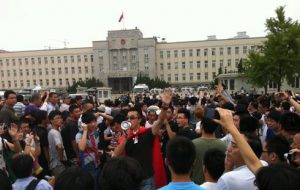
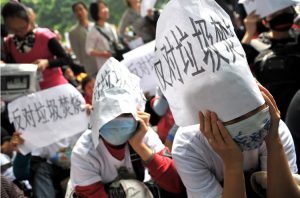
In the past decade, China has transformed dramatically. One of the biggest changes is citizens’ awareness of environmental issues, and as a result, environmental protests are on the rise.
But the surge in the number of environmental protests must be viewed cautiously, says Renmin University Environmental Department Director Ma Zhong – naïve support will not help the environmental movement.
China has made dramatic advances, but in many places industrialisation is still incomplete and income and production systems have not undergone substantive changes. However, people’s awareness has risen and citizens now demand higher standards of living and holistic lives that are fulfilling not only economically.
This contrasts greatly with the situation in the USA, where industrialisation was complete and production had started to be exported to different places before citizens started to have environmental protests.
This process was extremely important to the USA – moving production facilities based on the bottom line, profits increased and the environment was protected. China has no way of imitating this process and must think of creative solutions to respond to its current problems.
Because of the different foundations for environmental protests in China and the USA, there is a certain degree to which the two cannot be compared. The key factors of reform are familiar – legislation, tort reform, political system reforms, citizen and NGO work, etc. All of these happened in the USA. But policy decisions in China follow different logic – is it only that policy decisions are undemocratic?
Once Chinese people have taken to the streets, solving the problem picks up speed and surpasses other leverage that is used and discussions of the reform process even gain wide public participation in just a few days’ time. This is the typical style of Chinese policy making, but it’s price is too costly.
Is this kind of environmental policy making really legitimate? Is it effective, at all? This is a question that should be examined.
Environmental and social responsibility lacking
Among present environmental movements in China, another question that deserves reflection is the distinction of public and private matters. In the “mass incidents” that have already happened, it’s easy to see that people take care of issues that affect their homes and personal lives, but with regard to other issues, there is an obvious gap in public concern.
For example, in the Bohai oil spill, on the surface it seemed there was concern for the wellbeing of the local fishermen, but there wasn’t a reaction from Beijingers, Shaghainese, and Guangzhou residents. This doesn’t make sense – the ocean environment is a natural public resource that affects everyone and a coastal environmental crisis also affects mainlanders.
When the same kind of coastline oil spill happened in America, BP had to pay billions of dollars. But in China, only when extreme public pressure is exerted on the culprit is there a reaction and responsibility finally acknowledged.
Another example of the lack of public concern for greater environmental and social issues is coal mining. Today China relies on coal for 70% of its energy. Every year, thousands of lives are lost in the coal industry. Compensation for miners who die is 200,000 rmb, but even these accidents and costs have not aroused a response from the Chinese public.
If China were to go by America’s standards of compensation, many coal mines would be forced to close and the price of coal and other energy resources would increase.
For many Chinese people, pollution, incineration factories and chemical plants at their own doorstep are intolerable, but their consciousness of the environment stops there. People do not feel miners who die in coal mines have any direct connection to them, or that accidents like the Bohai oil spill relate to their personal lives. This lack of public concern and wellbeing is the current standard, and this kind of attitude is shortsighted and narrow.
Environmentalists need to work especially hard to encourage environmental movements and awaken people’s environmental consciousness. Getting the public to have a stronger feeling social responsibility is long-term work. But encouraging current concerns of the public can be a base for social movements that actually effect real reform, not merely get a group of agitated people protesting in the streets.
Translated by chinadialogue volunteer Marta Casey.