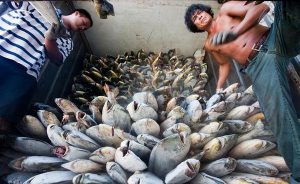
A senior Chinese fishing expert has spoken out about the ecological crisis facing the Yangtze River. Cao Wenxuan, from the Chinese Academy of Sciences identifies six factors damaging the Yangtze’s fisheries, the most important and direct of which is overfishing.
The other five are: land reclamation; pollution from industry and mines; the blocking of channels linking rivers and lakes, water management and hydropower construction; and agricultural pollution.
The Yangtze is China’s biggest freshwater fishery, accounting for 56% of all freshwater catches. Of the 35 species of freshwater fish farmed in China, 26 find their natural habitat in the Yangtze. The river is believed to produce the best quality black carp, grass carp, chub and bighead carp – four fish which have been farmed in China for hundreds of years and are known as the “four farmed fish”. Stocks for farming these fish have always come from the Yangtze.
As an ichthyologist – a zoologist focused on fish – and academician of the Chinese Academy of Sciences, Cao participated in the planning processes for The Three Gorges dam, as well as the Yangtze dams at Gezhou and Xiaonanhai.
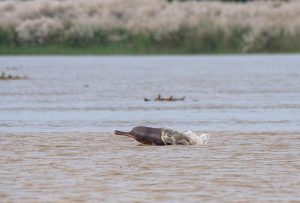
According to Cao, the Yangtze is home to the largest wild populations and gene pools of the “four farmed fish”, and also home to dozens of other commercial fish species, including the common carp and goldfish and valuable specimens like the Chinese high fin banded shark and mandarin fish. It is also the last refuge for endangered species such as the Chinese paddlefish and finless porpoise.
Fish are a key part of the Yangtze’s ecosystem. Without fish, other species that feed on fish cannot survive. Without fish to feed on plankton, the river will be less able to clean itself. If the fish disappear, the ecosystem and biodiversity of the Yangtze will face collapse.
In the 1960s, about 100 billion fish belonging to the four farmed species were born. Now at the Yichang spawning grounds, new fish number in only the tens of millions each year. Three other well-known migratory fish species have also suffered a rapid decline: the tenualosa has disappeared from the Yangtze, the Japanese grenadier anchovy, which sells for 8,000 yuan a jin at Shanghai markets, is endangered, and the taikifugu, a kind of pufferfish, no longer forms the large migratory shoals it once did.
So what’s Cao’s solution? “I propose a 10-year fishing moratorium on the Yangzte. The fish numbers can still recover from over-fishing,” he says.
But fishing is not the only thing affecting species that inhabit the Yangtze – the growing number of dams on the river has also had an impact. “The Three Gorges Dam made the water deeper, and so water temperature changes more slowly,” continues Cao. “The ‘four farmed fish’ used to spawn in late April or early May, now they spawn in mid-May.”
It’s the same with rare fish, Cao said: “The Chinese sturgeon spawns in late October or early November, but now that’s later too. It only spawns when the water temperature is below 19 degrees Celsius, and the water cools later now.”
Observations by the Chinese Academy of Sciences found that, before the dam at Gezhou was built, fish eggs and fry from spawning grounds upstream in Chongqing, Wanxian and Zigui would float down to the middle reaches of the river before hatching and growing. Gezhou is a “run-of-the-river” hydropower dam, and most of the eggs and fry which pass through the sluice-gates do survive. But bubbles of gas are found in the bodies of some of the fish, which do not survive.
And at the Three Gorges Dam, where in June 2003 the reservoir was filled to a depth of 139 metres, the majority of the fish passing through the sluices are believed to die as a result of nitrogen poisoning.
In 2007, the reservoir was filled to 156 metres, and 98% of the 316 million fry passing through the dam died. Many of the 912 million fry of the “four farmed fish” passing through in 2008 also died.
Cao explains that a dam changes the natural flow and rise and fall of the water, and this – especially the filling of a deep reservoir – affects the local climate and reduces the river’s ability to cleanse itself. Large quantities of harmful substances are produced, affecting the food chain.
“In the cold water of reservoirs like Anjiang and Danjiangkou, the methylation of heavy metals creates organic substances, which are absorbed by plankton and enter the human food chain and damage health,” says Cao.
“The water flow at Gezhou isn’t bad. The Three Gorges is a bit worse, and then Xiluodu and Baihetan are worse again. And it’s not just methylation. The vegetation at the bottom of the reservoir becomes methane, which is a greenhouse gas – that means carbon emissions.”
Destroying a nature reserve to make way for a dam
Weng Lida was formerly head of the Yangtze Water Resources Protection Bureau, a body under both the Ministry of Water Resources and the Ministry of Environmental Protection. He was in charge of the environmental impact assessments for projects including the Three Gorges Dam, the South-North Water Transfer Project and the cleaning up of Taihu Lake.
Weng has long worried about how dam cascades being built on the upper reaches of the Yangtze and its tributaries are breaking the river up into separate sections, with none of the caution of the closely-watched Three Gorges Dam. There is much less discussion, openness and transparency, he says, and construction is less rigorous. Research into the cumulative effect of all these dams is lacking, he says, and no solution to coordinated management of dams across the upper and lower reaches has been found.
The Xiaonanhai dam has been opposed by many environmental groups, as it will break up a rare fish reserve on the upper Yangtze.
Cao said that, according to Article 23 of China’s Nature Reserve Regulations, no “production facilities” can be built within the core or buffer zone of a nature reserve, while in the surrounding area, no production facilities are allowed which pollute, damage resources or spoil the appearance of the reserve. “So building this dam, which obviously affects the aquatic ecology, is in breach of this regulation.”
Cao explains that the borders of the nature reserve were last adjusted as recently as 2005, due to changes after the construction of the huge Xiluodu and Xiangjia dams, which reduced the space for aquatic life to survive. So, the State Environmental Protection Agency stressed in its response to the environmental impact assessment that no more dams or hydropower plants should be built in the reserve.
Numerous sources confirm that was the same year Chongqing put the Xiaonanhai Dam on the agenda.
In 2006, the city held a meeting to discuss the impact of the dam on the reserve. Cao was invited, but refused to attend. “It was obvious what the impact was going to be, what was there to discuss?”
“It’s as if national nature reserves are optional,” says Cao. “It’s unacceptable. It doesn’t matter if you’re talking about fish or about people – you’ve got to obey the law.”
In 2008, the National Development and Reform Commission, China’s top economic planner, sent a letter to its ministries and commissions soliciting views on the start of preliminary work for the Xiaonanhai Dam. The first line of the Ministry of Environmental Protections response was: “The Xiaonanhai Dam would be built in the Upper Yangtze Rare and Endemic Fish Reserve, and so is inappropriate.”
The document also described the reserve as “a last refuge”, “of huge significance” and “irreplaceable”. It also explicitly stated that, “planning for the Yangtze basin does not meet the needs of conservation and should be changed.” Finally, it suggested that the dam be considered with “extreme caution”.
Weng Lida said that the Ministry of Agriculture was not in favour either, until October 2009 when a change was made to the Chongqing section of the reserve. After that, the dam was “no longer in the reserve”. In November 2010, the Ministry of Environmental Protection accepted the same change.
This article was first published in Oriental Outlook.