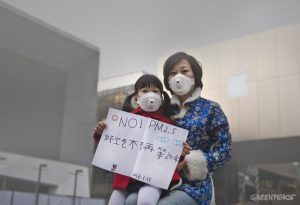
Pollution

Local officials in north China quit smoking to fight air pollution

As air pollution worsens in northern China, local officials in Cangzhou have adopted an unusual approach
English

If you are planning to quit smoking, here is another reason to do so – it can fight air pollution, at least according to local officials in China’s northern Hebei Province.

Officials in Cangzhou city, Hebei vowed to quit smoking in front of a mass rally this week, claiming the pledge would help to solve air pollution.

It began when Tian Jinchang, the Party secretary of Yunhe District, said that air pollution control and environmental protection should be more than just verbal commitments.“ Quitting smoking is a concrete move. It’s also a commitment to ourselves, our families and the environment,” Tian said.

Tian’s deputy echoed this sentiment, and to show his determination threw away a pack of cigarettes as he made the pledge.   

The showy campaign backfired and attracted criticism from the press. An editorial on China Youth Daily’s website asked if the campaign was a joke.

“Though there is no denying that smoking could be harmful to people’s health and is the major source of indoor PM2.5 (fine particulate matter), treating smoking as the prime culprit of air pollution is a sign of ignorance,” the editorial read.

Cangzhou officials’ campaign against air pollution came amid great public concern over north China’s worsening air pollution. According to the Ministry of Environmental Protection’s monthly air quality index ranking, most of the worst polluted cities are in the north of the country.

Public concern was further fueled by recent studies on China’s air pollution. A newly-published study shows that people’s life expectancy has been reduced by 5.5 years as a result of the severe air pollution north of the Huai River. Earlier this year, data research revealed that air pollution in China was related to 1.2 million premature deaths in 2010.

Though officials at the environment ministry dismissed these studies as untrustworthy, the government leadership seem more aware of the gravity of China’s air pollution. Premier Li Keqiang outlined ten guidelines for air pollution control at an executive meeting of the State Council last month.

Cookies Settings

Dialogue Earth uses cookies to provide you with the best user experience possible. Cookie information is stored in your browser. It allows us to recognise you when you return to Dialogue Earth and helps us to understand which sections of the website you find useful.

Required Cookies

Required Cookies should be enabled at all times so that we can save your preferences for cookie settings.

Dialogue Earth - Dialogue Earth is an independent organisation dedicated to promoting a common understanding of the world's urgent environmental challenges. Read our privacy policy.

Cloudflare - Cloudflare is a service used for the purposes of increasing the security and performance of web sites and services. Read Cloudflare's privacy policy and terms of service.

Functional Cookies

Dialogue Earth uses several functional cookies to collect anonymous information such as the number of site visitors and the most popular pages. Keeping these cookies enabled helps us to improve our website.

Google Analytics - The Google Analytics cookies are used to gather anonymous information about how you use our websites. We use this information to improve our sites and report on the reach of our content. Read Google's privacy policy and terms of service.

Advertising Cookies

This website uses the following additional cookies:

Google Inc. - Google operates Google Ads, Display & Video 360, and Google Ad Manager. These services allow advertisers to plan, execute and analyze marketing programs with greater ease and efficiency, while enabling publishers to maximize their returns from online advertising. Note that you may see cookies placed by Google for advertising, including the opt out cookie, under the Google.com or DoubleClick.net domains.

Twitter - Twitter is a real-time information network that connects you to the latest stories, ideas, opinions and news about what you find interesting. Simply find the accounts you find compelling and follow the conversations.

Facebook Inc. - Facebook is an online social networking service. China Dialogue aims to help guide our readers to content that they are interested in, so they can continue to read more of what they enjoy. If you are a social media user, then we are able to do this through a pixel provided by Facebook, which allows Facebook to place cookies on your web browser. For example, when a Facebook user returns to Facebook from our site, Facebook can identify them as part of a group of China Dialogue readers, and deliver them marketing messages from us, i.e. more of our content on biodiversity. Data that can be obtained through this is limited to the URL of the pages that have been visited and the limited information a browser might pass on, such as its IP address. In addition to the cookie controls that we mentioned above, if you are a Facebook user you can opt out by following this link.

Linkedin - LinkedIn is a business- and employment-oriented social networking service that operates via websites and mobile apps.