Pollution

Fines won’t solve China’s smog problem

Liaoning province, in north east China, has set a precedent by fining some of its cities for air pollution, but there are doubts that this approach will be enough to combat the country's smog
English
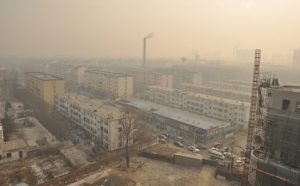
<p>While fines can help implementation, it is transparency and information disclosure that will truly hold local governments accountable, argues Professor Mol (Image: Alamy)</p>

While fines can help implementation, it is transparency and information disclosure that will truly hold local governments accountable, argues Professor Mol (Image: Alamy)

Eight municipal governments in northeast Liaoning province have together received 54.2 million yuan (US$ 8.9 million) in fines for failing to reach air quality standards – the first time a provincial government has imposed financial penalties on lower-level governments for pollution. The largest fine, of 34.6 million yuan (US$ 5.6 million), was given to Shenyang, the provincial capital.

The fines were based on a regulation passed last year by Liaoning’s provincial environmental authority. According to the regulation, Liaoning’s 14 cities will be evaluated on levels of pollutants, including PM10 (particles less than 10 micrometres in diameter), sulphur dioxide and nitrogen dioxide; cities failing the national air quality standard will be fined.

Liaoning’s fines came amid growing public concerns over the worsening smog which at one point blanketed more than 100 cities across China.

Professor Mol at Renmin University told chinadialogue that the fine was “exceptional” and “can be seen as an indication that implementation of environmental policies is getting more serious.”

“Strong fines help in enhancing implementation by lower level governments of national and provincial environmental policies,” Professor Mol added.

At Greenpeace East Asia, campaigner Li Shuo also noted that this time the fine was imposed on the municipal government rather than the industry. “This can hopefully generate some pressure on the cities to act further,” he told chinadialogue.

“Something is better than nothing. A meaningful fine is a step in the right direction,” commented Steve Tsang, the director of the China Policy Institute at the University of Nottingham. Nevertheless, Professor Tsang said that if the fine is modest compared to the cost saving involved in polluting, the effect of the fine will be minimal.

Tim Forsyth, an environmental policy expert at the London School of Economics and Political Science, told chinadialogue that he feared the fine might be a “demonstration rather than actual action.”

“There are examples of similar fines in Ho Chi Minh City in Vietnam in the late 90s and 00s, which were considered to be more about the central government trying to indicate to outside donors that they were trying to control the situation,” Dr Forsyth said.

Dr Forsyth’s caution was echoed by Steve Tsang. “Real change can only happen with a change in attitude and acceptance of the importance of environmental protection. A fine will not deliver that,” he said.

Professor Mol, a longtime keen advocate for openness, suggested that while fines can help implementation, it is transparency and information disclosure that will truly hold local governments accountable. “The direct information Chinese citizens can now collect on their mobile phone on air pollution quality puts direct pressure on local policy makers to improve air quality.”

However, whilst the implications of the fines are still being debated, other provinces show no signs of following Liaoning’s lead. Li Shuo said he had not heard of measures being adopted by other provinces.


Cookies Settings

Dialogue Earth uses cookies to provide you with the best user experience possible. Cookie information is stored in your browser. It allows us to recognise you when you return to Dialogue Earth and helps us to understand which sections of the website you find useful.

Required Cookies

Required Cookies should be enabled at all times so that we can save your preferences for cookie settings.

Dialogue Earth - Dialogue Earth is an independent organisation dedicated to promoting a common understanding of the world's urgent environmental challenges. Read our privacy policy.

Cloudflare - Cloudflare is a service used for the purposes of increasing the security and performance of web sites and services. Read Cloudflare's privacy policy and terms of service.

Functional Cookies

Dialogue Earth uses several functional cookies to collect anonymous information such as the number of site visitors and the most popular pages. Keeping these cookies enabled helps us to improve our website.

Google Analytics - The Google Analytics cookies are used to gather anonymous information about how you use our websites. We use this information to improve our sites and report on the reach of our content. Read Google's privacy policy and terms of service.

Advertising Cookies

This website uses the following additional cookies:

Google Inc. - Google operates Google Ads, Display & Video 360, and Google Ad Manager. These services allow advertisers to plan, execute and analyze marketing programs with greater ease and efficiency, while enabling publishers to maximize their returns from online advertising. Note that you may see cookies placed by Google for advertising, including the opt out cookie, under the Google.com or DoubleClick.net domains.

Twitter - Twitter is a real-time information network that connects you to the latest stories, ideas, opinions and news about what you find interesting. Simply find the accounts you find compelling and follow the conversations.

Facebook Inc. - Facebook is an online social networking service. China Dialogue aims to help guide our readers to content that they are interested in, so they can continue to read more of what they enjoy. If you are a social media user, then we are able to do this through a pixel provided by Facebook, which allows Facebook to place cookies on your web browser. For example, when a Facebook user returns to Facebook from our site, Facebook can identify them as part of a group of China Dialogue readers, and deliver them marketing messages from us, i.e. more of our content on biodiversity. Data that can be obtained through this is limited to the URL of the pages that have been visited and the limited information a browser might pass on, such as its IP address. In addition to the cookie controls that we mentioned above, if you are a Facebook user you can opt out by following this link.

Linkedin - LinkedIn is a business- and employment-oriented social networking service that operates via websites and mobile apps.