Pollution

Pumping pollution into China’s groundwater

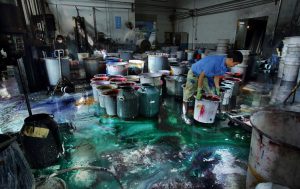
Large quantities of polluted water from a leading medical supplies manufacturer have been polluting groundwater in Henan province
English

This article won the prize for ´Best Scoop’ at the 2014 China Environmental Press Awards, jointly organised by chinadialogue and the Guardian.

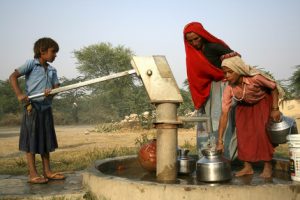
Like the other villagers in Dongwangying, on the outskirts of Pingdingshan city in Henan province, central China, Li Jia and his family rely on well water. A hand-pumped well in his yard draws water from 30 metres underground. But even water from that depth comes up yellow and murky. A factory belonging to the Shengguang Group, the world’s biggest manufacturer of IV drips and syringes, is just several hundred metres away.

Li Jia and the villagers say that the factory has been dumping waste water since the factory was built, and that “drinking the well water gives you the runs, and there’s some kind of chemical smell to it.” Despite repeated petitions the villagers have not been able to obtain the results of government water quality tests.

Sixty percent of China’s population gets its drinking water from groundwater, which in rural areas is often drunk untreated. Currently 360 million people in rural areas drink water which does not meet the relevant standards; while 20% of groundwater sources for municipal water supplies are not up to standard.

A Shengguang Group representative admitted that the company “does not have a water treatment facility.” Yan Zhenpeng, director of the Henan Geological Survey Institute’s Centre for Water Environmental Surveying, said that if polluted water is dumped directly into deep or medium-depth groundwater the pollution will spread rapidly across a wide area.

The Shengguang Group is important to Henan’s economy, with manufacturing output worth US$800 million a year. It sells medical supplies throughout China and to 40 countries in Europe and South-East Asia. But the huge quantities of waste water from the manufacturing process being injected underground are causing severe groundwater pollution.

Hidden danger

Unlike surface water, which is mobile and quickly replaced, groundwater is static and slow-moving. It cannot clean itself as efficiently as surface water, and pollution will be longer lasting.

This is why Chinese law strictly forbids the dumping of effluent underground. Article 35 of the Water Pollution Prevention Law forbids the disposal of harmful waste water or other pollutants in seepage pits, caves or crevices.

Local environmental authorities are able to order changes and impose fines when these rules are broken. If the offending company fails to make remediation, the authorities can appoint a third party to carry out the work at the offending company’s expense. But in reality the majority of cases result in nothing more than a fine.

The main causes of groundwater pollution are the improper disposal of industrial and domestic effluent, but other sources of pollution include agricultural pesticides and fertiliser and mining waste.

An employee with the Henan environmental authorities told Caijing that companies usually dispose of pollutants underground for one of two reasons: there is no convenient river to use; or the company is either unable to treat the water to make it suitable for surface disposal or is unwilling to bear the costs of doing so. 

Shengguang is not the only company to be polluting groundwater via seepage pits – it happens everywhere. In May 2011 Xinhua and other media outlets reported that in the Hebei county of Yuanshi dozens of chemical plants had been found to be dumping water containing chemical contaminants in seepage pits, with the resulting groundwater pollution forcing ten thousand locals to buy drinking water. And things are getting worse: in northern China some companies have been found using high-powered pumps to inject polluted water underground.

Understanding of the state of China’s groundwater is vague. There is a map of groundwater pollution published by the China Geological Survey, but this only gives an indication of the quality of groundwater across large regions, and the differing make-up of pollutants. For example in the industrial and oil-producing north-east groundwater pollution is severe. In the Yangtze and Pearl River deltas, home to large cities and a developed mining industry, pollution of shallow-level groundwater is common. In northern China pollution of groundwater is both common and worsening. However groundwater in the south-west and north-west of China has been less affected by human activity and, as such, is less polluted.

Cancer villages

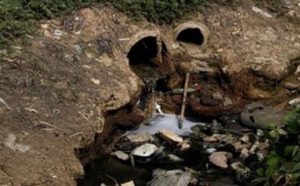
Shenqiu county, in the Henan municipality of Zhoukou, is known around China due to the high incidence of cancer in some of the villages. The county lies on the Shaying River, a major tributary of the Huai, but its residents rely on groundwater for daily use. Follow the Shaying upstream all the way to the Xinhua road bridge in Pingdingshan and you see water as thick and dark as soy sauce spewing out of sewers into the Zhan River – the only river to run through the city. Ten kilometres later that water flows into the Shaying and later the Huai, and then on to the plains of Anhui and Jiangsu.
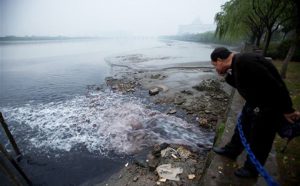
 
A group of locals playing cards under the bridge said effluent has been dumped like this for 20 years.
 
Even if waste water is dumped on the surface, pollutants still seep into groundwater and accumulate at greater depths. In 2005 the local environmental authorities found water drawn from a depth of 50 metres was unsuitable for drinking; and an official with the Shenqiu environmental protection bureau told us that the pollution now reaches even deeper. Now wells in some villages have reached a depth of 100 metres and still not found safe water.
 
Pollutants from the Shaying, the biggest tributary of the Huai river, account for half of all pollution in the Huai proper. For years the Shaying has been the focus of efforts to clean up the Huai, with many smaller polluting factories forced to merge or shut down. But despite all those efforts, the total amount of pollution released has not been brought under control.
 
Upstream at Pingdingshan pollution comes from coal mining and the production of steel, chemicals and pharmaceuticals. Further down river at Tahe it comes from food processing, paper-mills and tanneries. Further down again at Xiangcheng, manufacturing of MSG is to blame. “Pollutant after pollutant gets added as you travel downstream,” explained Huo Daishan of environmental group Huai River Guardians. “It’s nonsense to suggest it can be cleaned up inside a decade.”
 
Pingdingshan is home to about five million people, 3.9 million of them in rural areas. City water officials said that only 47% of those rural residents are connected to the water supply network, which draws water from deep wells. The remaining two million rely on their own hand-pumped wells, only able to reach shallow groundwater. “Groundwater pollution has a quick and significant impact on their health.”
 
Many areas on the banks of the Shaying suffer from high rates of cancer. But as pollution of water sources is so common, some locals have no choice but to continue drinking water they know to be “toxic”.
Cookies Settings

Dialogue Earth uses cookies to provide you with the best user experience possible. Cookie information is stored in your browser. It allows us to recognise you when you return to Dialogue Earth and helps us to understand which sections of the website you find useful.

Required Cookies

Required Cookies should be enabled at all times so that we can save your preferences for cookie settings.

Dialogue Earth - Dialogue Earth is an independent organisation dedicated to promoting a common understanding of the world's urgent environmental challenges. Read our privacy policy.

Cloudflare - Cloudflare is a service used for the purposes of increasing the security and performance of web sites and services. Read Cloudflare's privacy policy and terms of service.

Functional Cookies

Dialogue Earth uses several functional cookies to collect anonymous information such as the number of site visitors and the most popular pages. Keeping these cookies enabled helps us to improve our website.

Google Analytics - The Google Analytics cookies are used to gather anonymous information about how you use our websites. We use this information to improve our sites and report on the reach of our content. Read Google's privacy policy and terms of service.

Advertising Cookies

This website uses the following additional cookies:

Google Inc. - Google operates Google Ads, Display & Video 360, and Google Ad Manager. These services allow advertisers to plan, execute and analyze marketing programs with greater ease and efficiency, while enabling publishers to maximize their returns from online advertising. Note that you may see cookies placed by Google for advertising, including the opt out cookie, under the Google.com or DoubleClick.net domains.

Twitter - Twitter is a real-time information network that connects you to the latest stories, ideas, opinions and news about what you find interesting. Simply find the accounts you find compelling and follow the conversations.

Facebook Inc. - Facebook is an online social networking service. China Dialogue aims to help guide our readers to content that they are interested in, so they can continue to read more of what they enjoy. If you are a social media user, then we are able to do this through a pixel provided by Facebook, which allows Facebook to place cookies on your web browser. For example, when a Facebook user returns to Facebook from our site, Facebook can identify them as part of a group of China Dialogue readers, and deliver them marketing messages from us, i.e. more of our content on biodiversity. Data that can be obtained through this is limited to the URL of the pages that have been visited and the limited information a browser might pass on, such as its IP address. In addition to the cookie controls that we mentioned above, if you are a Facebook user you can opt out by following this link.

Linkedin - LinkedIn is a business- and employment-oriented social networking service that operates via websites and mobile apps.