In August 2011 microblogging was at the peak of its influence in China; anyone worried about the environment could report their concerns. One Weibo user, @VegetableVillageSword, started exposing local pollution.
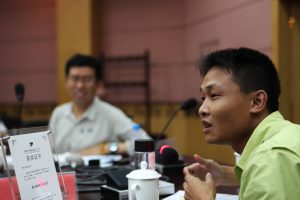
The account is run by Wang Chunsheng, a forty-year old citizen of Shouguang in eastern China’s Shandong province. He used his microblog to tell people how local crops were grown, traded and sold in the vegetable-growing cities of Shouguang and Weifang. Were highly toxic pesticides used? Were grave environmental risks concealed in the fields, irrigation water and air? Wang met with opposition, not just from local officials and farmers, but even people he was trying to help were sometimes unwilling to listen, preferring to believe that there was nothing to worry about.
Wang persistently monitored a local chemical company, Lianmeng Chemical Group: its acquisition of land, the environmental impact assessment process and the soil pollution left behind after it relocated. His work paid off. The environmental impact report was found to have been forged and the company responsible was punished by the provincial environmental authorities. Problems with how the company had acquired land also attracted attention from the provincial land authorities.
Citizen journalists often uncover isolated but real problems that have escaped the notice of the mainstream media. On February 22, 2014, Wang wrote on his microblog that he had asked a child if the river running by the chemical plant had fish in it. The child responded, “The only things in the river are dead pigs, rubbish, and black poisonous water.” This post was a challenge to the provincial environmental department’s claim fish were returning to Shandong’s rivers. It was reposted 885 times and drew a response from @ShandongEnvironment, the department’s official microblog.
In 2014 the Shandong environmental department launched a campaign inviting the public to post photographs of untreated waste water and warning signs were erected near effluent outlets. This was all spurred by Wang’s efforts. But even the environmental authorities found themselves getting impatient with his photographs and posts.
Wang has not studied journalism or the environment and he is not a particularly good photographer. But his impact shows that non-professionals are not necessarily ignored.
Wang is no longer content to work alone and he has identified many other ‘lone environmentalists’ in Weifang. He is preparing to gather them to form a group to be named Green Weifang.
From isolated individuals to advocacy groups
Like Wang, @ShennongFarmer and @DongtingGuardians are faithful defenders of their homes. They have evolved from individual to group action against environmental harm and they have turned microblogs into an advocacy tool.
The @ShennongFarmer account is run by Huang Yunguo, a farmer from Shennongjia. He found traps were being set to kill wild animals on a local mountainside, so he headed out and removed them. And then he posted about it on his microblog.
Huang joined forces with an environmental group to set up an eco-tourism group and is planning to turn his home into an inn. This will allow him to cooperate with environmentalists from around the country, and turn his environmental interests into a little economic benefit.
Huang started using his microblog to tell people about his concerns that the new Shennongjia airport will spur local development and have a huge impact on the environment.
On May 5 he posted more criticism: “The media are joking that the environmental impact report for the airport is being treated like an embarrassing secret, but reports for other major projects are also being hidden: the Xiagu mountain road, the work at Huaguoshan, the hot springs hotel at Hongping, the five star hotel at Longjiangping resort – these are all meant to be environmentally-friendly, but we haven’t seen the reports. Who’s trampling over ecological red lines?”
@DongtingGuardians was set up by more than ten fishermen who gave up their trade to protect the river porpoise and the environment of Dongting Lake. They started this undertaking in 2003, but it was only much later that anyone else heard their story. In August 2013 the group started to make occasional use of a microblog account.
On February 21, 2014, they wrote: “A fisherman told us of illegal snail fishing at Liumenzha off Yueyang and Huarong. We spent the day patrolling to protect the river porpoise and fight illegal fishing. We found over 40 boats fishing for snails illegally, and with help from the fishery authorities 700 heavy bags of snails were confiscated. The snails were returned to the lake.”
“Snails are important for water quality, as they are a part of a food chain: they are eaten by fish, which in turn are eaten by birds and the porpoise,” the fishermen explained. “But now people are over-fishing snails, with grave consequences for the environment.”
Despite sustained patrols of the lake, the group is little known. Their microblog gives them a way to reach the public and get other people involved. Since January, volunteers from around the country have been funding their operations and the purchase of a patrol boat. When those taking action are also able to report on what they do, they can become more powerful than journalists.
See all the winners from the 2014 China Environmental Press Awards, jointly organised by chinadialogue and the Guardian.