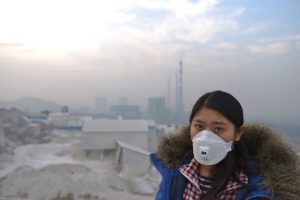
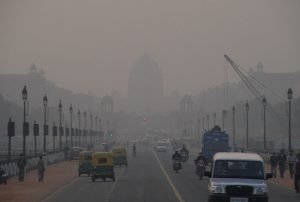
Air pollution levels in and around Beijing remained dire last year, underlining the scale of effort that will be needed to win the self-declared “war on pollution".
The area surrounding Beijing accounted for the worst air pollution in China, with Hebei home to six cities judged to have the country’s worst air quality, according to figures released over the weekend by the Ministry of Environmental Protection (MEP).
Baoding, Xingtai, Shijiazhuang, Tangshan, Handan and Hengshui had the worst air quality in China, the ministry said.
Given the scale of the problem, few will have expected China to make a big improvement to its air quality in just a year since premier Li Keqiang said that tackling chronic air quality would be a national priority.
But the figures show that heavily-industrialised areas surrounding the capital are still churning out harmful particulates on a massive scale despite the announcement of policies last year aimed at curbing coal use.
Hebei’s reliance on heavy industry, particularly iron and steel, means that targets on cutting pollution and coal use could stoke unemployment and migration to nearby Beijing, and local officials want more economic aid and subsidies to cushion the blow.
Average levels of PM2.5, tiny particles in air pollution regarded as the most harmful, dropped from 106 microgrammes per cubic metre to 93 micrograms in the Beijing, Hebei and Tianjin region in 2014, the MEP said, far above the 35 microgramme level deemed as safe by Chinese authorities.
In late January Beijing’s mayor Wang Anshun called the city “unliveable” because of its chronic air quality.
“To establish a first-tier, international, liveable and harmonious city, it is very important to establish a system of standards, and Beijing is currently doing this… At the present time, however, Beijing is not a liveable city,” he said in a report in the China Youth Daily newspaper.
Experts argue China is still underfunding its “war on pollution”. In 2013 China’s environmental spending fell by almost 10% despite premier Li Keqiang’s much-publicised commitment to tackling pollution.
This falls far short of what is needed to address problems of air pollution, much of which stems from the burning of coal for power generation and heating, and fuels used in cars and trucks.
One 2013 study estimates that particulate pollution from coal use in the north lessens average life expectancy by around 5 years when compared with southern provinces.
Shi Lei, an environmental economics professor at China’s Renmin University, told chinadialogue last year that environmental investment needs to reach 2%-3% of GDP before improvements become visible – which would be over 10 times current levels.
Dealing with pollution will be major theme at the National People’s Congress in Beijing next month, when Communist Party officials will discuss how measures to clean up China’s air, soil and water can be integrated in the 13th five-year-plan.
Cities in west, south, score better on air quality
The MEP data shows that only eight out of 74 big cities managed to meet national standards last year on a series of pollution criteria, including PM2.5 and sulphur dioxide levels.
These were Fuzhou in Fujian province; Haikou in Hainan; Huizhou, Shenzhen and Zhuhai in Guangdong; Kunming in Yunnan; Lhasa in Tibet and Zhoushan in Zhejiang.
The MEP figures, which clustered cities into wider regions, showed that the Pearl River Delta had comparatively better air quality last year, but that ozone pollution had overtaken PM2.5 as the worst source of air pollution.
The Beijing, Tianjin and Hebei cluster has already been set targets to cut coal use. The capital will be required cut consumption by 12 million tonnes from 2013-2017, Tianjin by 20 million and Hebei by 40 million.