Climate

China govt think tank urges early CO2 cap

China should aim to cap its carbon emissions in the upcoming five-year plan (2016-2020) so that a promised peak in 2030 is acheived, a scientist with a government think tank has proposed
English

Wang Yi, a representative to China’s communist-dominated legislature and director of the Chinese Academy of Sciences’ Institute of Policy and Management, has proposed a science-based carbon cap to ensure China achieves peak carbon on schedule.

Based on predictions made in 2013 by a number of research institutions, Wang expects China’s carbon emissions to peak at about 11 billion tonnes in around 2030. 

According to Wang’s proposal, a carbon cap is required if peak carbon is to be achieved by 2030, although reaching that goal is seen as having stronger motivation compared to Chinese policy earlier this decade. The 13th FYP aims at a more sustainable pace of economic growth and attempts to curb chronic air pollution. 

In the November 2014 China-US Joint Statement on Climate Change, China announced that carbon emissions would peak around 2030 – but did not say at what level.

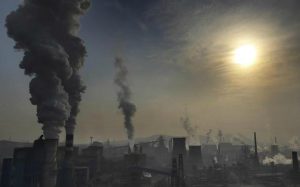
Wang has long been a proponent of energy and carbon intensity targets, and an overall carbon cap that could also help in the fight against smog.

See also: A carbon cap would show China’s determination to tackle climate change

Those existing targets include a 40%-45% drop in carbon intensity on 2005 levels by 2020; increasing non-fossil fuel sources of energy to 15% of the energy mix by 2020 and 20% by 2030; and for primary energy consumption to be held at about 4.8 billion tonnes of coal equivalent.

The Chinese government has also mandated that total coal consumption should be capped around 4.2 billion tonnes by 2020.

Research bodies including Tsinghua University’s Laboratory of Low Carbon Energy and the Lawrence Berkley National Laboratory have predicted that China’s total carbon emissions from energy consumption would peak at about 11 billion tonnes in 2030.

Wang’s proposal says a carbon cap would avoid possible restrictions on economic growth that might result from a simple energy cap, and allow space for development of clean energy.

A cap also provides the foundation for carbon markets and quotas, by sending a long-term price signal to individual companies. 
 

Cookies Settings

Dialogue Earth uses cookies to provide you with the best user experience possible. Cookie information is stored in your browser. It allows us to recognise you when you return to Dialogue Earth and helps us to understand which sections of the website you find useful.

Required Cookies

Required Cookies should be enabled at all times so that we can save your preferences for cookie settings.

Dialogue Earth - Dialogue Earth is an independent organisation dedicated to promoting a common understanding of the world's urgent environmental challenges. Read our privacy policy.

Cloudflare - Cloudflare is a service used for the purposes of increasing the security and performance of web sites and services. Read Cloudflare's privacy policy and terms of service.

Functional Cookies

Dialogue Earth uses several functional cookies to collect anonymous information such as the number of site visitors and the most popular pages. Keeping these cookies enabled helps us to improve our website.

Google Analytics - The Google Analytics cookies are used to gather anonymous information about how you use our websites. We use this information to improve our sites and report on the reach of our content. Read Google's privacy policy and terms of service.

Advertising Cookies

This website uses the following additional cookies:

Google Inc. - Google operates Google Ads, Display & Video 360, and Google Ad Manager. These services allow advertisers to plan, execute and analyze marketing programs with greater ease and efficiency, while enabling publishers to maximize their returns from online advertising. Note that you may see cookies placed by Google for advertising, including the opt out cookie, under the Google.com or DoubleClick.net domains.

Twitter - Twitter is a real-time information network that connects you to the latest stories, ideas, opinions and news about what you find interesting. Simply find the accounts you find compelling and follow the conversations.

Facebook Inc. - Facebook is an online social networking service. China Dialogue aims to help guide our readers to content that they are interested in, so they can continue to read more of what they enjoy. If you are a social media user, then we are able to do this through a pixel provided by Facebook, which allows Facebook to place cookies on your web browser. For example, when a Facebook user returns to Facebook from our site, Facebook can identify them as part of a group of China Dialogue readers, and deliver them marketing messages from us, i.e. more of our content on biodiversity. Data that can be obtained through this is limited to the URL of the pages that have been visited and the limited information a browser might pass on, such as its IP address. In addition to the cookie controls that we mentioned above, if you are a Facebook user you can opt out by following this link.

Linkedin - LinkedIn is a business- and employment-oriented social networking service that operates via websites and mobile apps.