Pollution

Reservoir that supplies Beijing could contain unsafe levels of lead: study

A key part of China’s vast water-transfer project has had major problems with lead pollution, researchers claim
English

A reservoir that supplies Beijing with drinking water has for several years contained levels of highly toxic lead many times the limit deemed safe by the World Health Organisation (WHO), according to research from Chinese scientists and reported by thepaper.cn.

Research by the Chinese Academy of Sciences found that lead levels in Danjiangkou Reservoir in Hubei province – a major source of water for the South-North Water Transfer project – were several times those permitted between 2007 and 2010. Yet official figures claim there is no contamination.
At unsafe levels, lead damages the kidneys and central nervous system, and is a cause of birth defects.
“Greater efforts must be made to reduce nitrogen, arsenic and lead pollution for water conservation in the reservoir,” the researchers said in their study, according to a report in the South China Morning Post.
They added that increased levels of lead during the three-year period may have been caused by an increase in vehicle exhaust pollutants in the upper Han river basin area, as well as mining-related activities. Large amounts of sewage also flow into the Danjiangkou reservoir, one of Asia’s largest.
Zhang Quanfa, who headed the research team, told thepaper.cn that water in some parts of the reservoir have improved, but worsened elsewhere, without providing figures for current levels. “It’s a bit better near the Danjiang River, but worse near the Han River.”
The research team said lead levels were three times the Chinese government’s definition of ‘safe’ levels, and 20 times the limit recommended by the WHO, while water quality was equivalent to ‘Class Five’ – the worst classification of domestic water quality.

Danjiangkou reservoir water-quality sampling points

Hanjiang Hydropower, a state-owned manager of Dajiangkou water hub, which provides water to the central route of the South-North Water Transfer Project, said its figures showed no instances of lead or arsenic being detected between 2006 and 2014.
The Hubei Environment Monitoring Centre also published data for the first half of 2015, showing that no lead, arsenic or mercury had been found and that water was ‘Class Two’, meaning it is deemed safe for drinking.
The central government in Beijing has said previously that the standard of water coming out of the city’s taps is often different from that in reservoirs, pointing to the many treatment plants dotted along the route of the water transfer project.
Danjiangkou reservoir is a major part of the South-North Water Transfer Project, which is designed to channel more than 14 billion tonnes of water per year from the Yangtze river region to parched northern cities.
Although water quality in Chinese lakes and reservoirs showed signs of improvement in 2014, around 28% of water in China’s rivers was “unfit for human contact”, according to a recent report by China Water Risk.
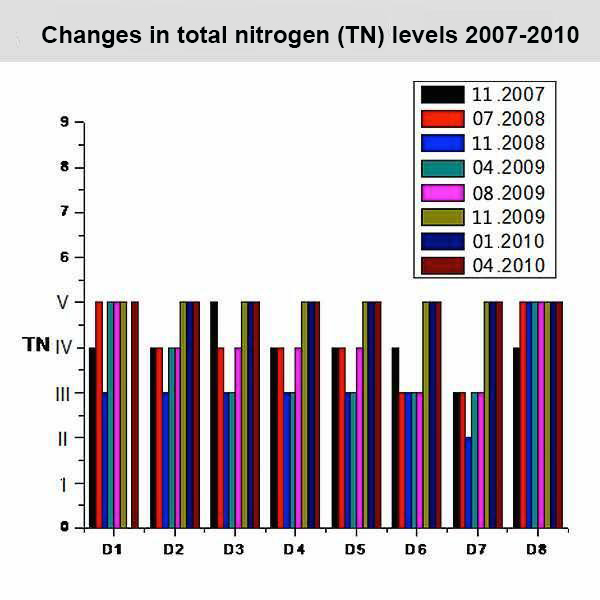
changes in total nitrogen levels

Cookies Settings

Dialogue Earth uses cookies to provide you with the best user experience possible. Cookie information is stored in your browser. It allows us to recognise you when you return to Dialogue Earth and helps us to understand which sections of the website you find useful.

Required Cookies

Required Cookies should be enabled at all times so that we can save your preferences for cookie settings.

Dialogue Earth - Dialogue Earth is an independent organisation dedicated to promoting a common understanding of the world's urgent environmental challenges. Read our privacy policy.

Cloudflare - Cloudflare is a service used for the purposes of increasing the security and performance of web sites and services. Read Cloudflare's privacy policy and terms of service.

Functional Cookies

Dialogue Earth uses several functional cookies to collect anonymous information such as the number of site visitors and the most popular pages. Keeping these cookies enabled helps us to improve our website.

Google Analytics - The Google Analytics cookies are used to gather anonymous information about how you use our websites. We use this information to improve our sites and report on the reach of our content. Read Google's privacy policy and terms of service.

Advertising Cookies

This website uses the following additional cookies:

Google Inc. - Google operates Google Ads, Display & Video 360, and Google Ad Manager. These services allow advertisers to plan, execute and analyze marketing programs with greater ease and efficiency, while enabling publishers to maximize their returns from online advertising. Note that you may see cookies placed by Google for advertising, including the opt out cookie, under the Google.com or DoubleClick.net domains.

Twitter - Twitter is a real-time information network that connects you to the latest stories, ideas, opinions and news about what you find interesting. Simply find the accounts you find compelling and follow the conversations.

Facebook Inc. - Facebook is an online social networking service. China Dialogue aims to help guide our readers to content that they are interested in, so they can continue to read more of what they enjoy. If you are a social media user, then we are able to do this through a pixel provided by Facebook, which allows Facebook to place cookies on your web browser. For example, when a Facebook user returns to Facebook from our site, Facebook can identify them as part of a group of China Dialogue readers, and deliver them marketing messages from us, i.e. more of our content on biodiversity. Data that can be obtained through this is limited to the URL of the pages that have been visited and the limited information a browser might pass on, such as its IP address. In addition to the cookie controls that we mentioned above, if you are a Facebook user you can opt out by following this link.

Linkedin - LinkedIn is a business- and employment-oriented social networking service that operates via websites and mobile apps.