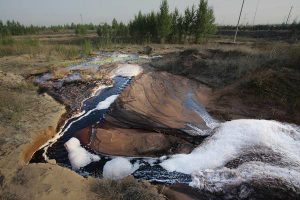
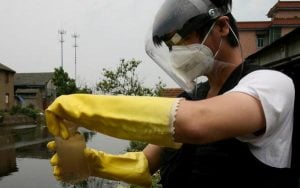
Consumer electronics, including computers and mobiles, are leaving a legacy of toxic waste in countries including China and India. Recycling factories across Asia are recovering e-waste exported from around the world, but discharging heavy metals and chemicals into local water supplies in the process.
How to safeguard drinking water for local residents is an ongoing battle, with existing solutions such as chlorination, distillation, boiling and high-tech filtration prohibitively expensive and often reliant on fossil fuels.
Now a new filtering device, invented by a US teenager, could provide a cheap and easy way to purify water.
The renewable heavy metal filter, designed by 18-year-old Perry Alagappan, removes 99% of heavy metals from water that passes through it. The filter, built from graphene nanotubes, can be rinsed with a vinegar concentrate and reused. The highly concentrated waste can then be evaporated, leaving a deposit of pure metal that can be used in many different applications.
Alagappan, who was awarded the Stockholm Junior Water Prize at this year’s World Water Week, said the filter cost just US$20 (127 yuan) to make, up to five times less than existing reverse osmosis technology.
“I became interested in water purification when I visited my grandparents in India, and saw with my own eyes how electronic waste severely contaminated the environment,” said the recent high school graduate from Houston, Texas, on winning the prize.
It’s common for water technologies to be subject to patent applications and granted patents. Alagappan, however, won’t be patenting his groundbreaking water cleaning technology, but sharing it with the world.
“The interest is more for science’s sake,” he said. “It needs to be available to everyone, rather than locked up. If you keep ideas that could unlock a lot of potential then you block progress. It’s when people from a lot of countries come together that you can move forward.”
The teenager first became obsessed with the promise of graphene nanotubes – a technology that won Manchester university scientists Andre Geim and Konstantin Novoselov the Nobel Prize in 2010 – by reading scientific papers in his spare time and contacting professors. Eventually Rice University, a private research university in Texas, allowed him to use its laboratory to develop his concept.
The technology could be used in homes, where it could be fitted to taps, and in industry, where it could replace existing, non-renewable filtration systems such as reverse osmosis, said Alagappan. “This has the advantage that you don’t have to throw away the filter and buy a new one,” he added.
Fredrik Moberg, the chair of the scientific jury for the Stockholm prize, said Alagappan had adapted graphene in an entirely novel way and the research he presented was so refined that he found himself scrutinising it in the same way he would peer-review the work of a senior scientist.
“Asking the other people in the jury who are experts in the field, they totally think that this could be developed into something that could be of great use both in treating waste water and purifying drinking water,” he said.
Alagappan, who has been accepted to study at Stanford University, plans to publish his findings in the scientific journal Nature Materials. The commercial production of the filters could begin immediately, he said, at a plant in Swansea, Wales, where similar materials are already produced on an industrial scale. The judging panel agreed: “Through its sound science and sustainable technology, the solution is scalable from household to industrial scale for a broad range of applications.”
Moberg said Alagappan’s generosity with his idea continued the long tradition of science being conducted for the benefit of society.
“Many scientists come from that background where they really want to contribute and have it open-source. They see that as something they are proud of. They want to produce knowledge that everyone can benefit from,” he said.
Rémi Kaupp, a programme support officer at WaterAid, adds that it’s the simple, affordable, long-lasting technologies available in local markets that are the most likely to be of use.
“Innovation is important if we are to reach everyone, everywhere with clean water by 2030, as is now promised in the UN’s new sustainable development goals,” said Kaupp. “Perry Alagappan’s technology demonstrates a new way of addressing a difficult and extremely troubling problem, water contamination with heavy metals. We’re encouraged by assessments that this is an effective, scalable technology. It could go a long way in addressing industrial contamination of water.”
This article was published originally on theguardian.com website and can be found here.