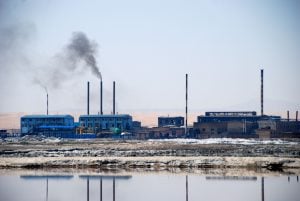
Pollution

China’s environment ministry puts a price on cost of clean-up

China's 'new normal' is a small economic price to pay compared with the overall benefits of lower pollution levels, environment ministry says in new report 
English

China’s efforts to clean up its air, soil and water have contributed to the country’s economic slowdown, the Ministry of Environmental Protection said in a report commissioned in response to criticisms that anti-pollution measures have waged an excessive price on heavy industry.    

The report acknowledges that environmental protection efforts are one reason for China’s recent economic slowdown, but describes these as short-term effects because of restrictions placed on sectors including coal-burning power generation, steel, concrete, LCD panel manufacturing, all of which are sources of harmful pollutants.
 
However, emerging sectors such as environmental services and technologies, and machinery manufacturing, will benefit from the anti-pollution measures, the report said.  
 
The economic cost of China’s efforts to save energy and cut emissions of harmful pollutants during the country’s 11th Five-Year Plan (2006-2010) was 186 billion yuan (US$29 billion), just 0.12% of GDP. This compares with 6% of output lost because of pollution, environmental damage, and harmful impacts on health, the Ministry of Environmental Protection estimated.   
 
A report from the MEP found that while environmental protection does have a short-term impact on GDP, in the longer term, efforts to clean up China’s air, soil and water would deliver an overall economic benefit.
 
With Chinese growth slowing, concerns are being voiced more loudly that environmental protection is damaging the overall state of the economy.
 
In July, Chinese media speculated that anti-pollution efforts in the industrialised city of Linyi, such as the shutdowns of factories, had contributed to job losses and posed major risks to the financial system. These include the inability of industrial companies to pay back loans.
 
Some critics of the ‘Linyi model’ have accused the MEP of taking excessive measures and harming the country’s economy, prompting the ministry to commission a response, which has taken two months to complete.
 
The report admits that environmental protection efforts are one reason for China’s economic slowdown, but describes these as short-term effects due to restrictions placed on sectors including coal-burning, power generation, steel and concrete making, and LCD panel manufacturing.
 
Meanwhile emerging sectors such as modern services, environmental protection, and machinery manufacturing will benefit from the anti-pollution crackdown.
 
Wang Jinnan, deputy head of the MEP’s Chinese Academy of Environmental Planning, said at the release of the report that strict environmental standards could lead to companies adopting better technology, as well as weeding out poorer-performing companies to raise overall competitiveness.
 
The report acknowledged that the US$586 billion economic stimulus plan launched in 2008 had contributed to overcapacity in key industries such as chemicals and heavy manufacturing, while China’s attempts to grow at a slower pace, known as the ‘new normal’, would mean less reliance on traditional industries.  
 
The contribution of heavy industry investment to GDP growth has fallen from 54.8% in 2010 to 48.5% in 2012; while that for exports plummeted from 31.3% in 2010 to 7.9% in 2012.
Cookies Settings

Dialogue Earth uses cookies to provide you with the best user experience possible. Cookie information is stored in your browser. It allows us to recognise you when you return to Dialogue Earth and helps us to understand which sections of the website you find useful.

Required Cookies

Required Cookies should be enabled at all times so that we can save your preferences for cookie settings.

Dialogue Earth - Dialogue Earth is an independent organisation dedicated to promoting a common understanding of the world's urgent environmental challenges. Read our privacy policy.

Cloudflare - Cloudflare is a service used for the purposes of increasing the security and performance of web sites and services. Read Cloudflare's privacy policy and terms of service.

Functional Cookies

Dialogue Earth uses several functional cookies to collect anonymous information such as the number of site visitors and the most popular pages. Keeping these cookies enabled helps us to improve our website.

Google Analytics - The Google Analytics cookies are used to gather anonymous information about how you use our websites. We use this information to improve our sites and report on the reach of our content. Read Google's privacy policy and terms of service.

Advertising Cookies

This website uses the following additional cookies:

Google Inc. - Google operates Google Ads, Display & Video 360, and Google Ad Manager. These services allow advertisers to plan, execute and analyze marketing programs with greater ease and efficiency, while enabling publishers to maximize their returns from online advertising. Note that you may see cookies placed by Google for advertising, including the opt out cookie, under the Google.com or DoubleClick.net domains.

Twitter - Twitter is a real-time information network that connects you to the latest stories, ideas, opinions and news about what you find interesting. Simply find the accounts you find compelling and follow the conversations.

Facebook Inc. - Facebook is an online social networking service. China Dialogue aims to help guide our readers to content that they are interested in, so they can continue to read more of what they enjoy. If you are a social media user, then we are able to do this through a pixel provided by Facebook, which allows Facebook to place cookies on your web browser. For example, when a Facebook user returns to Facebook from our site, Facebook can identify them as part of a group of China Dialogue readers, and deliver them marketing messages from us, i.e. more of our content on biodiversity. Data that can be obtained through this is limited to the URL of the pages that have been visited and the limited information a browser might pass on, such as its IP address. In addition to the cookie controls that we mentioned above, if you are a Facebook user you can opt out by following this link.

Linkedin - LinkedIn is a business- and employment-oriented social networking service that operates via websites and mobile apps.