International bodies have recently called for antibiotic manufacturers to make their supply chains public, and for antibiotics manufacturers to face the same scrutiny as other polluting industries.
Experts from the Chinese Academy of Science (CAS) told chinadialogue that new rules on antibiotic pollution are unlikely to be passed in the near future, however, trials that monitor antibiotic levels in regions where the problem is acute are possible.
Worldwide, there is currently a growing crisis of resistance to antibiotics. According to the World Health Organisation (WHO), ‘antimicrobial resistance’ (AMR), as it is known, poses an “increasingly serious threat to global public health”, affecting everyone, regardless of age or nationality. The WHO has called for immediate action – and they are not alone.
Sascha Marschang, a policy coordinator at the European Public Health Association (EPHA), a healthcare non-profit organisation, said: “The EU must take responsibility and work to find effective solutions in policy and international law to this exceedingly frightening, global menace. Otherwise, we are facing a truly catastrophic scenario and a return to the dark ages of medicine where simple operations and infections are again life-threatening.”
In 2012, there was a gradual increase in resistance to HIV drugs, albeit not reaching critical levels, reported the WHO. In 2013, approximately 480,000 new cases of multidrug-resistant tuberculosis were detected, while extensively drug-resistant tuberculosis was been identified in 100 countries. Since then, further increases in resistance to first-line treatment drugs have been registered.
China is the world’s biggest maker and exporter of antibiotics. In response, international bodies have called on China to better manage this sector, and for the international community to more better regulate antibiotic makers.
During the first World Antibiotic Awareness Week in November 2015, EPHA and corporate watchdog SumOfUs, held a joint event in Brussels calling for international policy-makers to introduce new legislation and force antibiotic manufacturers to make their supply chains public. The overall aim was to reduce the volume of antibiotics released into the environment in waste water from manufacturing, which is worsening the resistance crisis.
Resistance to antibiotics is on the rise for three reasons: incorrect use by humans, misuse in intensive agriculture, and through pollution resulting from manufacturing. Chinese experts from a leading science academy told chinadialogue that the first two of these three issues should be the focus of efforts to tackle antibiotic resistance.
International groups say that this is already happening in the first two cases. However, efforts to address antibiotic pollution remain negligble.
A recent report from SumOfUs reccomended that environmental standards should be applied to existing production methods, such as the Good Manufacturing Practice Framework rules. “This is a critical, yet still missing, part of the puzzle in the global strategy to combat AMR,” it said.
In order to reform the report suggested that, first, Chinese manufacturers and the government. First, antibiotic makers should adopt cleaner technology, such as using biological manufacturing methods rather than chemical synthesis, to reduce energy use and pollution; and eliminate toxic materials and other pollutants from the manufacturing process. Second, companies should adopt strict environmental standards for the disposal, transportation, storage, reuse and management of solid waste and waste water and gases.
It is also recommended that the government monitors antibiotic levels in surface water and in soil in manufacturing areas; and bolster research into the impact of antibiotics om the environment and on human resistance.
Developing nations have less environmental sanctions for businesses, and so have become home to polluting pharmaceutical firms and are particularly at risk. China makes 90% of the world’s ingredients for antibiotic manufacturing, a process that produces pollution. Despite being the world’s biggest maker of antibiotics, China has no environmental standards for regulating antibiotic pollution.
Hebei province, in northern China, is a centre for antibiotics manufacturing, producing 30% of the country’s antibiotic exports. One environmental group told chinadialogue that while driving through Shijiazhuang Luancheng Industrial Zone in October 2015, they encountered a powerful medicinal smell, even though the car windows were closed. However, the residents said that thanks to efforts to combat smog, high-level officials had visited the site and pollution had improved.
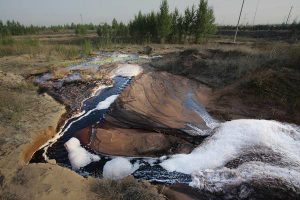
In late 2014, China Central Television (CCTV), a state media outlet, reported on antibiotic manufacturers faking data and dumping untreated effluent in rivers. It also reported complaints of noxious fumes and high incidences of cancer from residents who live near pharmaceutical factories.
The programme reported that Shandong Lukang Pharmaceuticals had excessive levels of antibiotics waste water. An environmental protection employee with the company told CCTV that waste water was treated to remove antibiotics, but the investigation found otherwise.
The pollution map maintained by the Institute of Public and Environmental Affairs (IPE) lists almost 3,000 incidences of pollution by pharmaceutical manufacturers, including those making antibiotics.
However, the IPE has not examined antibiotic pollution, specifically.
“Antibiotics are not [considered] pollution,” said Ma Jun, director of the IPE. While resistance is recognised as a problem, it is unknown whether or not these chemicals cause direct harm to public health or to the environment.
Ying Guangguo, a researcher with the Chinese Academy of Science (CAS) disagrees. He believes antibiotics in the environment are a form of harmful pollution, just one that is not yet taken seriously by officials.
Mr Ying has spent 10 years compiling a map of antibiotic pollution in China. He claims this form of pollution comes mainly from livestock rearing, rather than manufacturing.
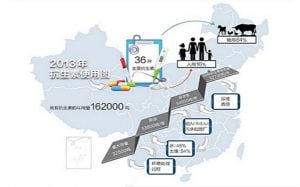
The CAS study tested for 36 common antibiotics. Up to 538,000 tonnes of these are released into the environment every year, 46% into water and 54% into the soil. The problem is worse in the Hai and Pearl watersheds, where levels reach an average of 79.3kg per square kilometre. Annual discharges of antibiotics are highest in Dongting Lake, at 3,440 tonnes. They are very high in the Yellow, Huai and Yangtze rivers, all of which see discharges of over 3,000 tonnes. The problem is less acute in the Bei River and Pearl River Delta.
CCTV’s report last year said that antibiotics had been found in the domestic water supply in Nanjing city and Anhui province. This worried locals, who wanted to know why levels of antibiotics aren’t included in China’s standards for the domestic water supply. Also, the current Standards for Environmental Quality of Surface Water includes 109 items for monitoring, but nothing about antibiotics.
Mr Ying told chinadialogue that there’s no need to monitor the domestic water supply for antibiotics, as levels are too low. However, he said monitoring of surface water for antibiotics could be considered.
But Zhang Gan, deputy head of the CAS Guangzhou Institute of Geochemistry, said: “Given China’s current circumstances, it’s absolutely impossible to monitor antibiotics in surface water.” He explained that better oversight is welcome, but it is currently unrealistic as the cost of equipment and staff would be too high, and no other country in the world does this. Furthermore, the actual amounts of antibiotics in the environment are tiny, he said: “It’s more important to look at wider targets. If existing standards are properly enforced, antibiotic pollution will fall as well.”
Mr Gan did say that trials of antibiotic monitoring could be started at sources of pollution, such as manufacturers and livestock farms, but that only big cities such as Beijing, Shanghai and Guangzhou had the resources to carry out such strict monitoring at this time. But as China’s cities grower richer, so too will their capacity to regulate the chemical antibiotics in their ecosystems.