A central government document aimed at improving urban planning across China has split public opinion. The controversy centres on a proposal, released in February, to pull down walled boundaries that run around residential compounds, which are common in China. The document says that paths and roads that cut through these compounds should be opened up to the public.
Online, there has been a backlash against the proposal, with residents and their supporters raising concerns over security and claiming ownership of the roads and spaces within the compounds that the government wants to open to the public. Residents of these areas say a new legal framework is needed to protect their legal rights.
Experts and the authorities have attempted to reassure the public that an opening up of compounds would not be applied universally, and would only happen when the time is right. In the last few months, public anger in online discussions about the government’s plans appears to have gradually calmed.
Meanwhile, trials were carried out in some localities – the city of Changsha ordered district and county governments to tear down their own walls, with official compounds to become public parks by the end of May.
Some pilot areas in Chengdu are demonstrating the “open neighbourhood” concept by gradually making the roads within residential communities accessible to the public.
The text from the central government proposal that has sparked the fuss runs as follows: “New residential complexes should in principle not be enclosed. Existing residential and work unit compounds will be gradually opened up, making internal roads accessible to the public.”
The document adds that in cities, the ideal urban road layout should consist of a tight network of narrow roads that would complement expressways, primary and secondary main roads and branch roads. Both existing and new construction should be “open”, the document adds.
The People’s Daily, an official newspaper, explained this as the result of the Central Committee restarting its urban planning work after a 37 year hiatus, with measures aimed at combating urban ills such as congestion and pollution. In the view of some, the cause of those scourges is that China has often focused too much on expansions of cities, rather than prioritising ways of making them more liveable.
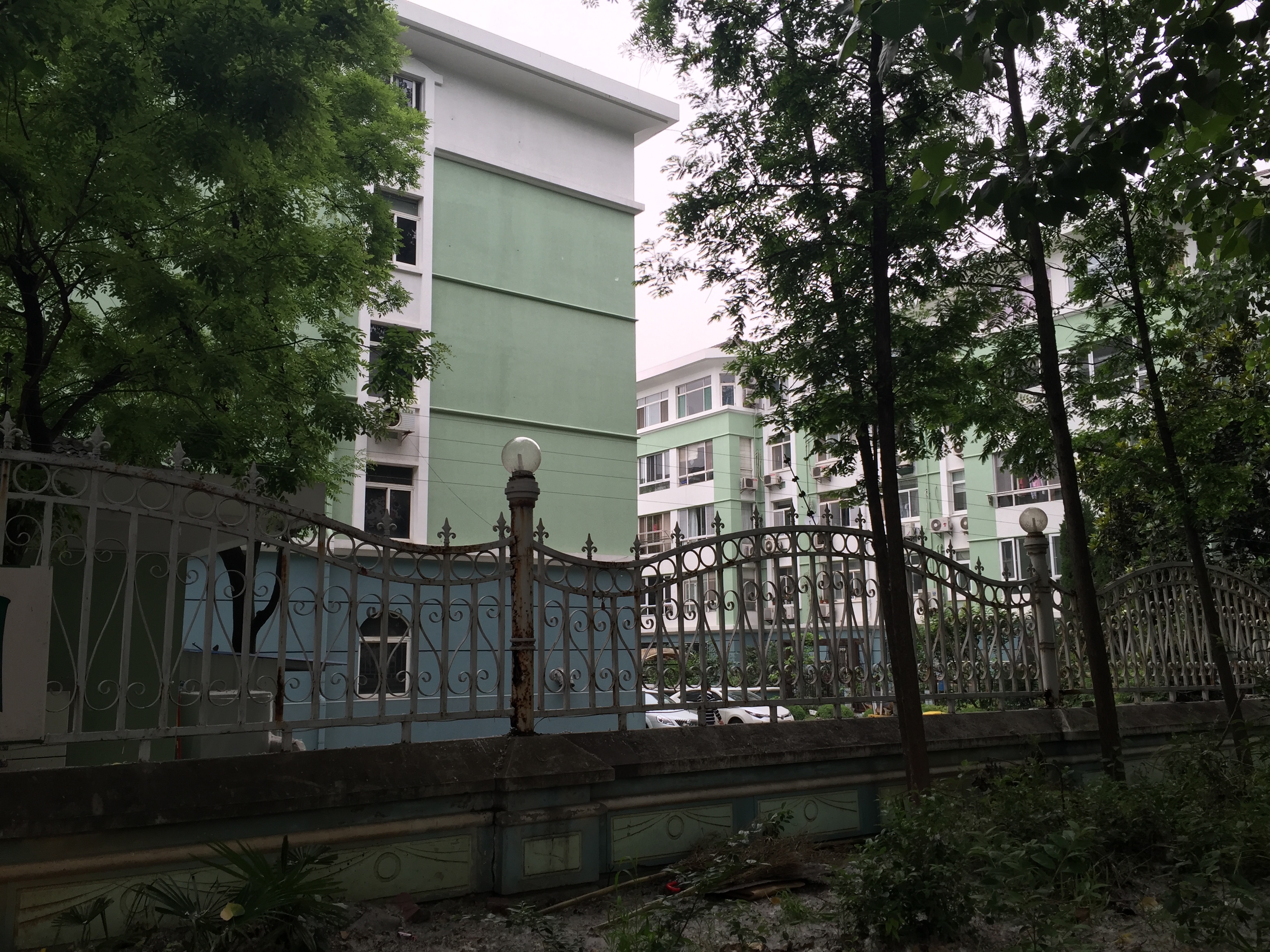
(Image by 喻婕)
The death of the enclosed community
But that expansion has driven 20 years of rapid urbanisation, with the government relocating existing residents and then making sites available for developers to build housing compounds to sell off to home-buyers. This provides funds for urban development, while the large scale of these projects has helped cut costs for developers, allowing them to expand and increase profits.
The residential compounds built under these circumstances are referred to in Chinese as “little districts”. These are unlike the company or government compounds of the planned economy era. These sprawling areas are sealed off from the outside world and have their own green spaces, car parks, roads and even gyms and restaurants; and are run by a dedicated property management company.
Alongside these commercial developments, which can be home to hundreds if not thousands of households, there is another type of “super community”. Tiantongyuan in Beijing is a classic example. Built in 1999 to provide subsidised government housing, it covers eight square kilometres, has over 6 million square metres of building area and was home to 300,000 people in 2008 – and nearly 400,000 by 2011.
A look at the map shows that there are few roads within the compound, and it could be a 20 minute walk from homes to the gates on its boundary. Non-residents have to drive around Tiantongyuan, rather than through it.
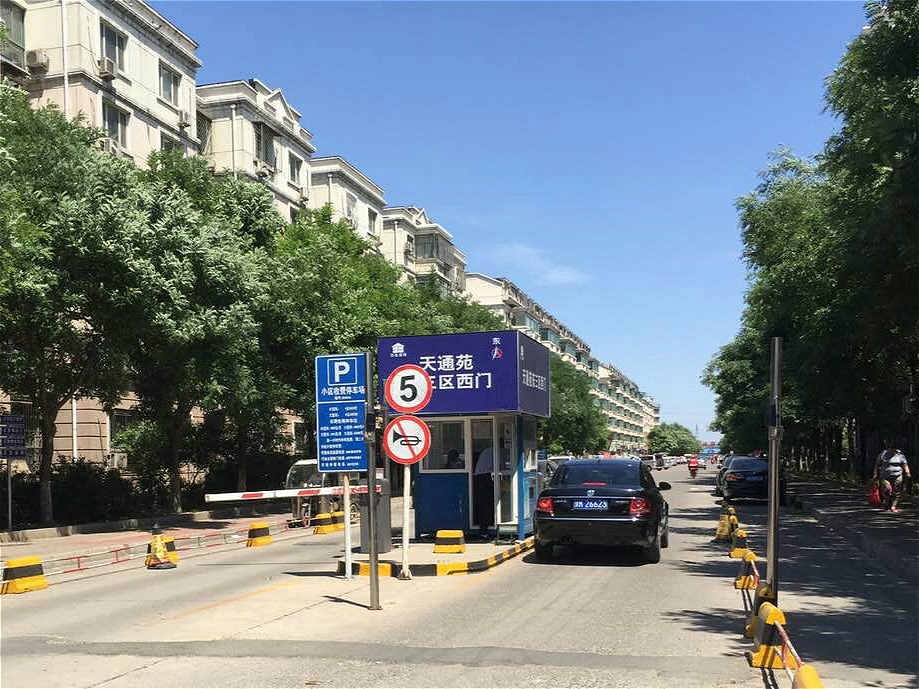
It’s quite a walk from the gate to the nearest subway station. (Image by 路岩)
This is an extreme example, but it is common in China for urban roads and functions to be interrupted by such compounds. Road density is much lower in Beijing and Shanghai than it is in Paris, Tokyo or Washington, and this lack of smaller routes leads to congestion in the main arteries.
Zhang Guohua, director of the National Development and Reform Commission’s Urban Centre Transportation Planning Institute, explained that in cities in fully-developed nations you find 100 or even 200 junctions in every square kilometre – but Pudong New District in Shanghai has only 14, and some parts of Beijing a mere 10. Large company or government compounds are also common, particularly in Beijing.
But controversy has been inevitable. One of the main questions being asked is: who has the right to decide that already established communities should be opened up? The right to use this land – the roads, the green spaces, or that which the buildings themselves stand on – was leased to the developers for 70 year terms, and then sold to house-buyers.
Under the 2007 Property Law, in the absence of specific regulations to the contrary, those roads belong to the people who own the homes. And these roads are also used for parking and other functions. The People’s Supreme Court’s response to the issue was to say that it will take time for the new state policy to become enshrined in legislation.
During the controversy, an article on “community rights” written by CCTV host Wang Zhi’an, became popular. For security reasons, during the 2008 Olympics the Beijing government required all such compounds to install gates and prevent non-residents from entering – including Wang’s.
However, as head of the residents’ committee he opposed this and ultimately prevented the changes going ahead.
In a major change of mind after the Olympics, the residents decided in the end to install gates and enclose their compounds more effectively, and cover the associated costs.
Concerns
Opening up the compounds will depend on the rights the law gives the owners. But what do the residents actually want?
A survey by the Foshan Daily found 32% of respondents agreed that “in principle no more enclosed residential communities should be built”, while around 46% were opposed to such a moratorium because they felt actual implementation would be too difficult.
Meanwhile, just over 21% were undecided. But only 19% agreed that existing compounds should be opened to allow for road access and more efficient land use, with 40% opposed and 41% waiting for “more detailed policy”. One online commentator said: “You can’t do it universally, you should decide according to specific circumstances.”
Yuan Qifeng, a professor at Sun Yat-Sen University who studies planning, says that enclosed communities are a product of social division. This, a widening gap between rich and poor, and increasingly mobile populations within cities, leads to crime and safety issues – promoting demands from the urban middle classes for security.
What’s next?
In late February the Ministry of Housing and Urban-Rural Development published a statement on its website on “correct understanding” of the plans – they would not be applied universally, nor would it be a case of simply knocking down the walls. The changes would be planned and gradual, with local opinions heard when specific approaches were being drawn up. In addition, the legal rights of residents would be protected.
Provisions on sustainable development ideas in the original document were actually welcomed by NGOs and research bodies. But the controversy shows how the implementation of such ideas face social and legal constraints. It is possible the law will be changed, but changing the minds of those who are content with the status quo will require policymakers to tread carefully – and have compensation ready.