Much of the focus on air pollution in South Asia is on vehicular pollution, and smoke – whether from burning agricultural fields to clear them, or from traffic. While this is an important aspect of air pollution, particularly as burnt particles produce a high level of particulate matter less than 2.5 microns (PM 2.5) in width, which can enter the bloodstream and lungs, another source of such pollution – stone crushing and the creation of fine dust particles, often also PM 2.5, is ignored.
In Pakistan’s mountain communities the cost of the country’s development for many locals is asthma and other respiratory diseases, as well as both air and sound pollution, that comes from stone crushing machines working around the clock. These provide the raw matter for roads and buildings, but while those buildings and roads often benefit the urban inhabitants, it is the poor mountain communities in rural areas that pay the price.
“In every home you will find an asthma patient”
Shaukat Ali works as a principal at a private school in Abbottabad in Khyber Pakhtunkhwa (KP) in northern Pakistan. The school is located in the rural area, on the way to the well-known tourist resort Thandiani.
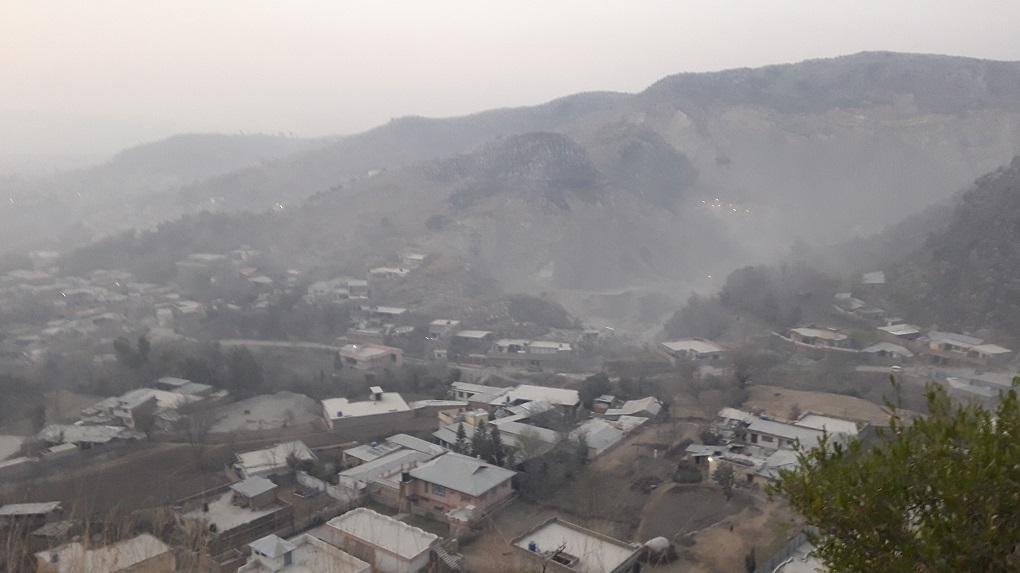
Shaukat Ali claims that these machines are located near populated areas, and work 24 hours a day, creating a great deal of pollution, affecting the health of everyone living in the area, especially the children. “In our area more than twenty thousand people live in five thousand houses,” he said. “In every home you will find an asthma patient and children with respiratory diseases.”
He added that explosives were also used once every 24 hours. “After the blasts, a mountain of dust covers the area. Blasting and the crushing machines working for 24 hours are making us deaf; we can’t hear the normal noise.” Even a decent night’s sleep was denied to them.
![After a blast, a mountain of dust rises up [image by Mohammad Zubair Khan]](/wp-content/uploads/2017/01/A-cloud-of-dust-billows-out-after-a-blast-to-cover-the-landscape.jpg)
Nazir Khan, who also lives in the area, complained that their lives have become hellish, but despite many complaints to the authorities, there has been no action. “We want to sell our houses and lands to shift from the area, but no one is ready to buy even at the cheapest prices, at the same time living in the area means to invite diseases and death.” Two of Khan’s children are suffering from asthma.
The pollution is not limited to the air that residents breathe. Muhammad Mast Khan, a university student, said that stone crushing also polluted the water. “We are forced to use polluted water and live in the polluted environment,” he said.
The district health officer of Abbottabad, Doctor Qasim, accepts that there has been an increase in asthma and other respiratory diseases, but no relevant data has been collected by the government. But, since there was no other major source of pollution in Abbottabad and similar cities, the blame for the illnesses had to be because of the stone crushing machines.
A phenomenon across Khyber Pakhtunkhwa
Similar complaints have filtered in from the 24 districts of KP. The Industries Department told thethirdpole.net that 615 stone crushing machines have been given permission to work in the 24 districts – most of these are located along the river basins in the Himalayan areas. Market sources suggested that the real number may be quite a bit higher, as illegality and rule breaking form part of the industry.
This large uptick in stone crushing is due to the increasing demand of the limestone from the area, which is considered of very good quality, especially for construction work and for the manufacturing of cement.
![Crushed stone being transported away [image by Mohammad Zubair Khan]](/wp-content/uploads/2017/01/Crsuhed-stone-being-transported-away.jpg)
Even the courts are playing games
Recently the Supreme Court banned the use of explosives in Margalla Hills, overlooking Islamabad, the capital city of Pakistan. But this may only slow down the speed at which the Margalla Hills are being consumed.
More problematic has been the non-implementation of rules and regulations. According to Mandi Zaman, the former deputy attorney general of KP, “a stone crushing machine must be installed one kilometre away from human activity area; even if it is only a road or a passageway”. But in case after case illegal quarrying and crushing continues, with even the courts passing contradictory orders. Zaman said that, “most of the crushes machines violate rules, regulation and the authorities are silent on the major violation which is hazard of the human lives.”
The Environmental Protection Agency (EPA) in KP told thethirdpole.net that 28 complaints had been received in 2016 and a number of stone crushing machines were shut down because of rule violations. But the EPA did not provide any data to back this claim.
Zafar Iqbal, and environmental lawyer and activist, said that “stone crushing machines are found in our most beautiful valleys, disturbing the landscape’s natural geographical formations and archaeological features. The clean environment has been replaced by the pungent smell of industry and the noise of vehicles and machines.”