


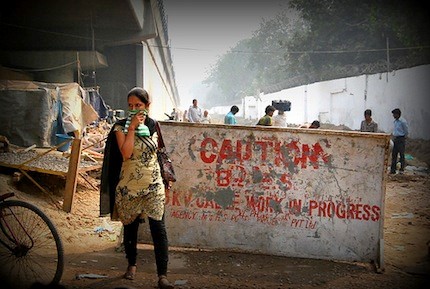

The issue is once again in the spotlight following a recent Yale University study that ranked India 155th among 178 countries on the state of the environment. China was ranked 118th. The report also quoted figures obtained by a NASA satellite to say that between November and January, the level of PM 2.5 in the air of New Delhi averaged 575 micrograms per cubic metre, about 60 times the level considered safe by the World Health Organization.
The average in Beijing over the same period was 400 micrograms per cubic metre – quite bad, but far lower than New Delhi. London had an average of 20 micrograms.
The term PM 2.5 refers to particulate matter up to 2.5 microns in diameter. This miniscule size enables these particles to lodge deep inside lung and blood tissues. The particles are mostly ammonia, carbon dioxide, carbon monoxide, various oxides of nitrogen, sulphates, soot and dust.
However, politicians and bureaucrats in New Delhi continue to live in denial. Once the Yale University study was reported in the local media, the first reaction of a senior official in the Delhi Pollution Control Committee was that India’s capital could not be considered the world’s most polluted city, because the study ranked countries, not cities. The second reaction was that Beijing got occasional sea breezes that cleaned the air, but New Delhi did not have this advantage.
M. Veerappa Moily, India’s minister for petroleum and natural gas as well as being in charge of the environment ministry, sounded surprised when asked to react to the studies. “Are you sure of your facts?” he asked a journalist. “We have CNG.”
CNG, or compressed natural gas, is the fuel used by taxis, auto rickshaws and buses in New Delhi, following a Supreme Court order in 2000. This shift from diesel to CNG did clean the capital’s air, but the gains have now been overtaken by the rising number of private vehicles. For years, residents of New Delhi used to boast that there were more cars in their city than in Mumbai, Chennai and Kolkata put together. That statistic is now coming back to haunt the residents. India has 810 million cars and motorcycles, with around 1,400 new ones registered in the capital every day.
Why isn’t air pollution a political issue in New Delhi?
New Delhi has been sitting under a blanket of smog for weeks, yet the issue has featured little as the country prepares for a general election in April or May.
New Delhi is a city state that voted in a new government last December. The political debates were bitter, but did not involve air quality. The new government has had little to say on the matter. The reaction of the transport minister to the reports was that he would boost public transport, re-examine an old plan and start an awareness campaign. No opposition politician took him on, though they are prepared to argue on just about everything else.
And this is in a situation where doctors from three well-known research centres in New Delhi – the All India Institute of Medical Sciences, theVallabhbhai Patel Chest Institute and St. Stephen’s Hospital – have repeatedly warned about the very high incidence of chronic respiratory illnesses. Their reports show increase in asthma every winter, chronic obstructive lung disease, heart attacks, vitamin D deficiency in children living in especially polluted neighbourhoods.
A study in the Harvard International Review in 2008 had said 40% of all New Delhi residents suffer from respiratory ailments. The Lancet’s Global Health Burden ranked air pollution as India’s sixth biggest cause of death in 2013.
“Restricting car usage, upgrading public transport with walking and cycling access, and leapfrogging vehicle emissions standards is the solution,” says Anumita Roychoudhury from the New Delhi-based think tank Centre for Science and Environment (CSE), which has published its own study on air pollution.
Authorities in Beijing have already fixed the number of cars that can be sold in one year to 240,000 and are going to lower it further to 150,000. However, there are no such limits in New Delhi.