![<p>Oil spill over the Shela River [image by Arati Kumar-Rao/ Peepli.Org]</p>](https://dialogue.earth/content/uploads/2016/01/mist_stains2-1600x1065-768x510.jpg)

After experiencing three major incidents over the last thirteen months, Bangladesh has finally started to formulate a national oil spill contingency plan. This will help the country avoid further large-scale damages and also receive cooperation from other countries in the region to jointly to tackle such accidents. In fact a Memorandum of Understanding (MoU) was signed in 2010 among five coastal countries in South Asia- Bangladesh, India, Pakistan, Sri Lanka and the Maldives, but the initiative is only being taken now, five years later to draft the contingency plan under the MoU.
The Bangladesh government has assigned the Department of Environment under the Ministry of Environment and Forests to lead the work. Despite the government’s new urgency, the task will take time. Mokbul Hossain, director of the Department of Environment, who is in-charge of the task, told thethirdpole.net that the country does not have expertise on the issue, and so things cannot be done overnight.
“We have already identified 12 different government agencies,” Mr Hossain said, “including all port authorities, the Bangladesh navy and coast guard as related stakeholders who can serve during oil spill incidents.”
According to government statistics revealed in a workshop held in August 2015, approximately 5,000 large water vessels, including oil tankers and cargo boats, ply along the country’s coast annually. In addition, about 7,000 small and medium size water vessels run on Bangladesh’s coast and inside rivers and canals. All of the vessels have been releasing huge amounts of oil into the water through normal operations. According to statistics from the Mongla Port Authority, “navigation in the Sundarban waterways has increased 236% in last 7 years,” making it particularly susceptible.
Accidents by sea, rail and river
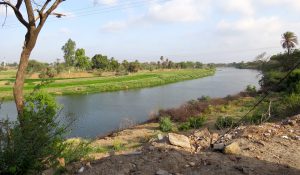
The most acute distress was caused by large oil spills because of accidents. On 9 December 2014 an oil tanker carrying 357,000 litres of furnace oil capsized in the Shela River inside the Sundarbans the world’s single largest mangrove forest. The oil spill killed a huge number of animals and wildlife including Irrawaddy dolphins. Sadly, the damage was exacerbated and the rescue operation delayed because the Forest Department did not have the know-how and necessary equipment to deal with the oil spill.
![Rescuing the Sundarbans from the oil spill [image by Arati Kumar-Rao/ Peepli.Org]](/wp-content/uploads/2016/01/cleanup_mr_sarda-640x427.jpg)
In October 2015 it was once again the turn of the Sundarbans as a cargo vessel loaded with 510 tonnes of coal capsized in Pashur River in Mongla upazila (sub district) near the Sundarbans. The Khulna bound ship MV GR Raj capsized in the river due to a fracture in the keel of the ship.
![The dreadful health hazards of cleaning the oil [image by Arati Kumar-Rao/ Peepli.Org]](/wp-content/uploads/2016/01/fumes2-640x427.jpg)
Acknowledging the damages caused by oil spills as a result of poor planning, the Secretary of the Ministry of Environment and Forests Kamal Uddin Ahmed said the government has taken the issue seriously. “We should have formulated the plan much earlier when the country signed the MoU. If we had done so, the damage may have been less,” the secretary acknowledged.
According to the MoU, all signatory countries have to formulate its own national contingency plans first to promote regional cooperation. India, Pakistan and Sri Lanka have formulated their plans, while the Maldives is trying to do it in cooperation with India.
As soon as the national contingency plan is in effect, the country can receive support from other countries during any oil spill incident, including technical and logistical support, equipment and information sharing.
Recommendations
The Department of Environment has now formulated a draft contingency plan, which will be discussed with different agencies, before going to the cabinet for approval.
The draft plan suggests the government should establish a separate entity that will lead the response to future oil spills. At the same time, the draft suggested that the government makes the Bangladesh Coast Guard the operational entity as the only organisation that has the access and the capacity to work across coastal areas. The Department of Environment would remain the lead agency under the contingency plan as it is the sole authority to check the environmental pollution in Bangladesh.
Regional cooperation
Since Bangladesh does not have expertise on the issue the other signatories, who have already formulated their own national contingency plans, have extended a helping hand. For example, Sri Lanka invited Bangladeshi government officials to join in a week-long workshop on oil spill management. Mr Hussain told thethirdpole.net that the workshop was very helpful, and looked forward to a future with greater regional cooperation.
Another form of regional cooperation, though, has raised questions about Bangladesh’s commitment to keeping its waterways clean. On 15 November 2015 India and Bangladesh signed a standard operating procedure (SOP) to launch the ‘Agreement on Coastal Shipping’ between the two countries. This agreement was part of a series of initiatives between the two countries when the Indian prime minister visited Bangladesh in June 2015. While the agreement may boost trade, commentators have noted that the route – so far unspecified – is likely to be through the Sundarbans using the Shela River, endangering the mangrove forests again.
Originally published on 8 January 2016