Experts and environmentalists have criticised Bangladesh’s environment agency for its decision to declare four dying rivers around Dhaka as ecologically critical areas (ECAs).
The department of environment (DoE), which can declare any area an ECA according to the 1995 environment conservation act, has drawn the flak after environment minister Anwar Hossain told parliament on June 7 that the government has been working on the management of the rivers – the Buriganga, Turag, Balu and Shitalakhya – considered lifelines to the 16 million people in the capital.
“Now we are working to save the rivers; hopefully this will be possible,” Rafiqul Islam, a deputy director of the DoE, told thethirdpole.net.
But many do not agree with decision, saying that it is too little too late.
“What is the sense to declare the rivers as ECA? They died more 20 years ago,” Amanat Ullah Khan, a geography professor at Dhaka University, told thethirdpole.net. “The land grabbers choked the rivers. The water is no more water. This is nothing but whims.”
“Before declaring the rivers as ECA, the government should have stopped dumping thousands of tonnes of untreated sewage into these rivers. How can the government ask industry owners to stop polluting the rivers before they do the same?” he asked.
Dhaka is more than 400 years old, but the government is yet to install an environmentally sustainable sewerage system. Instead, sewerage and storm water is dumped into the four rivers.
The Dhaka Water Supply and Sewerage Authority (Wasa) can treat only 20% of the city’s sewerage, Abul Hasanat Abdullah, the chairman of the parliamentary standing committee on local government ministry, told thethirdpole.net. “The remainder goes to the rivers and water bodies,” he said.
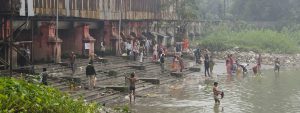
Local polluting textile and tannery industries dump untreated industrial effluents into the rivers. Worse, powerful and influential people have gradually taken over the river banks and basins to set up factories as industrial land ran out. Originally a 500-metre wide river, the Buriganga was once rife with dolphins and fish. Today, it is just three metres wide in some places; land grabbers dumped sand and garbage into the river to make industrial plots while law enforcement and public servants turned a blind eye.
This uncaring attitude of the authorities has resulted in the destruction of the rich biodiversity and fish resources, and navigation facilities are almost blocked. The four dying rivers are now synonymous with a bad stench – it’s hard to walk along them without pressing a handkerchief to the nose.
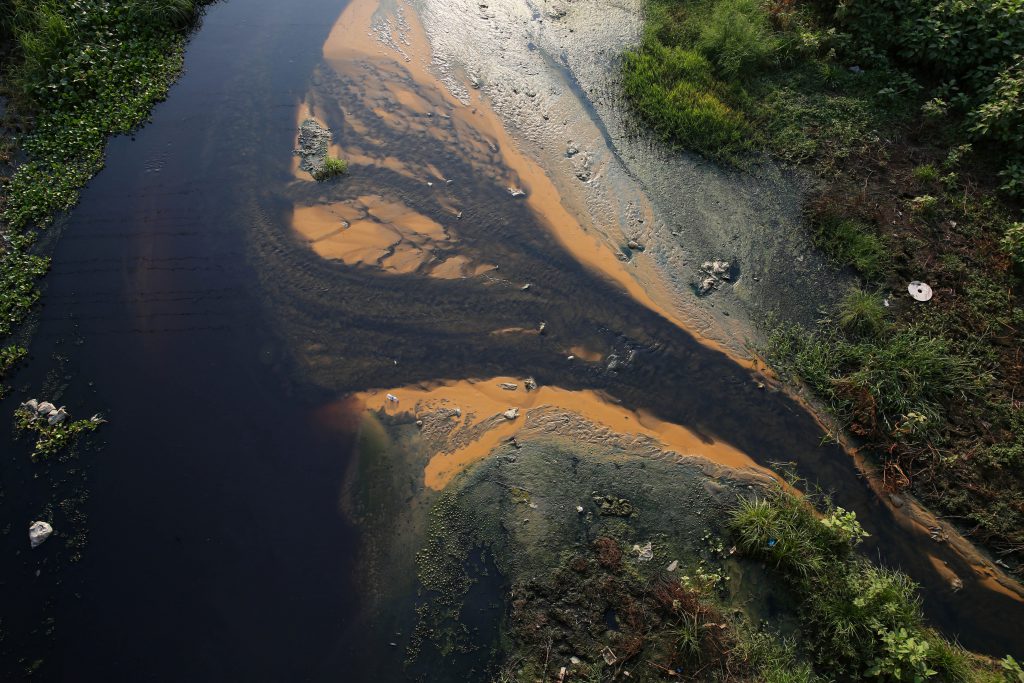
The waters of river Shitalakhya look red, blue, green and black. The textile and dyeing factories dump highly toxic effluents into the river, and hundreds of stone crushing machines roar along the rivers banks. The stone-powder and particles make the whole area cloudy and , ultimately, they end up in the river, raising the river bed.
The Turag gasps with wastewater from hundreds of the textile factories located along its bank, but the condition of the Balu is even harder to imagine: its waters looks like burnt lubricating oil drained out of a motor engine. Dhaka Wasa is the culprit, Abul Hasanat Abdullah, the chairman of the parliamentary standing committee on local government, told thethirdpole.net. Two months ago, the parliamentary watchdog discussed Dhaka’s wastewater management and recommended that treatment plants be installed in the capital.
A DoE study found that the tannery industry accounts for 35% of pollution of the Buraganga, while the Dhaka Wasa is responsible for the same amount of pollution in the four rivers, Sultan Ahmed, a DoE director, told thethirdpole.net.
But the booming textile industry, which dumps huge volumes of liquid effluents into the rivers, is Bangladesh’s top polluting industry. At least 300 tannery factories dump untreated waste, including poisonous heavy metals. The increasing use of polythene bags, used crisps packets and plastic bottles is also of concern; the bed of the Buriganga is said to be covered by a 10-feet layer of polythene bags.
Only around 40% of industries in Bangladesh had effluents treatment plants (ETPs) and 10% were in the process of constructing them, according to a 2009 survey conducted by the Bangladesh Centre for Advanced Studies — the latest research available. This means that waste from half of the country’s industries was ending up in rivers untreated.
What ECA means
“When an area is declared an ECA, it means that the very existence of the area is under threat,” environmentalist Ainun Nishat told thethirdpole.net. “The ECA is declared to save the place from total destruction, to restore its biodiversity and environment.”
To do that “you have to stop the sources of pollution and stop physical encroachment”, said Nishat, an expert on South Asian rivers. “If executed properly, an ECA can be saved from destruction. We have done it outside Dhaka and the outcome was encouraging.
“But for the four rivers around Dhaka, this is hard to do. Thousands of illegal structures were erected in the rivers. So to save the Buriganga, for instance, the government must recover the original land of the river. Declaring the rivers ECA is not significant.”
While only time will tell if it’s possible to evict all land grabbers and demolish the thousands of illegal buildings, Dr Sultan Ahmed said the government had already started relocating the tannery industry from the banks of the Buriganga.
“Within the next six months, all tannery factories will be shifted to a new place in Savar,” he said. “All factories must have ETPs there, then we can stop 35% of pollution from the tannery industry.”