


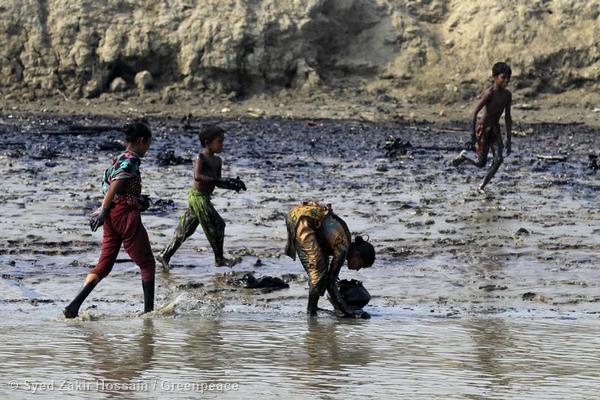

A wrecked oil tanker spilled 350,000 litres of furnace oil into Bangladesh’s Shela river that runs through the Sundarbans, the world’s largest mangrove forest, on December 9 last year, prompting the worried UN-Bangladesh joint oil spill response team to call for the controlled operation of commercial vessels and warn that it was a “serious wakeup call”.
But nobody it seems woke up.
Five months later, on May 4, another cargo vessel, this time carrying 300 tonnes of potassium fertiliser, sank in the Bhola river in the Sundarbans, posing fresh threat to the sprawling mangrove forest that runs through both Bangladesh and India. With the authorities unable to salvage the fertiliser, the chemical has been steadily dissolving into the river, turning the water red.
According to media reports, dolphins have disappeared from the sanctuary area and might be moving into other rivers and canals. Locals say dead fish can be seen floating in the Bhola river, one of the many rivers crisscrossing the Sundarbans.
Though environmentalists are alarmed, a forest official said the spill would not be harmful for fish, dolphins or for the vegetation in the long run as Bhola is a tidal river and fertiliser would go away with the tidal waves.
“It would be very harmful for the forest if the concentration of the fertiliser increases in the water. But in this case the fertiliser would soon go away into the sea. So I don’t think it will leave any significant impact on the Sundarbans,” said Amir Hossain Chowdhury, divisional forest officer of East Sundarbans.
Though the government formed an inquiry committee that visited the spot, there have been no measures yet to recover the fertiliser-laden boat.
Protesting government inaction and negligence regarding the Sundarbans, a UN heritage site and the home of the Bengal Tiger and at least three species of endangered dolphins, green campaigners formed a human chain in the Bangladesh capital Dhaka on May 7.
The two cargo accidents have proved that the government does not have the capacity to handle the fallout and it still continues to allow vessels to ply through the water channels of the area, say activists.
“The government has put the sensitive mangrove forest in severe risk by allowing vessels through the forest,” said Sharif Jamil, joint secretary of the Bangladesh Poribesh Andolon (BAPA). Such risky ventures should be stopped immediately, Jamil, who is also a member of the Waterkeeper Alliance in Bangladesh, added.
New India-Bangladesh shipping pact
However, quite the opposite is happening. In fact, the boat that was heading towards the northern district of Sirajganj from the Mongla port sank on the very day that the Bangladesh cabinet had given its nod to a proposal on a coastal shipping agreement with India.
The agreement will increase the operation of commercial vessels through the rivers in the Sundarbans and could be signed as early as June.
The final agreement is expected to be signed during Indian Prime Minister Narendra Modi’s upcoming visit to Bangladesh, Shipping Minister Shajahan Khan told journalists. The two countries had signed a draft deal on coastal shipping on April 20 in New Delhi.
Currently have to be first sent to Colombo or Singapore first and then shipped to ports in India or Bangladesh. A shipping pact will enable any vessel from India to come directly to Dhaka and anchor in an inland port. And Bangladeshi ships will similarly be able to carry goods to India.
The pact will not only save time and money in transporting goods but also significantly increase the number of vessels operating through the Sundarbans.
“We are expecting that more ships will come into the Mongla port when this agreement comes into effect,” said Ahsan Habib Hasan, general secretary of the Mongla Port Ship Chandler Association.
Any boat wanting to go to the Bangladesh capital Dhaka from Mongla would have to use a river route through the Sundarbans, he said.
The operation of cargo vessels through the Sundarbans increased after 2012 when Bangladesh and India signed a trade protocol. Over 200 cargo ships go to India to carry fly ash from Indian coal-fired power plants for cement factories near the Sundarbans.
Original navigation route
Vessels began plying the Sundarbans a few years ago when the original Mongla-Ghushiakhali route to the Mongla port silted up and became unnavigable. Dredging work began on the route after the December 9 oil spill.
Then, following the most recent capsize, Shipping Minister Shajahan Khan announced the operation of cargo vessels through the Shela river would be permanently stopped from June next year.
Though a welcome move, it is a tough job.
The Mongla-Ghushiakhali route is outside of the Sundarbans, said Mohammed Liton, former president of Mongla Boat Owner Association. “If the route is revived again after dredging, it will be possible for all vessels to come to Mongla port avoiding the Sundarbans. But it needs at least 25 feet depth in the river to ply big vessels,” he added.
Liton, who has been plying his tourist boat in the Sundarbans for the last 20 years, believes that it would be tough to dredge and maintain a tidal river at that depth.
Maminul Haque Sarkar, deputy executive director of the Center for Environmental and Geographic Information Services (CEGIS), is also sceptical about its chances of success.
“The dredging work would not be sustainable after a few months from October when huge quantity of sediments will be disposed in the river and the riverbed will be filled up again,” the hydrology expert said.
Other challenges
Commercial vessels are not the only challenge to the fragile ecology of the area. There are about 20 cement factories in Mongla at the edge of the forest.
Green campaigners have also been protesting the 1,320 MW Rampal coal-fired power plant, a joint initiative of India and Bangladesh, just 14 kilometres from the forest. The coal is supposed to be carried through the Sundarbans. The government has permitted another 600 MW coal-fired power plant to be built by a private company, Orion limited.
Environmentalists and civil society of Bangladesh have formed a national committee to save the Sundarbans and have decided to launch a global campaign asking international funding agencies and donors to not finance the power plant.
“Two coal fired power plants and other development activities taken up by the government shows how the government caring less about the sensitive Sundarbans forest. Despite repeated requests from environmentalists, the government is going ahead with the power plant,” said Abul Matin, secretary general of the committee.
The unique mangrove forest of Sundarbans, which stretches for 10,000 hectares with roughly 60% in Bangladesh and the rest in India, is important for both countries. It forms a natural wall against cyclones. About 30% of the area comprises water bodies, including rivers big and small, canals and creeks. However, there is no exact estimate about how many rivers flow through the area.