Situated over 3,880 meters above sea level in the Himalayas, is the 40-meter-high Amarnath cave which houses an ice stalagmite formed through the dripping of water from the cave roof. This naturally forming object is considered a lingam, and a representation of Shiva, one of the principal deities of the Hinduism. Hindu devotees consider the cave as one of their holiest shrines. The formation of the lingam is an annual natural process and the lingam waxes and wanes as per the seasons in the year.
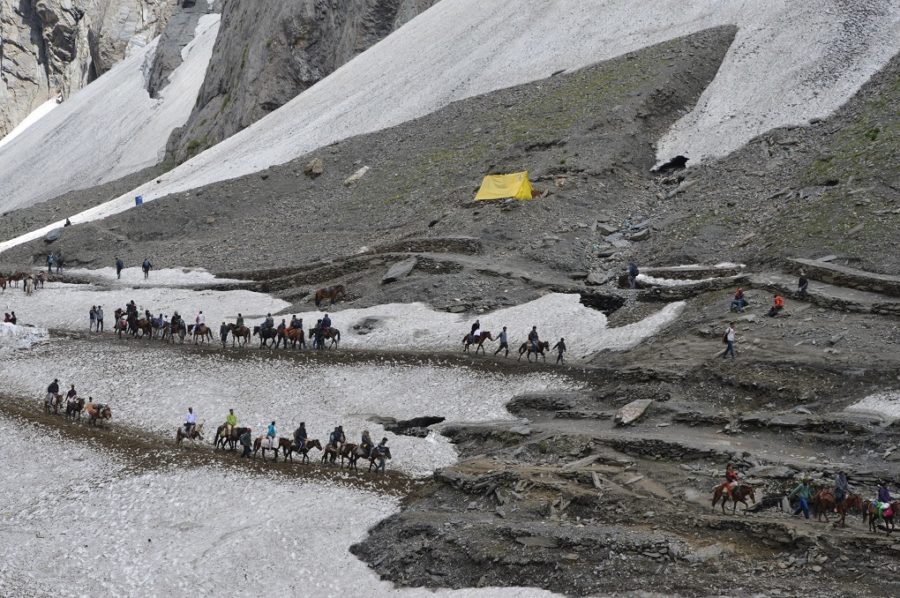
For two months each year, between July and August, an average of half-a-million devotees make the long treacherous trek to perform the Amarnath pilgrimage known as the Amarnath Yatra. The cave is approachable through two different routes – via the 46 kilometre Pahalgam route in south Kashmir and 14 kilometre Baltal route in north-eastern Kashmir. Both these trekking routes are narrow tracks snaking through a stunning landscape and mostly flanked by steep cliffs.
The shrine falls at the far end of Lidder Valley in an area where several small and large glaciers such as Nehnar, Kolhai and Bodpathri are concentrated. The mountain range overlooking Lidder valley and Sonamarg is an important source of water for the major tributary to the Jhelum river, the Lidder, with the majority of Kashmir’s glaciers concentrated in this range.
Global warming is already taking a toll on these glaciers and anthropogenic (human) activities on a large scale in this sensitive ecology “can further precipitate the melting” of these glaciers, said Mohammad Sultan Bhat, head of the department of geography and regional development at Kashmir University.
Bhat, who has carried out the Environmental Impact Assessment (EIA) of the Lidder Valley a few years ago, said that the area has a carrying capacity of only 4,300 people on a single day. But, as per the official figures , an average of 12,353 pilgrims have visited the cave every day during the first 25 days of the pilgrimage this year.
In fact, the number of visitors to the Amarnath Cave has far exceeded the carrying capacity of the area during the first half of the pilgrimage every year for more than a decade.
“This year in just 28 days, the number of devotees who have undertaken the Amarnath Yatra is more than the entire Yatra period of 60 days in 2015,” said the Indian prime minister, Narendra Modi, during his monthly radio talk broadcast on July 28, 2019. “This is beneficial for the future of tourism in our country,” he added.
But if that tourism, especially if it involves the generation of a large amount of waste that is disposed off by the side of the trail, endangers the very eco-system, resulting in impacts on the formation of the ice stalagmite, it may be self-defeating. This concern is one that is also shared by a number of pilgrims, distressed with the casual dumping of plastic bags and waste along the route, who worry that those that come after them will be robbed of the experience they have had.
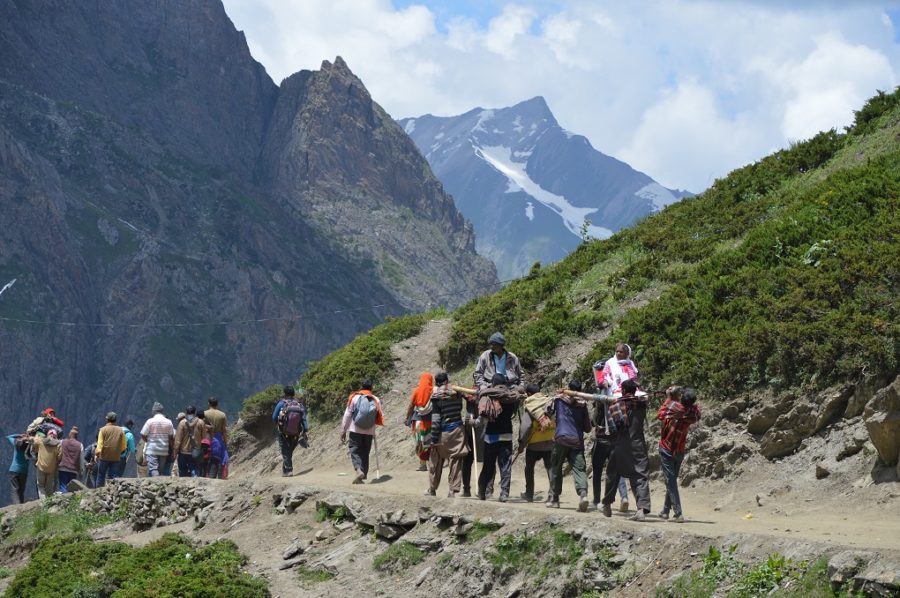
Two pilgrims being carried by local labourers on their shoulders after they performed pilgrimage. Getting to the cave and trekking down after paying obeisance at the shrine is quite challenging [image by: Athar Parvaiz]
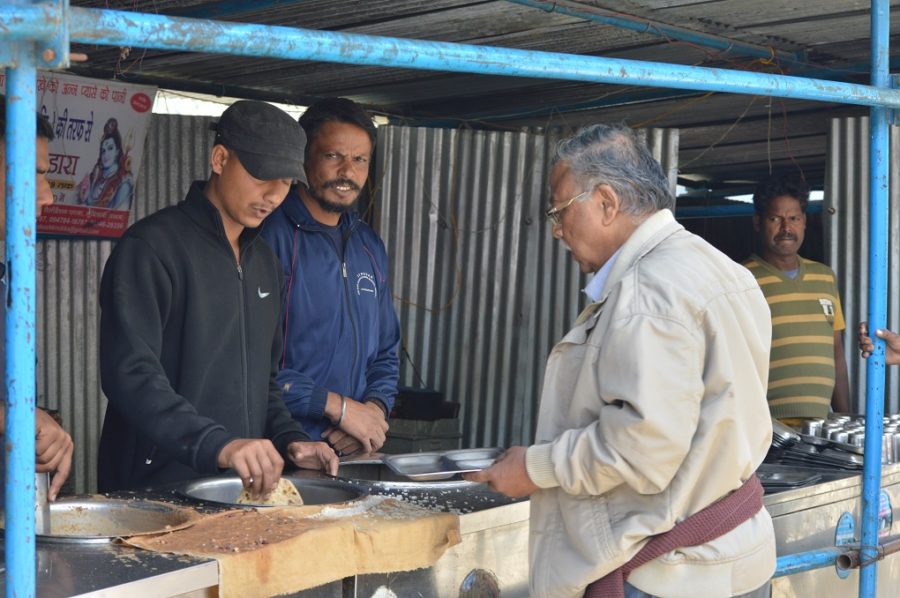
There are eleven campsites and seven langars (food canteens) which include the langars at the cave, Brari Marg, Sangam and Baltal campsites [image by: Athar Parvaiz]
A pilgrim being served food at the Brari Marg langar (food canteen). Thousands of Yatris eat every day at the langars during the course of the 60-day Yatra [image by: Athar Parvaiz]
Horse manure and plastic on accumulated snow near the Amarnath Cave campsite. The accumulated snow is spread over a large area and is several meters thick at some places. The glacier-rich forest area around Amarnath shrine has a large concentration of glaciers which feed the Lidder and Sind rivers, tributaries of the Jhelum [image by: Athar Parvaiz]
A pilgrim expresses her happiness as she, along with other pilgrims, is just a few hundred meters away from the Amarnath Cave. Pilgrims trek on accumulated snow for a long distance via Pahalgam to get to the cave [image by: Athar Parvaiz]
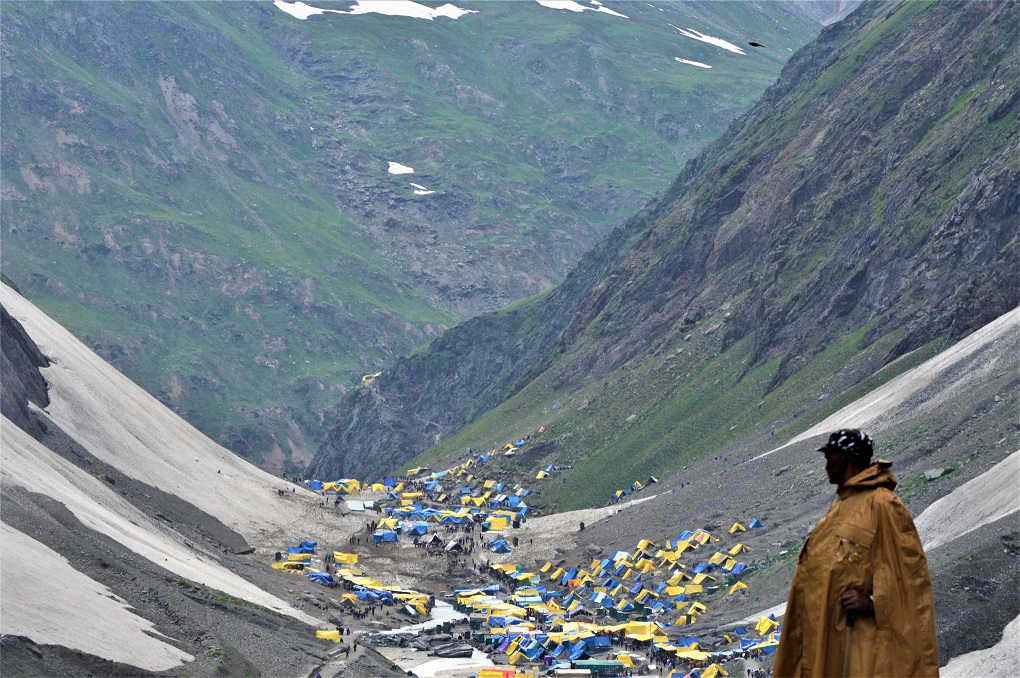
A securityman standing guard near the Amarnath Cave. Thousands of security personnel are deployed in the ecologically sensitive areas along the Pahalgam and Baltal tracks for the security of Yatris in the militancy affected region where an armed conflict has been going on for three decades [image by: Athar Parvaiz]
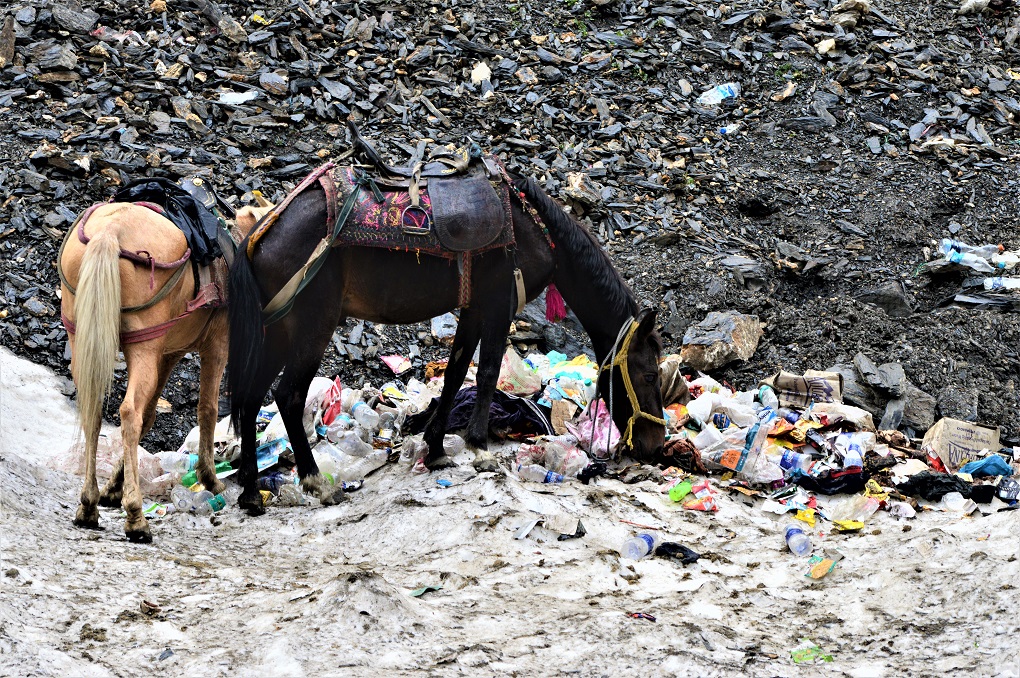
Horses searching for food in rubbish. Plastic bags and bottles comprise a major part of the rubbish that clogs this delicate mountain ecosystem when scores of devotees flock to the Amarnath cave [image by: Athar Parvaiz]
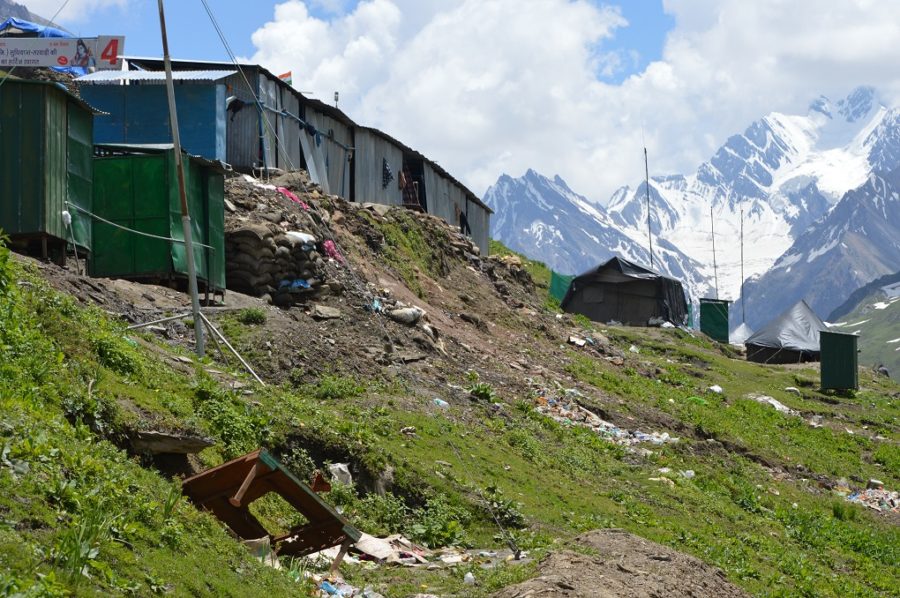
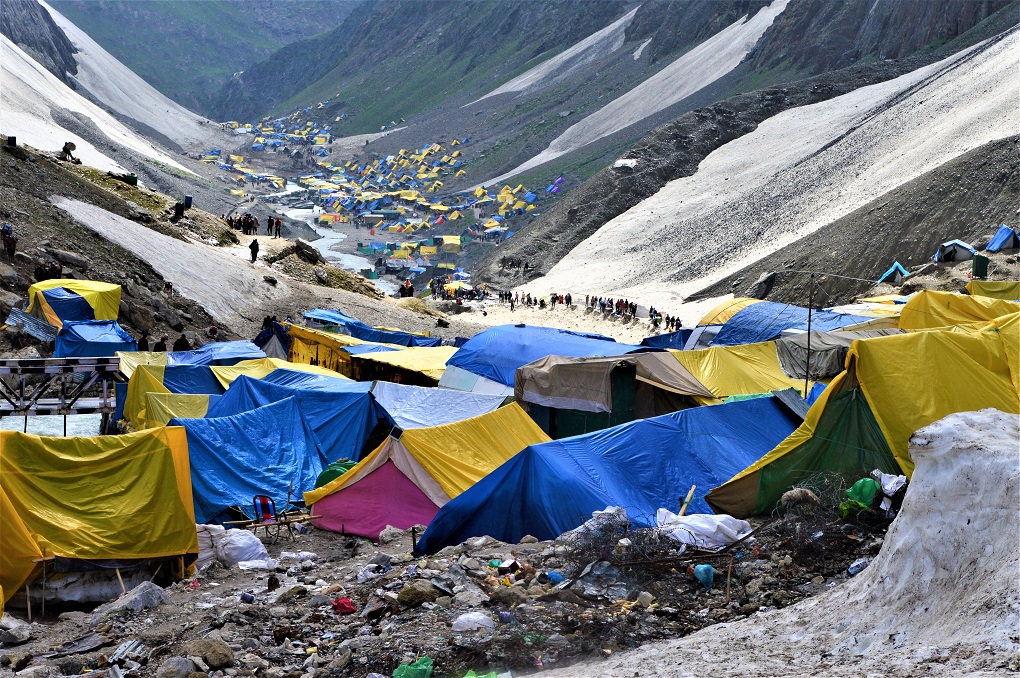
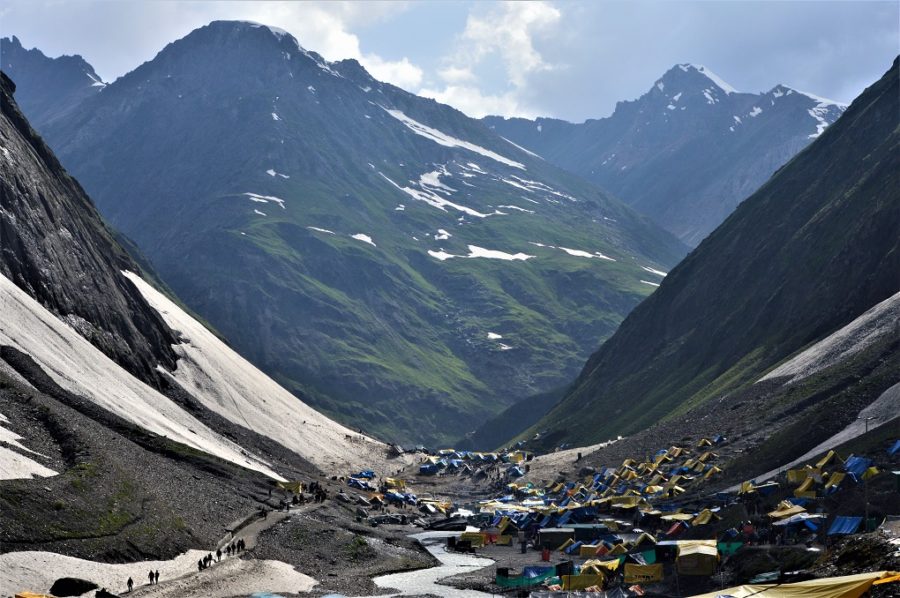
A campsite near the Amarnath Cave. Campsites and markets can be seen at various places along the Yatra routes [image by: Athar Parvaiz]
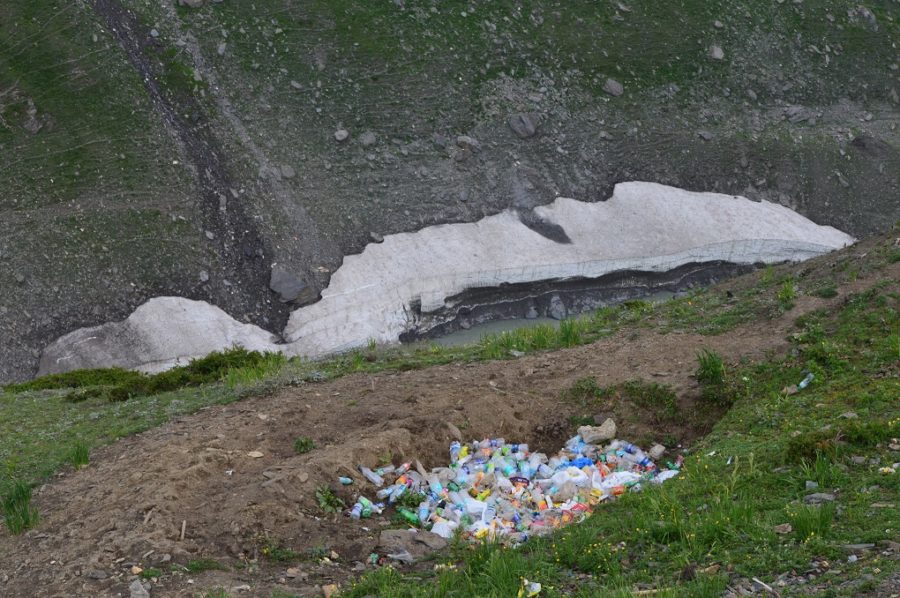
Plastic waste dumped in a pit on the bank of a stream which flows into Sind, one of the major tributaries of the Jhelum. Over 130 small and large waste pits and heaps along the Baltal track were found during the trek by this photographer. Experts say that storing of plastic waste in pits on the banks of streams de-stabilises the soil and causes soil erosion [image by: Athar Parvaiz]
Pilgrims raising slogans to celebrate the completion of their pilgrimage. These pilgrims, however, said that they found the pollution along the Yatra tracks quite disturbing [image by: Athar Parvaiz]
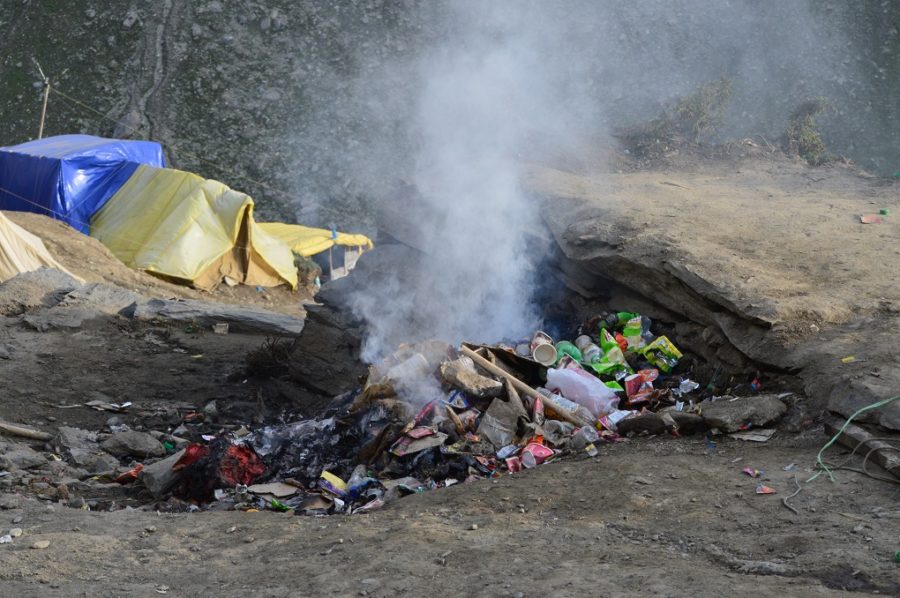
Open burning of plastic waste, which is considered highly hazardous, is followed at some places along the Baltal route for removing the waste. Shopkeepers and labourers, however, said that a lot of waste still either finds its way directly into the streams emerging from glaciers or is dumped into deep pits [image by: Athar Parvaiz]
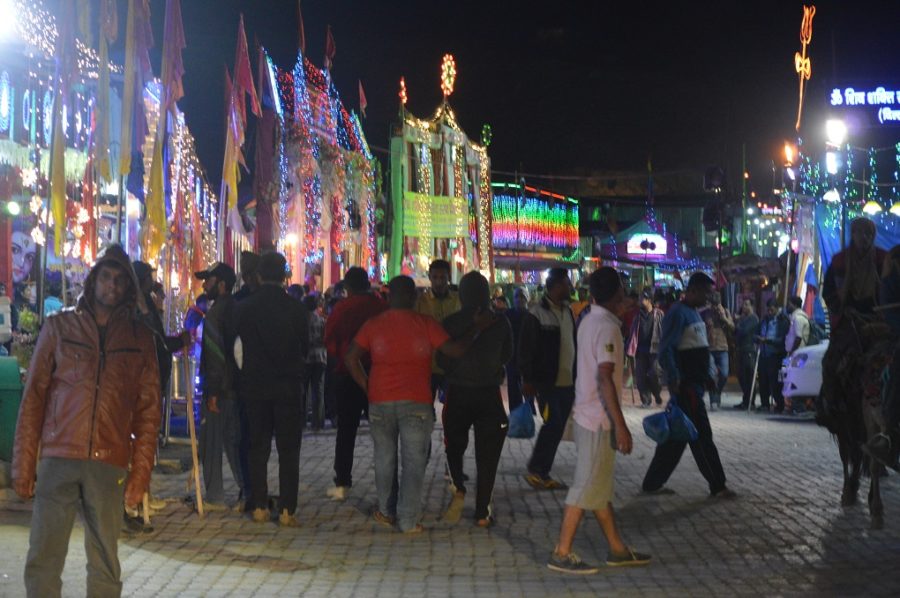
View of the market in Baltal base camp at the evening. The market keeps buzzing with activity round-the-clock during the course of two-month Amarnath Yatra as thousands of Yatris and local labourers throng the market [image by: Athar Parvaiz]
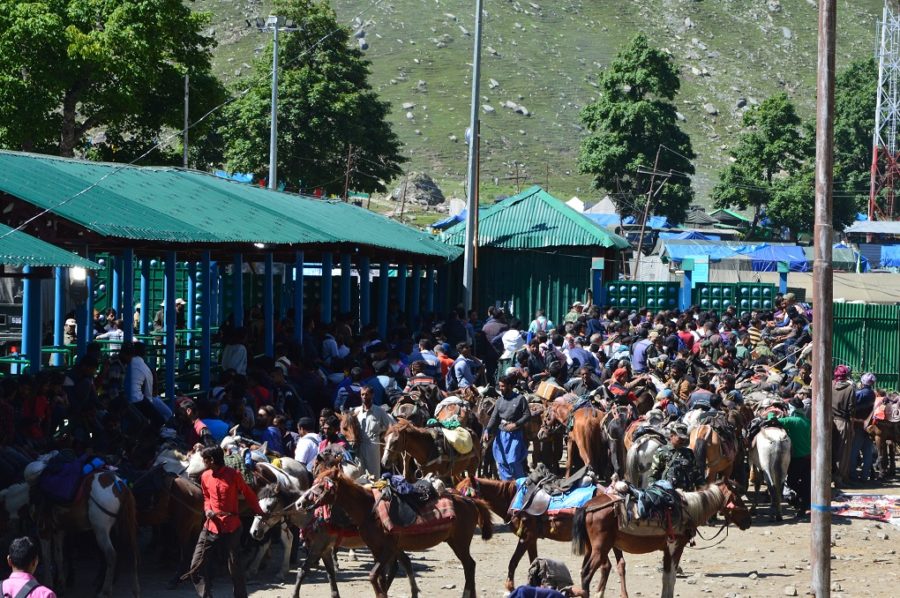
Pony wallas (labourers who transport pilgrims on their horses) outside the entry gate of the Yatra near Baltal. Over 1,500 pony wallas, along with their horses, keep trekking up and down Amarnath Yatra route carrying pilgrims on their horses and their bags on their shoulders [image by: Athar Parvaiz]
Langer at Brari Marg. The liquid and solid waste from the canteen goes into the stream flowing alongside. At various places, sewage from washrooms also flows into the streams [image by: Athar Parvaiz]
Pilgrims on horses trek on the accumulated snow near the Amarnath Cave [image by: Athar Parvaiz]
![<p>The Amarnath cave and the market near the shrine. Besides the market, there is a large langar (food canteen) which provides food to the pilgrims during the day; and dinner for those who stay at the site for the night [image by: Athar Parvaiz]</p>](https://dialogue.earth/content/uploads/2019/07/1-1-768x510.jpg)



![Horse manure and plastic on accumulated snow near the Amarnath Cave campsite. The accumulated snow is spread over a large area and is several meters thick at some places. The glacier-rich forest area around Amarnath shrine has a large concentration of glaciers which feed the Lidder and Sind rivers, tributaries of the Jhelum [image by: Athar Parvaiz]](https://dialogue.earth/content/uploads/2019/07/5-1-2.jpg)
![A pilgrim expresses her happiness as she, along with other pilgrims, is just a few hundred meters away from the Amarnath Cave. Pilgrims trek on accumulated snow for a long distance via Pahalgam to get to the cave [image by: Athar Parvaiz]](https://dialogue.earth/content/uploads/2019/07/6-e1564554400195-1-2.jpg)
![Pilgrims raising slogans to celebrate the completion of their pilgrimage. These pilgrims, however, said that they found the pollution along the Yatra tracks quite disturbing [image by: Athar Parvaiz]](https://dialogue.earth/content/uploads/2019/07/11-1-e1595519866674-1.jpg)