Pollution

Chinese city upbraided for using water to combat smog

Central government demands answers from Zhengzhou's city bosses after scarce supplies of fresh water are used to combat air pollution
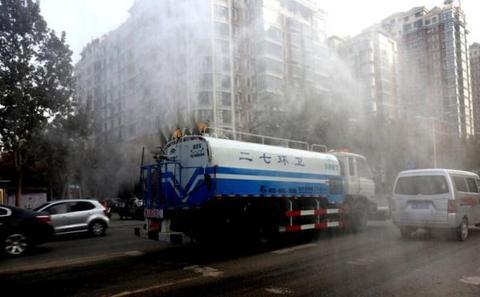
<p>A municipal truck sprays water in Zhengzhou, but the measure has irked central government, which wants cities to do more to conserve scarce supplies and tackle pollution at source. (Image by 澎湃新闻)</p>

A municipal truck sprays water in Zhengzhou, but the measure has irked central government, which wants cities to do more to conserve scarce supplies and tackle pollution at source. (Image by 澎湃新闻)

Officials in the city of Zhengzhou are under central government scrutiny after media reports revealed the capital of Henan province is using valuable fresh water supplies to combat air pollution.

Scientists and academics have criticised municipal leaders in Zhengzhou for “fake environmentalism” after it emerged the city is using more than 2% of its fresh water supply to combat dust from building sites.

Since April the city has been spraying as much as 35,000 tonnes of water, the equivalent of 14 Olympic swimming pools, into the air each day to remove dust from more than 20,000 building sites, according to an August 23 report by chinanews.com. The spraying is estimated to cost up to 107,000 yuan ($16,800) a day.

Dust control has been the main focus of air quality improvement efforts in Zhengzhou.

But many scientists have questioned the effectiveness of the technique, saying the spraying doesn’t remove key pollutants and that more should be done to combat pollution at source.

Zhengzhou officials were called before the Ministry of Environmental Protection in Beijing on July 28 to answer for poor performance on air quality, the first time a provincial capital has been called to account under new environmental protection laws.

Per capita water resources in the city are only one tenth of the Chinese average, and Zhengzhou’s water supply of 540 million tonnes a year comes almost entirely from the South-North Water Transfer Project, according to official data. Officials did not confirm whether the water being used for spraying was supplied by the Transfer Project.

City leaders disputed a report by chinanews.com that as much as 35,000 tonnes of water was being sprayed each day. They told the thepaper.cnthat during hot periods about 15,000 tonnes of water a day was used.

Zhang Ruiqin, head of Zhengzhou University’s Environmental Sciences Institute, told chinanews.com the spraying would do little to reduce the amount of PM2.5 particulate matter in the air. High concentrations of particulate matter have been shown to cause lung cancer, asthma and other respiratory illnesses.

Other scientists have also questioned the effectiveness of water spraying as a way to combat air pollution. Pan Jiahua, head of the Chinese Academy of Social Sciences’ Institute of Urban and Environmental Studies, said that water-spraying fails to treat the root causes of dust pollution.

In arid, particularly-parched cities, good quality water is a scarce natural resource, and using it to combat dusty air is a waste, Pan said. He described the spraying as a typical example of “fake environmentalism”, and said the key to dealing with dust pollution is to combat it at source.

But Duo Kexin, a professor at the Henan Environmental Monitoring Centre, said that without the spraying “things would be even worse.” She added that water-spraying is a “last resort”, but if it is to continue in the long term then “cheap and more plentiful grey water (recycled, but non-drinkable water)  sources should be used as much as possible.”

“In the 14 days after the meeting with the Ministry we had 13 days of good air quality, 1 more than last year,” Duo said. “In particular, PM10 levels dropped 25%. This shows how much of a difference dust control measures can make.”

Zhengzhou officials contend that removing street dust is a key part of efforts to combat smog. “Apart from better building site management, water-spraying is the most effective, quickest and safest way to remove that dust,” they said.

Cookies Settings

Dialogue Earth uses cookies to provide you with the best user experience possible. Cookie information is stored in your browser. It allows us to recognise you when you return to Dialogue Earth and helps us to understand which sections of the website you find useful.

Required Cookies

Required Cookies should be enabled at all times so that we can save your preferences for cookie settings.

Dialogue Earth - Dialogue Earth is an independent organisation dedicated to promoting a common understanding of the world's urgent environmental challenges. Read our privacy policy.

Cloudflare - Cloudflare is a service used for the purposes of increasing the security and performance of web sites and services. Read Cloudflare's privacy policy and terms of service.

Functional Cookies

Dialogue Earth uses several functional cookies to collect anonymous information such as the number of site visitors and the most popular pages. Keeping these cookies enabled helps us to improve our website.

Google Analytics - The Google Analytics cookies are used to gather anonymous information about how you use our websites. We use this information to improve our sites and report on the reach of our content. Read Google's privacy policy and terms of service.

Advertising Cookies

This website uses the following additional cookies:

Google Inc. - Google operates Google Ads, Display & Video 360, and Google Ad Manager. These services allow advertisers to plan, execute and analyze marketing programs with greater ease and efficiency, while enabling publishers to maximize their returns from online advertising. Note that you may see cookies placed by Google for advertising, including the opt out cookie, under the Google.com or DoubleClick.net domains.

Twitter - Twitter is a real-time information network that connects you to the latest stories, ideas, opinions and news about what you find interesting. Simply find the accounts you find compelling and follow the conversations.

Facebook Inc. - Facebook is an online social networking service. China Dialogue aims to help guide our readers to content that they are interested in, so they can continue to read more of what they enjoy. If you are a social media user, then we are able to do this through a pixel provided by Facebook, which allows Facebook to place cookies on your web browser. For example, when a Facebook user returns to Facebook from our site, Facebook can identify them as part of a group of China Dialogue readers, and deliver them marketing messages from us, i.e. more of our content on biodiversity. Data that can be obtained through this is limited to the URL of the pages that have been visited and the limited information a browser might pass on, such as its IP address. In addition to the cookie controls that we mentioned above, if you are a Facebook user you can opt out by following this link.

Linkedin - LinkedIn is a business- and employment-oriented social networking service that operates via websites and mobile apps.