Official bodies from Brazil and Peru have expressed concern about the social and environmental impacts of the proposed interoceanic railway, which will connect the coast of Peru and Brazil cutting through a thousand kilometres of pristine rainforest.
Brazil’s state-run rail operator Valec said construction of a stretch of the route straddling the border with Peru, proposed by the China Railway Eryuan Engineering Group (CREEC), represented an enormous task that would necessitate the creation of a new city in the heart of the Amazon, in a report in January.
Valec criticised CREEC’s choice of route through the Amazon and the Andes mountain range, which bisects an indigenous reserve, as damaging to sensitive ecosystems, in the report issued in response to initial feasibility studies by CREEC.
During a public hearing in the Brazilian senate on June 29, CREEC representatives stated that the responsibility for conducting studies on the environmental viability of the railway lied with Brazil and Peru.
In a rare statement from the Peruvian government, the ministries of culture and the environment told local non-governmental agency DAR (Environmental Law and Natural Resources) that it was imperative that native communities be consulted on the 5,000-kilometre logistics corridor prior to construction.
The Brazilian and Peruvian transport ministries and China’s National Development and Reform Commission first agreed to look into the project in 2014. In May 2015, the now suspended Brazilian president Dilma Rousseff and former Peruvian president Ollanta Humala, signed a memorandum of understanding (MoU) with Chinese premier Li Keqiang to proceed with viability studies.
Work on the US$10 billion (66 billion yuan) project, which would link the Atlantic and Pacific oceans by rail for the first time, is scheduled to begin next year and be completed by 2025, according to CREEC.
The railway will provide an alternative to the Panama Canal, the main channel by which Latin American countries to export millions of tonnes of grain, metals and minerals to China and other countries each year.
The route
The three routes originally proposed are to the north, the centre, and south of the Serra do Divisor National Park, which straddles the Brazil-Peru border area and is protected by laws in both countries.The north road is CREEC’s favoured option because it lies on lower ground and so would be less complicated and costly to construct. By contrast, the southern route would involve complex geological challenges since construction would have to take place at altitudes of up to 4400 metres.
Proposed routes of the interoceanic railway
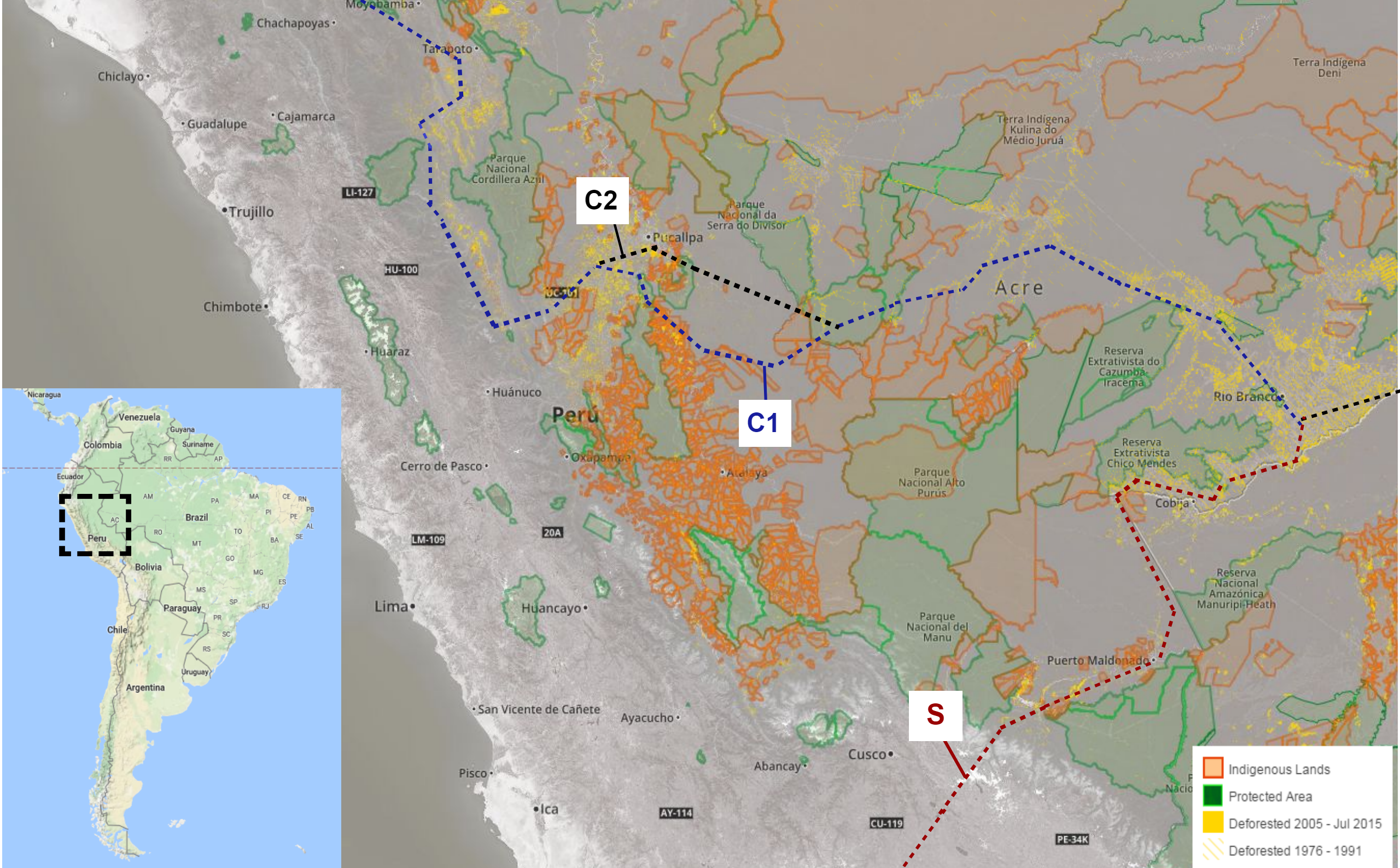
CREEC prefers route C1; C2 (central route); S (southern route). (source: InfoAmazonia/ DAR – click the map to view a larger version)
Country concerns
Work on the Brazilian stretch is set to begin in the city of Lucas do Rio Verde, in Mato Grosso state, the country’s agricultural heartland. From there, the line extends 3,300 kilometres to the border between Peru and the Brazilian state of Acre, and then another 1,700 kilometres to the Pacific coast.
According to Valec the border crossing would require a transfer station to be built, since the gauge of railways differs in Brazil (1.6 metres) and Peru (1.4 metres). “Besides the need to establish a new city to house all the employees involved in the process, all this [takes place] in a very environmentally sensitive and sparsely populated region,” Valec said.
Peru’s ministries of culture (MINCUL) and the environment (MINAM) also expressed concern about the impact on indigenous communities living in its path, documents obtained by DAR revealed.
MINAM noted that the proposed northern corridor crosses the protected Altomayo forest, and agreed with Brazilian authorities that local communities should be consulted before construction begins.
Researchers at DAR, a member of the Regional Group of finance and Infrastructure, told Diálogo Chino they feared the project would replicate the disregard for Amazonian communities shown during construction of the interoceanic highway.
Mountains to climb
Zheng Jianya, an engineer at CREEC, said: “They say the geology can be an obstacle. But the geology is even more complex in China, which has made Chinese railway construction technology more refined,” adding: “The potential geological obstacles will be overcome.”
In Brazil, a 1,600-kilometre stretch of the project (the Centre-West Integration Line), expected to cross 96 perennial rivers) has been granted permission to proceed by environmental authorities. Chinese contractors are now negotiating agreements with the states Goiás, Mato Grosso and Rondônia, through which Brazilian credit bureau FICO would pass with a provisional start date of 2017.
The Brazilian ministries are awaiting announcements from new president Michel Temer on public spending. It is not certain that the railway will remain among investment priorities, although many influential senators defend the project in the capital Brasilia.
Finance
The funding model for construction of the transcontinental railway has not been publicaly disclosed. Investments could take the form of a loan from China to Brazil. Another possibility could be a public-private partnership (PPP), which are increasingly common in Brazil.
Supporters of the project say they believe that partnerships between Chinese enterprises and local companies encourage regional development.
According to Luiz Antonio Fayet, a consultant at the National Agricultural Confederation, the construction in 2014 of a new highway (route BR-163) in the midwest of Brazil has rendered the interoceanic railway uncompetitive.
The highway is an attractive option for transporting products out of the country. The route sees good travel up to Brazil's northern city of Miritituba in Pará state, then along the Tapajós River to the port of Santarém for shipping across the Pacific via the Panama Canal or around the Cape of Good Hope.
“It makes sense to move production through the north, and the most economical mode of transport is the waterway,” said Rodrigo Koelle, South America transport director at logistics multinational Cargill, one of the world’s largest exporters of soybeans and corn. Cargill has extensive operations in Brazil, 80% of which go to China.
But others disagree.
According to CREEC's preliminary estimates, the transcontinental railroad could reduce the cost of exporting grain and minerals by US$ 30 per tonne compared to current routes. And once operational, the project could support a third of total exports from Brazil to China, some 35 million tonnes of soybeans, annually. No matter the size of the saving, it is unlikely that the local Amazon peoples will benefit.
The original version of this story was published on Diálogo Chino.