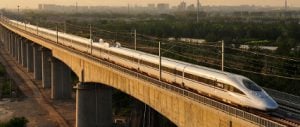
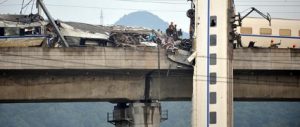
An uncomfortable lesson for Beijing that rose from the mangled debris of the high-speed rail (HSR) accident is that a crash inside China is heard instantly around the world. For all the stifling checks on unfettered information, the microblog Sina Weibo (the “Chinese Twitter”) shined as a vehicle that beamed the ferocity of public opinion rapidly across the globe.
As I have written elsewhere, that opinion overwhelmingly reflected collective ire toward a government that remained more opaque than necessary and less accountable than demanded. Unlike the aftermath of the Fukushima nuclear fallout – when officials defended imported nuclear technology as more sophisticated and blamed Japan’s disaster on a once-in-a-century freakish natural calamity – deflecting responsibility over an entirely self-created problem rings hollow.
The public and unofficial media continue to have none of it and have mounted calls for full disclosure of what went wrong. As policymakers’ hands are increasingly bound by the tide of public opinion, it appears that some changes will have to be made in China’s approach to rail development. It would be a mistake for the central government to respond to the disaster with inaction. Yet it would equally be a mistake if the ultimate course of action was to abandon HSR altogether. I have argued and continue to believe that HSR is in and of itself a rational idea to accommodate China’s economic development and urbanisation ambitions.
Still in crisis management mode, neither the rail ministry nor the State Council – China’s highest administrative organ – has indicated what long-term steps are being debated. In the interim, however, the State Council has announced a blanket suspension of new high-speed rail projects, while Wen Jiabao has pledged to get to the bottom of the accident’s true cause. In the absence of further information, it’s probably reasonable to entertain a range of scenarios for the future of China’s HSR programme. Here are five:
* No change; China goes full throttle forward with existing plan and timeframe.
* Temporary respite to reassess, but ultimately the programme forges ahead.
* Pace of development slows in order to address serious issues with rail ministry and governance.
* Scale of project is significantly curtailed and funding cut.
* China throws the baby out with the bath water and scraps entire programme.
Scenarios at either end of this spectrum seem rather unlikely at this point. Since voices like Caixin, a boundary-pushing media company, continue to pressure the top leadership to hold the rail ministry’s feet to the fire, at a minimum a legitimate – and potentially independent – probe into whether to reform the stodgy ministry is a real possibility. Indeed, the chances seem to be strengthening daily: yesterday, the railway ministry announced a small step of reducing top speeds of the trains across the board and chopping ticket prices; today came the State Council’s announcement on the suspension of approving new rail projects.
If that reform then went ahead, it would amount to one of the most significant political restructurings that Beijing has undertaken in at least a decade. Just as China lacks an overarching energy ministry akin to the United States’ Department of Energy, a comprehensive transport ministry is nonexistent. This creates a “too many cooks in the kitchen” situation, where governance is fragmented among various bureaucratic interests with little horizontal coordination.
In fact, the rail ministry only cared about its own interests. And under the leadership of the fallen former minister Liu Zhijun, it was particularly adept at pushing for those interests and for the businesses associated with it, as I have noted. Yet meaningful restructuring of the entity will come at a cost, especially as the agency is saddled with debt that could easily grow as public fear reduces ridership on the bullet trains and crimps revenue. Already, there are signs that passenger volume on the new Beijing-Shanghai service has plummeted.
With the litany of issues that have surfaced, a failure on the part of central government to take any action would likely exacerbate the public crisis of confidence in handling this political hot potato. But this action should not extend to complete abandonment of HSR: the basic arguments for building an advanced rail network in China remain strong.
Proponents of HSR have argued that increasing passenger rail transport can free up freight transport for needed commodities like coal. Having been stuck behind a line of coal trucks in Inner Mongolia for miles, I can’t seriously dispute the practical aspect of expanding rail capacity. What’s more, there’s sound justification for an HSR network to link a continent-sized nation with high urban density. The latest census, from 2010, showed that 50% of China’s population – close to 700 million people – already live in cities, pointing to a faster rate of urbanisation than expected. But this ratio is still considerably below that of developed countries with urbanisation levels in the 70% to 80% range.
With huge volumes of population waiting to be absorbed into cities – including the integration of younger migrants who want to become full-fledged urban citizens – Beijing is planning mega urban clusters while simultaneously dispersing urbanisation into the interior, according to research firm Dragonomics. The megacities are meant to contain more than 10 million people, with the next category of “large cities” accommodating five to 10 million residents.
It is no coincidence that the four main arteries of the HSR connect the currently planned mega urban regions. They basically stretch north to south, from the Beijing/Bohai region to the Yangtze River Delta and from Changsha-Wuhan in central China down to the Pearl River Delta. On the horizontal axis, the HSR lines are intended to eventually connect Shanghai and Chongqing – now the hub and model of development in China’s western regions. So, the planned HSR services are meant to facilitate regional integration and development and provide an appealing mode of public transport. The existence of HSR can also force a consumer choice between driving, flying, or riding a bullet train, which, for the “green-minded”, is less carbon-intensive.
But despite reasonable arguments in favor of HSR, it is clear that the execution of the project got away from what were likely good intentions. I suspect that when the concluding chapter of this human tragedy is written, the fault will lie less with technical deficiencies than mismanagement, politics and wholly avoidable human errors. Indeed, it is the seeming addiction to speed (both in terms of running the trains and the pace of track expansion), the chabuduo (“good enough”) mentality, a culture of secrecy and a ministry seduced by solidifying a powerful fiefdom that threaten to derail the realisation of the country’s technological aspirations.
Damien Ma is a China analyst at Eurasia Group and blogs at www.theatlantic.com/damien-ma.
Homepage image from China’s Ministry of Railways