This article is a response to “Eco-toilet project ends in failure” by Wu Shan, published on chinadialogue on July 30.
For a large share of the 750 million urban people worldwide who lack adequate sanitation, flush toilets connected to municipal sewers are not a viable option due to poverty, water shortages, groundwater contamination risks and other issues. The research and development project at the China–Sweden Erdos [Ordos] Eco-Town Project was the first major urban project of its kind and was designed to test, at full scale, alternative sanitation in the form of eco-toilets in an arid area of the world.
The project encountered many challenges and uncovered many truths, and was a valuable learning experience that will make future urban ecological sanitation projects more effective.
The project was a collaboration between the Dongsheng district government in Ordos and our organisation, the Stockholm Environment Institute, and aimed to save water and provide sanitation services in this drought-stricken and rapidly urbanising area of northern China.
Before the start of the project in 2003, the 250,000 residents of Dongsheng suffered water-rationing and used mainly public toilets, which were largely unfinished, concrete-slab squatting pit latrines that had no lighting or heating, and no running water for washing. The harsh winters, during which temperatures can drop as low as minus 30° Celsius, made the existing pit latrines even tougher to use, and during the hours of darkness they became more or less open defecation zones in the city.
The birth of eco-toilets
The challenge for the project was to work with local builders, officials and residents to improve conditions and develop a dry sanitation system with urine diversion in multi-storey apartments. Although the technology for these systems is not standard, it has been successfully carried out in Sweden and Germany as well as other locations at a smaller scale. The “Gebers” project in southern Stockholm has been running well since 1997. The Ordos project was an upscaling effort, involving 832 apartments and about 3,000 inhabitants.
As the project got under way, the value of coal in China was rapidly increasing and Dongsheng saw a mammoth building boom. The standard of living skyrocketed to levels similar to Hong Kong and Shanghai. Also, a 100-kilometre pipeline was built from the Yellow River to Dongsheng to increase freshwater supply, and fossil groundwater reserves were further developed. As a result, the bases for the project – extreme water shortage and poverty – quickly disappeared, and the eco-toilet project was overshadowed by the rapid development. In fact, an entire new city, Kangbashi, was built adjacent to Dongsheng during the period of the project.
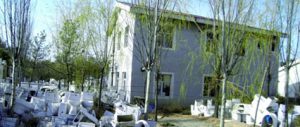
The rapid urbanisation became a major burden and the project lacked skilled labour. The buildings were put up very quickly and the plumbing done by dozens of firms with varying levels of competence. There was a serious lack of building inspection and apartments were put on the market before the eco-toilet and ventilation equipment was properly installed. Much of the poor workmanship came from not following the blueprints carefully, resulting in leaky or wrong-sized pipes, and these faults were not discovered until walls were dismantled in 2008, two years after the buildings were completed. The building company was not interested in repairing its poor work and the city government was not in a position to apply pressure. The necessary investments to complete the project were not going to be made, mainly because there was no dedicated owner.
Air-pressure differences caused by high winds, open bathroom windows and kitchen fans also created ventilation problems. Some top-floor apartments experienced odour problems more often, due to design limits and improper construction. During the project, design improvements to the basement ventilation installations were implemented at full scale by SEI. However, the building company did not play its role in repairing the pipe work, which was in fact poorly constructed from the outset.
Furthermore, a lack of pipe insulation in the attics and above the roof – an item not covered in China’s building codes – was mainly to blame for the frozen ventilation pipes which caused havoc during the extremely cold winters of 2007 and 2008.
Eco-toiley technology not only needs care in its construction, but also in use and maintenance. Many residents used the eco-toilets as receptacles for solid waste, blocking the ventilation system. Those who put bags of food waste into their eco-toilets often saw flies during the summer, and the faeces containers in the basements needed to be sprayed, although, “maggots and cockroaches crawling from the toilets”, as reported by Wu Shan, appears to be an unfortunate exaggeration, and was not reported by residents at the time nor observed by our staff. Residents who used and maintained their toilets properly did not suffer the same problems.
It should also be noted that neither residents nor workers reported health effects of any kind during the entire period of the project. The project had a 24-hour hotline where residents could file observations and complaints, and they received immediate service from the maintenance team. Most complaints dealing with odour could be solved on the spot.
The residents who were worried about the dry toilets reducing the value of their apartments actually found out that their properties had increased in value by three to four times during the project. In fact these apartments were and remain very popular because of the green spaces and parking which were insisted on by the architects involved in the project from Sweden.
During the final stages of the project, a new kind of dry toilet from Separett AB was tested. Each eco-toilet contained its own small evacuation fan, meaning odours could be eliminated even if the external vent pipes had been improperly built. The ideal eco-toilet is therefore something that works even if there are building and plumbing faults. These new eco-toilets were successfully run for an additional year up to the end of 2010, however the decision to install flush toilets had already been made by the local government.
Besides rapid regional economic development, the main reason the dry toilet project ran into problems was the lack of a dedicated owner. Other decisive factors were:
1. Water shortage was – at least temporarily – no longer a problem due to the Yellow River pipeline and deeper groundwater extraction.
2. The odour problems during the extreme winter of 2007 acted as a negative tipping point for the project.
3. It was not possible to take a stakeholder approach among tenants to help choose the most appropriate sanitation system, since the tenants arrived on the scene as buyers after the apartments were built.
4. The household committee stated to the local government that it was not capable of taking on the costs of continuing the scheme, and the district governor responded by investing in flush toilets.
5. The standard of living in the Ordos area rose dramatically during the project period. Dry toilets were considered by some residents as something backward in a modern urban setting.
Ecological sanitation is progressing well around the world. Ten years ago it was a fringe activity, but is now reaching mainstream status within the UN system, and some governments have far-reaching plans for expansion. About five million people are using these systems and the numbers are growing.
Closing the loop on water and nutrients is a necessity in order to feed an increasing (mostly urban) world population, expected to reach 9 billion by 2050. Dry urine-diverting toilets are just one approach and others are being developed. The dialogue on this development around the world continues on the Sustainable Sanitation Alliance discussion forum.
Arno Rosemarin and Guoyi Han are senior research fellows at the Stockholm Environment Institute (SEI).
SEI has produced the new book The Challenges of Urban Ecological Sanitation: Lessons from the Erdos Eco-Town Project, which aims to make lessons from this project available to all.
This article is published as part of our Green Growth project, a collaboration between chinadialogue and the Energy Foundation.
Homepage image by Sustainable sanitation