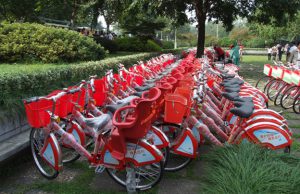
With their colourful, customisable wheels and lightweight frames, fixed-gear bikes make a bright addition to the hordes of traditional bikes in Chinese cities. “Fixies” as they are known for short are becoming increasingly popular among cyclists in China, both as a way to keep fit and a fashion accessory.
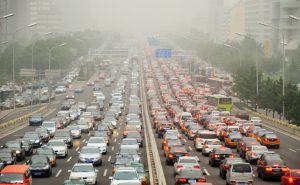
China was once synonymous with bikes as a means of cheap and easy transport, but the country’s economic boom has led to a massive increase in the number of cars on the roads. Bikes became linked to the image of a poorer past that many Chinese wanted to forget.
In 2010, Ma Nuo, a model and contestant on a popular Chinese dating show famously summed up the sentiment when she said to a potential suitor that she would “rather cry in a BMW car than laugh on the backseat of a bicycle”.
In recent years, however, cycling has enjoyed something of a revival, not just as a cheap and necessary way to get around but as a means of exercise, a way to reduce pollution and a trendy pastime.
Bike culture in China “is about to go crazy on all levels, not just fixed-gear but people riding out to the mountains on bikes and road bikes,” says Shannon Bufton, a cycling promoter in China and co-founder of Smarter than Car. “A few weeks ago in Beijing we had a vintage ride where people were riding high-seat vintage bikes in British tweed and also in Chinese traditional dress. From all aspects of cycling, things are really moving here.”
Fixed-gear bikes, which just have one gear and no freewheel mechanism, have played an important role in this revival, becoming a popular fashion accessory and inspiring a culture and community of “fixie” enthusiasts.
Bufton says interest in these bikes has been growing for three or four years. "There has been a fixed-gear boom in China, mainly in Beijing and Shanghai, but now it is also moving into the third and fourth tier cities. New fixed-gear ranges and new fixed-gear clubs are emerging all over China.”
Safety fears?
Recent reports in the Chinese media have pointed to a possible ban on fixed-gear bikes in some areas, however. In Fujian province, newspapers reported that students would be barred from riding such bikes to school after a young girl died in an accident involving a fixed-gear bike with no brake. There were also online rumours of a crack-down on fixed-gear bikes in Beijing, though these seem to be unfounded.
Some users of the Chinese social media platform Sina Weibo reacted negatively to talk of a potential ban. “This is a lively cycling culture that a group of young people helped to re-emerge in the cities. The traffic police should encourage and guide it. Riding bikes as a green activity helps carbon reduction,” said one user.
There also seems to be some confusion about whether fixed-gear bikes usually have brakes or not. Jeff Liu, one of the founders of Factory Five, a fixed-gear bicycle shop in Shanghai, explained that “the only thing that separates the fixed-gear bike from a traditional bike is the gearing. The idea that fixed-gear bikes don’t have brakes is taken from track racing.”
Bikes without brakes of course have their dangers – but by no means account for all fixies. Liu says it “feels pretty irresponsible” for a shop to sell a fixed-gear bike without a brake to a teenager. “We definitely won’t sell you a bike without a brake unless you have been cycling for a long time. Or if you are buying a bike from us for track use,” he says.
Even if there was to be some sort of ban on fixed-gear bikes, “it is just going to make them more popular,” believes Bufton. He doesn’t think it would have an impact on the increasing popularity of cycling in general in China either. “There is an emerging bike culture across all different forms [of cycling]. It’s very diverse in China. You have older people who are getting out on mountain bikes. Then you have school kids who are starting to discover road bikes who go out and explore the suburbs of Beijing on the weekend.
"There is a whole diverse range of people who are into cycling and fixed-gear is just one of those diverse parts of the culture,” he says.
Bikes for the hip – and rich
In Shanghai, the flatness of the city makes it an ideal location for fixed-gear cycling. It’s also a city with a strong sense of fashion and fixed-gear bikes have become popular among hip young professionals “because people can customise the bike for themselves and they like to design it for themselves,” says Liu. But a one-of-a kind bike does not come cheap: prices at Factory Five begin at 5,000 yuan (US$815).
While at first sight the Shanghai traffic might not look the most welcoming for cyclists, Liu says he “feels safer cycling here” than in the United States. “There are dedicated bike lanes. There is a method to the madness, even though drivers come really close to you and don’t give you that much space, they know you are there.”