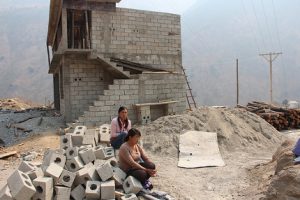
Changing current land policies and overhauling the hukou, or household registration system, are considered two necessary and complementary reforms to China’s urbanisation efforts, and important measures to release the so-called reform dividend. Hopes are high that the coming third plenary session of the Communist Party’s 18th Central Committee will unveil land reforms.
The country’s land falls into two categories: urban land belongs to the state and rural land is owned communally. Land reforms mostly involve rural land, especially that designated for construction purposes, which is not allowed to be directly traded on the market.
Read also: A road map for reforming China’s hukou system
A recent State Council think tank proposal to the party meeting, dubbed the 383 Plan, charts out a roadmap for land reforms. This means giving farmers the right to transfer, manage and mortgage land; allowing collective land to be traded as equal to state land and setting up a pricing mechanism based on a unified market; and giving market-price compensation to farmers whose lands are expropriated by the government. The 383 Plan did not spell out land privatisation, but it clearly articulated many people’s hopes that rural construction land will be allowed to trade directly on the market.
This could be an ideal plan, but how likely is it to be adopted? Previous policy changes, in 1952, 1962, 1978 and 2005, were difficult to push forward because land is the foundation of Chinese farmers’ livelihoods. The new reform, aimed at shifting rural land to urban land, involves a large amount of money. Meanwhile, many interests are intertwined. This is a dangerous situation to say the least.
In fact, in October 2008, the third full meeting of the party’s 17th Central Committee called for a unified rural-urban construction land market, equal rights for collective land and state land, and reasonable compensation for farmers. Isn’t this in the same vein as the 383 Plan?
Then why, after five years, has there been no substantial progress in these areas? Why have experiments in cities like Suzhou, Shenzhen and Chongqing failed to form a national model? And why has the Land Management Law, which was deliberated on for five years and passed by the State Council last year, not been given a timetable for review by the National People’s Congress?
The answer is because land policy, which involves so many farmers, is incredibly important and sensitive. It is hard to change. And it is very likely that top decision-makers and society have not reached a consensus on how to reform it.
There are three major concerns. The first is that allowing land to be traded on the market could result in its accumulation by the wealthy, hurting the interests of farmers. Look at what is going on in cities, where a few can amass more than 100 flats via dubious means and simply sit back and collect high rents. The central government might not want this to happen in the villages.
Second, reform would sever the main financial resource of local governments, which monopolise the land market. Local governments are already suffering the double blow of reduced fiscal income and reform of the tax scheme. Local governments would protest this elimination of "land finance" channels.
Finally, many seemingly voluntary decisions of farmers are in fact forced upon them. The power to deal with collective assets is usually controlled by a small number of rural village chiefs and low officials. If rural land were put on the market, farmers could lose their land without getting anything in return. Then there is the question of the country having enough farmland.
Before these problems can be solved, only minor changes should be made to land policy. The priority now is still protecting the management rights, usage rights and rights to share collective benefits by farmers.
The government should quickly survey the usage rights for individual construction land, collective construction land and farmland and hand out ownership certificates. This would follow on from the successful precedent of clearing up the rights to forest land and set the foundation for a fundamental solution. Meanwhile, we should enhance land trading among farmers to increase their returns and the efficiency of usage without changing the nature and designation of parcels. Local governments’ expropriation efforts should be put under tight scrutiny and compensation levels should be significantly raised. In addition, we should allow more experiments in land trading and give farmers the right to mortgage their land.
The 383 Plan can serve as a long-term goal. In the short term, the emphasis could only be on the allocation of returns on land, not allowing the direct trading of land.
A version of this piece was first published on Caixin Online