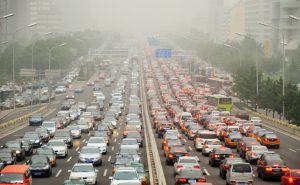
As air pollution once more soared to hazardous levels last week in Beijing, in Washington a panel of Chinese and other international experts explained some of the solutions to taking cars off the roads in the world’s most populous country, but there are few easy answers.
Chinese cities are struggling to discourage driving after decades of unprecedented growth in car ownership, meaning that new measures may be needed to cut the number of car journeys, said the World Bank’s Binyam Reja at a conference last Friday organised at his employer’s headquarters in Washington.
Efforts by cities such as Shenzhen to cap new car license plates at 100,000 a year will have a positive impact in slowing future growth in car sales and pollution, but these types of initiatives do little to curb existing environmental impact related to the 240 million cars said to be on China’s roads at the end of 2012.
“(The use of number plate lotteries) doesn’t influence your behavior once you own a car”, Reja added.
In the past two years, a further 45 million cars may have been sold in China, according to estimates, cementing China’s position as the world’s biggest car market, and second-biggest consumer of oil.
But per capita car ownership is far behind that of the US.
Controlling vehicle emissions has become an increasingly urgent priority for governments of China’s biggest cities. In Beijing and Shanghai, vehicle emissions account for roughly 30 percent of PM2.5 – the fine pollutant particles that are considered most dangerous to human health.
“We did not expect such rapid growth in small passenger vehicles, therefore many cities had problems adjusting to such growth,” said Pan Haixiao, a professor in the Department of Urban Planning at Shanghai’s Tongji University.
Pan pointed out though that his city has done better than the capital Beijing when it comes to limiting the use of cars: “Shanghai has a bigger population and a bigger GDP than Beijing, but the use of small vehicles in the city is lower than in Beijing by three million cars.”
Congestion charges
Shanghai was a pioneer when it comes to regulating car ownership. In 1986, the city introduced a bidding system to allocate a limited number of new car licenses.
Revenue from the auctions has been spent on improving roads and the public transport system.
Beijing only started setting quotas for car ownership in 2011 when the city introduced a lottery system for new licences – dramatically limiting the number of newly registered vehicles each year.
Experts say that for those who already own a car, higher parking fees would work as a deterrent, as would congestion pricing – such as levying fees for using roads during rush hour along the lines of London's congestion charge.
While a lot of the discussion focused on private cars, Li Jingzhu from the GIZ Sino-German Climate Change Program reminded the audience that in Beijing, trucks account for the same amount of particle emissions as private cars. This despite the number of private cars in Beijing outnumbering trucks by ten to one.
“In China we have a lot of low level trucks with high emissions,” Li said.
A possible solution could be to scrap old, smoke-belching lorries and replace them with new ones that are more efficient and less polluting.
Public transport
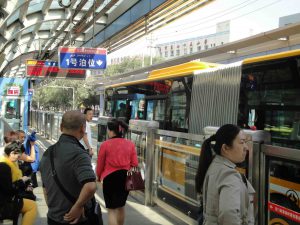
Offering alternatives through public transport will be another important part of the equation in solving China’s transport conumdrum. Again, Shanghai is a pioneer. The city has 300 kilometres of exclusive bus lanes, and up to 80 million people use its 450 kilometres long metro train system every day. The number of Chinese cities with metro systems has gone up to 18 from one two to three in the 1990s.
However local governments will have to find less risky methods of financing costly metro systems than land leasing, which has to fill a large funding gap.
Local governments are typically responsible for 85 percent of the expenditures on infrastructure, but only have access to 40 percent of the local tax revenue.
“The overreliance on land leasing has backfired – it led to urban sprawl, speculation in the housing market and the depletion of agricultural land,” said the World Resources Institute’s Xue Lulu, who thinks the public-private partnership used by Shenzhen would be a good model.
Meanwhile, the conference heard that bicycles, once such a typical sight on Chinese streets and now an increasingly common source of transport for urban professionals in western cities, could make a comeback, but only in certain places.
Not every Chinese city lends itself to biking. In Harbin, for example, it is too cold to cycle for more than 200 days a year while Guiyang and Chongqing are considered too hilly. Worsening pollution – some of which caused by cars – and erratic driving can erode some of the health benefits delivered by pedal power.
However in some cities, such as Kunming, which enjoys a warm climate most of the year round, the government has set up bike parking opportunities at bus and metro stops to accommodate the city’s 1.8 million bikes.