Historians have long argued that cultural reasoning or abstract ideas do not determine everything in the human story. Material conditions matter. But this time we are discovering something new: old notions of materiality, focused on technology and production, class interests, debtors and creditors, do not exhaust the possibilities. In fact they may be only superficial manifestations of deeper material conditions. Such powerful forces as climate change, soil fertility, microorganisms, and indeed the evolving complexity of the ecosphere within which all societies, ancient and modern, have existed may be the most fundamental engines of history. We cannot separate human aspirations and failures from the natural environment or the laws of matter and energy.
Perhaps the single most compelling idea behind the history of the United States, as David Potter told us more than a half-century ago in his book People of Plenty: Economic Abundance and the American Character (1954), has been the notion of abundance and of the infinite economic growth such abundance long seemed to promise. It has been at the core of American thinking for centuries, and now it has gone global, driving almost all societies as much as it ever did Americans. Economists may debate whether “growth” can continue indefinitely into the future or not, but typically they agree with Potter that the idea has been a defining one for Americans. But typically the economists, like Potter, fall silent when they confront the question, where does the idea of abundance or growth come from? How, where, and why did it become so persuasive to so many people? And if it had material foundations, are those foundations beginning to disappear in our time?
Recently, economists have been talking a lot about the decline of American growth rates since around 1970. Robert J. Gordon, for example, in his widely admired new book The Rise and Fall of American Growth: The U.S. Standard of Living since the Civil War (Princeton University Press, 2016), warns that a hundred-year spurt of growth is coming to an end and there is nothing that policy makers or social scientists can do to stop the process. He has compiled the all-time greatest catalog of “advances made” in energy consumption, clothing, housing, communications, and transportation over a century of American “progress.” But why that century ever occurred, or why it is now running out of steam, eludes his grasp. Somehow, he maintains, it was the mysterious force of “technology” that once produced the miracle of growth, and now that technology is faltering, giving smaller and smaller returns, leading us back into an older pattern of far slower, more inconsequential, and more inconspicuous change.
Gordon is a “materialist,” make no mistake, but I would argue that he is not material enough. What is missing from his narrowly conceived history of innovation is any awareness of how ecological conditions in America were at least as important as the fabled inventors of railroads or steel mills in making us a “people of plenty.” And today it is changing ecological conditions that explain—better than a loss of American inventiveness—that winding down of growth.
Why were railroads built with such zeal and hunger throughout the nineteenth century? Why did a national market for lumber develop so rapidly? The answer staring us in the face is that a bounty of natural resources once existed across the interior of North America. The railroads or lumbermen did not altogether invent those resources. They only made them available and turned them into commodities to satisfy a booming population. Among the most important resources were the fabulous soils of the Middle West and the mineral wealth that lay waiting throughout the mountain and desert states. It was the unparalleled natural abundance of a continent that drove people into the interior, helped shape new technologies, provided the raw materials for new cities, plowed the prairies, leveled the forests, and dammed the rivers. Abundance was “man-made” to some extent, but only in a proximate sense. Ultimately, people came looking for the same resources that had from time immemorial driven their foraging and farming ancestors. What had changed most basically was the population-resource equation and the consequent invention of new ways to get at those resources.
The modern vision of unlimited economic growth began much earlier than Gordon realizes, among the first European explorers and immigrants to the New World, arriving from 1492 CE forward. A not dissimilar vision of plenty had driven their predecessors, the resource-seeking indigenous peoples, to spread over two continents and their coastal waters, a process taking thousands of years and producing many different social arrangements, from tribes to empires, to control and exploit the bounty they found. Much later the impact of New World abundance on the merchants and farmers of a Europe raddled by disease, soil depletion, deforestation, the Little Ice Age, stagnation, and poverty was even more profound—touching off an age of revolution in politics, global power, economics, science, and technology that has defined the modern age.
The natural abundance of the New World, as technology developed more and more to serve the race for exploitation, led to the most extraordinary increases in human population and consumption the world had ever seen. In 1870 the United States was approaching 40 million in population, while the world counted 1.3 billion. By 1970, those numbers had grown respectively to 203 million and 3.7 billion. At that moment the idea of an overpopulated planet, with diminishing resources, began appearing, and the material reality of a shrinking planet was captured in such book titles as Only One Earth and The Limits to Growth (both published in 1972). Failing the discovery of another “New World” equivalent in resources and livability to the old one, the history of the nation and the globe must pass through a watershed of monumental importance.
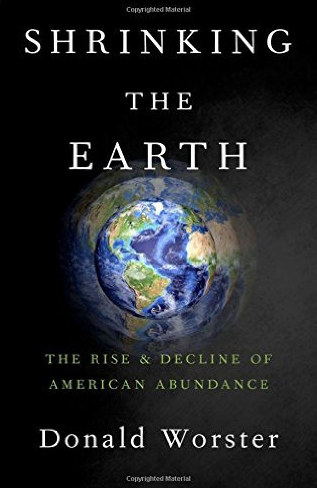 I argue in my new book Shrinking the Earth: The Rise and Decline of American Abundance (Oxford University Press, 2016) that the United States is in the early stages of reinventing itself to grapple with those changing demographic and environmental conditions. Its institutions, social relations, values, and beliefs are all under siege, along with those of other countries around the world, reflecting the end of an expansion era that has lasted, with varying rhythms of intensity, for five centuries. Looking back, we have to acknowledge the power of the earth’s materiality, but not merely in terms of cooling and warming climates or changing oceanic currents or erupting biota or shifting plate tectonics. The ecosphere is more complicated than any of those factors—it is nothing less than the sum total of their interaction. How nations rise and fall, or simply change, depends on how we live within that whole material cosmos around us.
This article was first published on the History News Network .