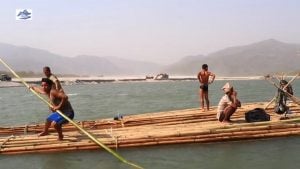
![<p>Waterbased transport is already in extensive use by locals of the region such as in Hatsingimari, Assam [image by: CUTS]</p>](https://dialogue.earth/content/uploads/2017/12/Assam-768x529.jpg)
The North East Region (NER) of India looks like an extended arm of the mainland connected through the chicken neck corridor via Siliguri, West Bengal. With more than 4,500 kilometres of international border shared with countries like Bangladesh, Bhutan, China and Myanmar, this region is strategically and economically important being the gateway to farther east. Blessed with pristine scenic beauty and bountiful natural resources, NER had enjoyed attention from traders since the British era. The rivers Brahmaputra and Barak were the main conveyance system through which goods were transported to Kolkata port through undivided Bengal. However, post-independence, new political boundaries dealt a major blow to the existing and flourishing inland navigation system and NER suddenly became disconnected with the mainland in India and gradually went on to become a territory with connectivity hurdles very similar to those of a land-locked country.
Road networks have an advantage over rail networks in terms of offering last mile connectivity. In the case of NER however, routing through the chicken neck corridor in Siliguri coupled with poor condition of roads has escalated both transport costs as well as time taken. Annual flash floods in Brahmaputra and Barak also wash off roads and transport infrastructure. The river network systems, on the other hand, offer natural and centuries-old navigation channels connecting the NER region. For instance, in Assam, where the Brahmaputra traverses the state across its length with multiple channels, inland water transport is the major means of conveyance for people. Such conveyance, other than serving a large rural population in the state, is also the sole mode to connect to the main land for those living on the small alluvial formations in the mid channels, called chars.
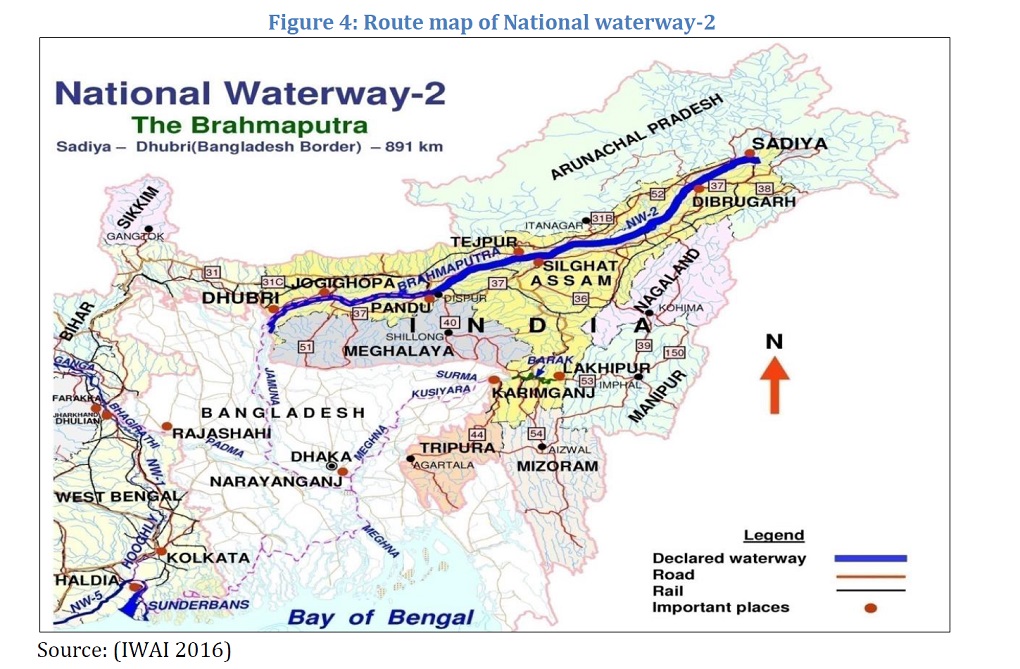
Of late, the government of India has shown a renewed focus on reviving inland navigation, as it is cost effective and environment friendly. The National Waterways Act 2016 declared 106 new waterways as national waterways (NWs) in addition to the existing five NW. Among these, prime attention is being given to NW-1, (1620 km of Ganga from Haldia to Allahabad) followed by NW-2 which is 891 km of Brahmaputra from Dhubri to Sadiya falling in the state of Assam. Feasibility studies are also being undertaken in NW-16, the Barak river (121 km from Lakhipur in Cacher district of Assam to Bhanga, Karimganj). Both these rivers are also part of the India- Bangladesh Protocol Routes for Trade and Transit (PIWTT), Kolkata- Shilghat and Kolkata- Karimganj respectively.
Trade via waterways
As of now, the major cargo transported through NW-2 comprise of food grains, electricity generation and transmission equipment, fertilisers, building material and bamboo. The trade volume in NW-2 is minimal compared to NW-1 as there are no major industries in the NER along the river bank. Commodities like tea which were transported through waterways during the colonial period are now being transported through roadways as it takes considerably lesser time to reach Kolkata by road and is also perceived to be more secure and predictable in terms of supply chain management factors. However, the scope for project based cargo via this route is projected to be high as there are several hydro and thermal power plants coming up in upper Assam and Arunachal Pradesh.
A joint study by Inland Water Authority of India (IWAI) and RITES has estimated that there will be significant movement of cargo by 2031-32 at Joghighopa (10.03 million tonnes (MT), comprising mostly of coal) and Pandu (14.63 MT consisting of food items, cement, coal, fertilizers and building material). While looking at the transit cargo movement through PIWTT, it is evident that significant quantities of fly ash and food grains are transported through Kolkata–Karimganj route whereas it is mostly over dimensional cargo that is transported via Dhubri, in addition to food grains. Given the recent thrust on infrastructure development in terms of roads, railway, waterways and power generation in the North East, easing of navigation through NW-2 promises substantial gains in terms of commercial and environmental costs.
Furthermore, a considerable volume of commercial goods is already being transported across shorter stretches along the NW-2 in Assam which is dominated by the unorganised sector. For instance, in lower Assam, which is marked by a number of small islands, day-to-day necessities are transported by the unorganised sector for the stretches between Dhubri to Hatsinghimari and Phulbari near Meghalaya. As per estimates by the central government, unorganised sector contributes to 23.21% of the total passenger and goods transport in Assam. This indicates that promoting the use of waterways can lead to greater economic activities along the river banks by communities, which in turn will have positive impact on local economy and livelihoods.
In the face of such prospects, there are challenges to effectively utilising the waterways in the region. This include heavy siltation, shifting channels, lack of adequate depth of water during the lean season, constraints in night navigation and absence of other navigation aids in many parts of the channels in Brahmaputra and Barak rivers. Also the links to other forms of connectivity, such as roads and railways as well as digital connectivity (mobile, phone, internet) that can help raise optimise the benefits of the waterways in the region.
Tourism prospects
River-based tourism is yet another prospect that the region has and there has been some movement on this in the recent times, particularly with India and Bangladesh signing a MoU on operating cross-border river cruises along protocol routes. The NER has wonderful potential for nature, cultural and adventure tourism; there are very strong prospects for religious tourism involving Nepal, Bhutan, Myanmar and India, with particular reference to Bodhgaya (Bihar), Kushinagar (Uttar Pradesh) and Lumbini (Nepal) for Buddhist circuit. There is also immense potential for nostalgia tourism for people on both sides of the border in Bangladesh, West Bengal, Assam, Tripura and the likes and also for war tourism in NER and its surrounding, particularly for Japanese and Chinese nationals.
The tourism prospects of this region can lead to inclusive development given that tourism links and relies heavily on local natural resources, culture, cuisine, art, and history to draw tourists. This, in turn, promises enhanced livelihood and economic opportunities for local people as well as external agencies. In a nutshell, tourism has the potential to effectively connect the BBIN sub-region with Myanmar, building people-to-people connectivity, trust and inclusive economic prosperity.
The picture on larger connectivity
Recent developments like the signing of Memorandum of Understanding (MoU) between Bangladesh and Bhutan (2017) on the use of inland waterways for bilateral trade and transit cargo, as well as on passenger and cruise services on the coastal and protocol routes between India and Bangladesh, makes it evident that inland navigation is gaining greater traction in the Bay of Bengal sub-region. The agreement between India and Bangladesh on the development of a fairway from Sirajganj to Daikhowa and Ashuganj to Zakiganj on Indo-Bangladesh protocol would pave way for year round navigation in these routes. This will facilitate bilateral and transit trade, a large part of which will move through NW-2 in India.
The predominantly agrarian economy of NER as well as the bordering areas of Bangladesh, Bhutan, and Myanmar, poses a restriction with regard to the kind of cargo generated in the region, but the same can be turned into a substantial advantage through promotion of regional value chains, particularly on agricultural and horticultural products. The region known for its exotic fruits, vegetables, and spices, can find a market both within the sub-region and beyond, particularly farther east, if well-connected. But the absence of better connectivity and smooth and predictable supply chains is a major hurdle to realising such potential. The short shelf-life of these perishable goods makes them less profitable due to the inland transport system, which in its present state, is not equipped in terms of timely delivery owing to multiple infrastructural challenges.
Hence developing an integrated transport plan with special emphasis on multimodal connectivity would open up this isolated region to its neighbours and rest of the world, with the prospect for substantial gains in terms of economic growth, new livelihood generation and prosperity, leading to political and social stability. At present, Pandu is the only port with multimodal connectivity in NW-2; the IWAI is presently considering a proposal to develop a multimodal terminal at Joghigopa as well. This will provide Bhutan easier access to NW-2 by road and from there to Bangladesh via waterways. The entry points to India by road could be Phuentsholing, Gelephu, or Samdrup Jhongkar and the potential export cargo for Bhutan are boulders, gypsum, and limestone.
With regard to Myanmar, in the absence of a transboundary river flowing between India and Myanmar, the Kaladan multimodal project connects Kolkata to Sittwe port by sea (539 km), from there to Paletwa through river Kaladan (158km) and finally to Zorinpui at Mizoram border by road. The proposed NW-16 in Barak river which extends from Bhanga to Lakhipur (close to Manipur) would connect Manipur, Mizoram and Nagaland by road. The Chindwin river of Myanmar runs close to the Indian border states of Manipur and Nagaland. While Chindwin faces similar issues of year round navigability, the Myanmar government is exploring possibilities of dredging sections of the river subject to resource availability. If appropriate connecting links with other modes like roads and railways could be established near Chindwin, it can open up the possibility for building a region-wise cross-country multimodal network for both cargo movement as well as tourism development.
Conclusion
The development of inland waterways in India has to be in tandem with the larger connectivity development plans happening in the Bay of Bengal region. A comprehensive approach wherein regional waterways development is aligned with other major developments like the East West corridor, Trans Asian Highway and the Trilateral Highway is the need of the hour. With the recent policy thrust to “Act East” and the slew of infrastructure development projects that are coming up in India as well as the region, NER stands to gain majorly. However, for such gains to happen it is equally important to see that bigger visions at regional and national levels are matched and aligned with ground level realities and needs. Such vision alignment will help the long neglected NER to integrate with economic growth centres and networks both within India as well as in adjacent countries, which in turn, would create positive changes in the local economy and bring back the glory of old days.