![<p>The Nodi Boithok meetings in Bangladesh along the Brahmaputra are empowering local communities [image courtesy: TROSA]</p>](https://dialogue.earth/content/uploads/2019/03/Nodi-Boithok_1-768x512.jpg)
Afazuddin is not catching as many fish on the Brahmaputra in Bangladesh as he used to and does not know what to do. Ambia Begum is leading her village in installing embankments to control erosion on Jinjiram river, near the Brahmaputra. One voices his concerns, and the other becomes the leader she is at the Nodi Boithoks (river meetings) held in the village.
“Leaving no one behind” – that is the call being given this year on World Water Day, March 22.
But how is that to be done? Billions of people around the globe live without access to safe water. When decisions related to water and river governance are taken, they overlook the river communities and marginalised groups such as women, children, refugees, indigenous peoples, disabled people and many others.
In South and South East Asia, over 750 million people depend on the transboundary Ganga-Brahmaputra-Meghna (GBM) and Salween basins for water, energy and food. Rivers connect nations and provide the means for trade. They also support a wide variety of ecosystems now under threat due to unregulated infrastructure developments, unplanned land use practices and climate change. Conflict and lack of cooperation leave poor and marginalised riverine communities even more vulnerable. People living on riverbanks struggle every day to gain access to water. Their fundamental right to water is not ensured by current models of governance and development. Riverine communities are not organised and do not have the capacity or knowledge to influence policy decisions.
Some attempts are being made to address the situation. NGOs are coming forward to raise awareness and mobilise riverine communities to realise their rights on water. With support from Oxfam’s Transboundary Rivers of South Asia (TROSA) programme, riparian communities in Bangladesh, India, Myanmar and Nepal, are now engaging with local authorities so that their voices and concerns are reflected in water resources management. That is how Afazuddin can voice his concerns and Ambia can become a leader.
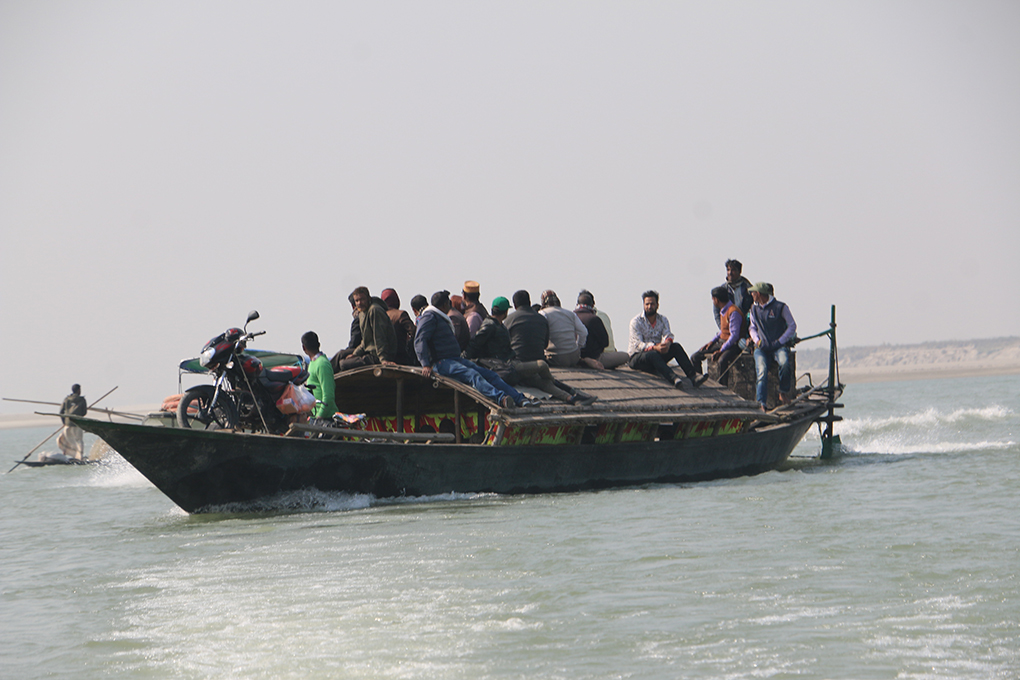
It is not easy to reach Foluarchor in north-western Bangladesh. From Rangpur, the big town in the region, it is a three-hour drive to the Chilmari riverport in Kurigram, then an hour-long boat ride avoiding sandbanks on the Brahmaputra before reaching the village just a little downstream of Dhubri in India.
Most residents of Foluarchor live by fishing, but the catch keeps going down. Flash floods and river bank erosion add to their plight. The community did not have any platform to voice their plight till they came in touch with a local NGO Gana Unnayan Kendra, a TROSA partner. Now they hold regular Nodi Boithoks during which they identify water governance challenges and work to influence authorities to ensure they have access to water resources and the river. They talk of river bank erosion control support, fishery rights, access to inland water transport, and unplanned and unregulated sand and gravel extraction. They come up with plans of action.
At the Nodi Boithok I attended in Foluarchor, we heard many reports about the struggles of the community and how people are trying to cope. Afazuddin is a local fisherman whose whole family lives on fishing. However, due to the changing nature of the river, his catches are decreasing. Afazuddin blames it on the siltation of riverbeds and construction of dams and bridges.
The annual ban on catching Hilsa to protect brood and juvenile fish affects him and his family as the compensation package provided by the government is not enough to sustain them. Now the Nodi Boithok provides him with a channel to talk to the local government representatives about his problems.
New women leaders
Close to the mighty Brahmaputra, Jinjiram is a small transboundary river that runs through India and Bangladesh. On its bank, Namapara village looks timeless. But there are changes underway, as the next Nodi Boithok brought out.
Flash floods, bank erosion and construction of a dam upstream in India are changing the character of the Jinjiram. There is less water, and Namapara residents felt helpless till the Nodi Boithoks started. Now they know who to talk to.
Perhaps more important, these meetings have brought Namapara women to the fore. Like women elsewhere in the developing world, they always played a critical role in providing, managing and safeguarding water resources. But, they were not given any role in the management of the river and water resources.
That has changed. Ambia Begum, mother of a four-year-old, dropped out of school when she was married, and had not thought of life beyond household chores. Now she leads the community, not just in raising awareness about water rights but also through activities. Recently, the residents installed Bandals – an indigenous method of protecting the embankment – to save their village from erosion. It worked, and more women are joining the movement to voice their views. Ambia is now thinking of running in the local government election.
Foluarchor and Namapara show that given the opportunity, local communities, including women, can stand up for their rights. Nodi Boithoks are creating for a space for dialogue and cooperation between residents and policymakers. The evidence gathered from these meetings is now being compiled and communicated to policymakers at local as well as national levels.
By building on this process across river basins, especially transboundary river basins, communities and governments can create a more inclusive water governance system in the region. The United Nations Sustainable Development Goal 6 clearly states there must be water for all by 2030. World Water Day gives us an opportunity to change the prevailing narrative and move towards that goal.