



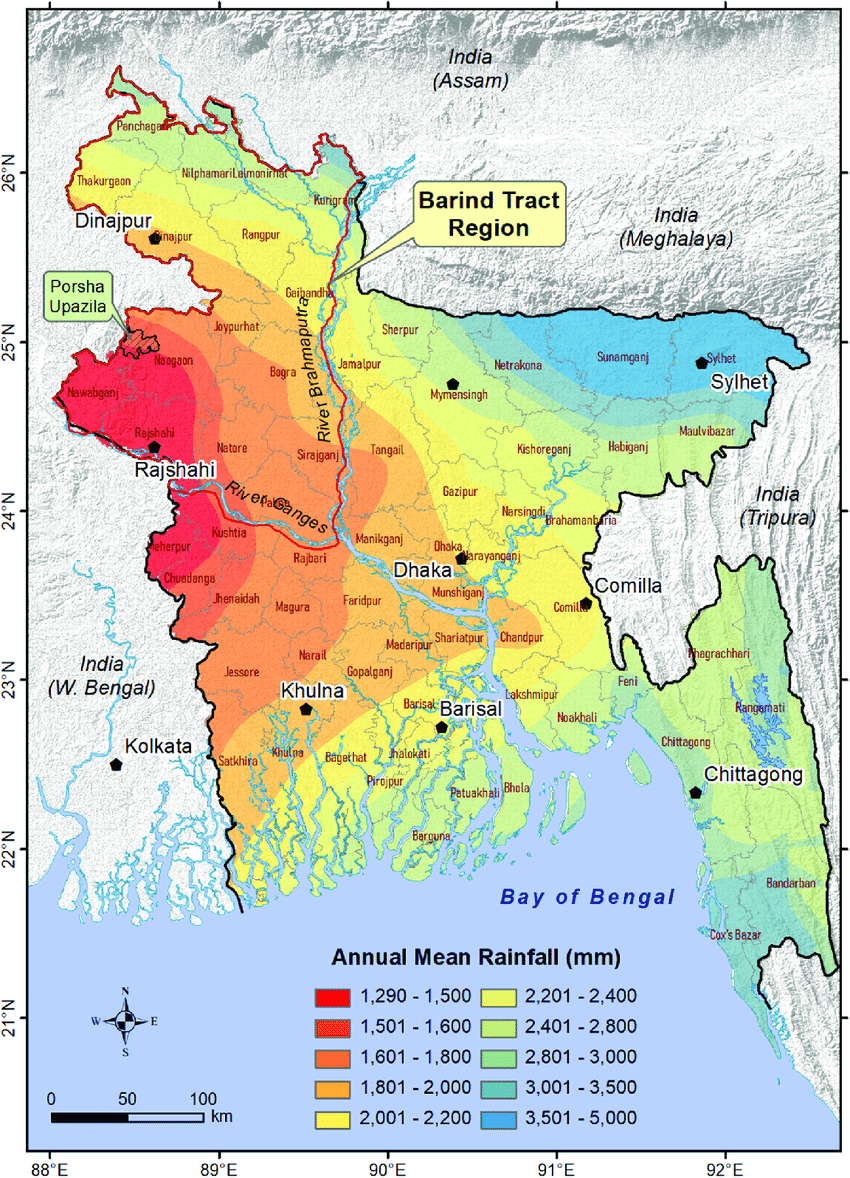
The Bangladesh government is about to declare a “state of water emergency” in the drought prone Barind tract in the northwest of the country, where over-extraction of groundwater for rice farming and dwindling rainfall caused by climate change have combined to create a crisis.
Officials hope that by declaring a state of emergency they can continue to ration irrigation water and force farmers to shift to growing less thirsty crops, slowing the dramatic decline of groundwater levels in the relatively highland region.
The Barind Multipurpose Development Authority (BMDA), the department within the Ministry of Agriculture responsible for irrigation across the 34,359 square kilometre region, has called for a state of emergency.
“We initially proposed five sub-districts – Nachole, Tanore, Gomostapur and some portions of Godagari and Porsha – under the three districts of Rajshahi, Naogaon and Chapai Nawabganj to declare an emergency,” said BMDA chairman Akram Hossian Chowdhury.
Authorities want to use this opportunity to gradually shift farming away from boro rice paddy to less water intensive crops like oilseeds, maize and others, he added.
Rice sucks land dry
The Bangladesh Rice Research Institute (BRRI) estimates producing one kg of boro rice uses about 3,000 litres of water, while wheat and maize use about 400 and 600 litres per kg respectively.
The Barind tract – consisting of 16 districts of Rajshahi and Rangpur divisions – is a relatively dry region of Bangladesh. There is less rainfall here than elsewhere in the country, so farmers depend on irrigation to grow at least two crops a year.
Since its formation in 1985, the BMDA has been supplying irrigation to the region by extracting groundwater from 16,000 deep tube-wells.
Since then, agricultural production has increased at least three fold in this zone.
Boro rice production in Rajshahi region grew from 96,000 tonnes in 1980 to about 300,000 tonnes in 2015, according to national statistics.
Currently, Bangladesh produces 33.8 million tonnes of rice a year, of which boro contributes 18 million tonnes.
But major irrigation abstraction for rice production has led to a dramatic drop in the region’s groundwater table, especially in the higher Barind tract – covering about 7,500 square kilometres in Rajshahi, Noagaon and Chapai Nawabganj.
The groundwater table has dropped from 3.5 metres in 1980 to 25 metres in 2017 in Nachole, a sub-district in Chapai Nawabganj district, according to the Bangladesh Water Development Board.
The scenario across the entire zone is similar.
Water rationing
In the 2018-19 fiscal year, the BMDA provided irrigation to about 900,000 hectares of land in 16 districts. Of them, about 560,000 hectares are in the high Barind tract.
The BMDA has rationed irrigation during the lean season in water scarce areas since 2014 to prevent overuse. For example, it supplies irrigation water for boro paddy in each area every other year. This has led to major losses for farmers.
Consequently, rice production has dropped by about 40,000 tonnes in Rajshahi district over the last five years.
Abdullah Ali, a farmer from Nachole, said, “Since my childhood, my father has cultivated two rice crops – aman and boro – on our land every year. Nowadays we get water for boro every other year. This ultimately reduces our income, as [boro] paddy produces more than any other rice.”
Meanwhile, the irrigation authority and the department of agriculture are trying to encourage the farmers to shift their crop cultivation pattern from rice to maize and vegetables to save groundwater.
Yusuf Ali, from Tanore sub-district, has shifted to producing maize on his one and a half acres of arable land for last few seasons.
“Last season I grew about 100 maunds (370 kgs) of maize making a profit of about 25,000 Bangladeshi Taka (USD 294). It is more profitable than boro, but it does not give me a sense of security because rice production gives us annual food supply at least,” he said.
Sarwar Jahan, a geology professor from the University of Rajshahi, has been working on the Barind tract’s water crisis for many years. He welcomed the government’s move to declare a water emergency. Otherwise the region will lose its agricultural production in future, he said.
The government should also introduce appropriate cropping patterns in the country based on water availability and quality, he suggested.
Draining the Padma
To ease the drought situation, the BMDA has also been draining about 300-cusecs of water from the nearby Ganga river, known locally known as the Padma, for the last couple of years. It has pumped up a lot of water from the Mahananda river as well.
The water is piped to different canals to be stored and used for irrigation on nearby agricultural land.
The BMDA has been draining about 150 million litres of water from the Padma during the winter into the Sarmongla canal programme to serve 353 hectares of arable land in Godagari and Rajshahi.
But this method is only possible for areas adjacent to the rivers. River diversions are not a long-term solution for most of the Barind tract, said Jahan.
Less rainfall
Drought is a common phenomenon in this part of Bangladesh. The average annual rainfall in Barind area is about 1,100 millimetres, compared to a national average of 2,550 mm.
On top of this, the Barind area has seen less rainfall over the past four decades. Average rainfall during the monsoon has fallen by 24-31%, 36-41% in the summer and 86-115% during the winter, according to analysis of rainfall data from 1980-2018. Scientists have drawn a correlation between climate change and the weakening of the monsoon that brings most of the annual rainfall to South Asia.





![Forest fire near Ramgarh, Uttarakhand [Image by: Joydeep Gupta]](https://dialogue.earth/content/uploads/2020/03/Forest_Fire_Ramgarh_JG-300x200.jpg)
![Farmers carry a sack of harvested clover to feed their animals, near Khuspur village, Punjab Province, Pakistan [image: Alamy]](https://dialogue.earth/content/uploads/2020/03/E62ENH-300x200.jpg)