


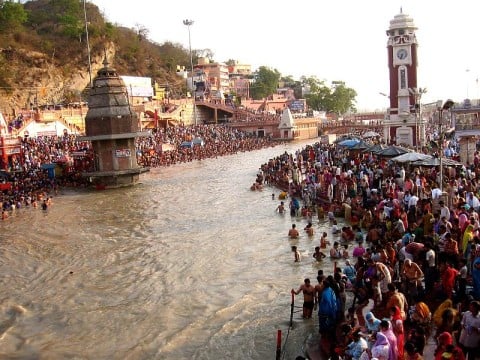
Arun Jaitley, India’s finance minister, marked his maiden budget presentation on Thursday by allocating the large sum of Rs 2,037 crore ($338 million) on what he called an Integrated Ganga Conservation Mission, to be titled Namami Ganga. Green activists remained rather unimpressed.
Of this amount, Jaitley allocated Rs 100 crore for development of ghats (steps) and riverfronts in Kedarnath, Haridwar, Kanpur, Varanasi and Delhi. New Prime Minister Narendra Modi, who has been elected from Varanasi on the banks of the Ganga, had promised this step during his campaign. The government has recently held an all-day conference with Hindu seers and environmentalists on how to clean the Ganga, and this job has now been moved from the environment to the water resources ministry.
Jaitley said that there were many non-resident Indians who wanted to donate money for the Ganga clean-up, and he was going to set up a dedicated fund for that.
But some environmentalists were quite worried about parts of the Ganga rejuvenation plan. Himanshu Thakkar of the NGO South Asia Network of Dams, Rivers and People (SANDRP) said, “On Ganga, the budget mentions one of the most disastrous initiatives, which is development of inland waterways. They plan to put a barrage after every 100 km for the entire 1600 km stretch. And massive dredging will take place. Currently there is just one barrage – Farakka Barrage and that too has already been a disaster for the river. It has destroyed fisheries both upstream and downstream. And now if these barrages come up, fisheries, dolphins will vanish downstream. They have not done any EIA (environment impact assessment) before announcing this. I wonder how they are going to rejuvenate the Ganga.”
The plan mentioned in the budget is for a project on the Ganga called Jal Marg Vikas (National Waterways-I) between Allahabad and Haldia, a distance of 1,620 km, which will enable commercial navigation of at least 1,500 tonne vessels.
On the plan to develop and beautify ghats, Thakkar said, “I fear they will try and bring the model of Sabarmati here. What they have done on Sabarmati is they have put concrete walls on both the banks and a large chunk of riverbed – around 200 hectares – got left outside the walls where buildings have come up. The river has been constricted. The flood resilience capacity of the river has been reduced. Even in the context of climate change, it is worrisome as all cities will experience greater flood intensities in future.”
The Bharatiya Janata Party which heads the new government has had a controversial pet project for decades – to interlink all the rivers of India. Jaitley said in his budget speech that he was earmarking Rs 100 crore for a project report.
Reacting to this, Thakkar said, “We don’t want river linking. NWDA (National Water Development Agency) which was supposed to look into only this has not produced a single worthwhile document that can pass public scrutiny. They are afraid to put them in public domain. Right now they have proposed 100 crores, but the unplanned budget for this will be even higher.” In the 22 years since it was founded, none of the NWDA documents is in the public domain.
There was another scheme in the budget which made the greens see red. The finance minister said he would allocate Rs 50 crore to accelerate the construction of the Renuka dam in Himachal Pradesh. The dam is meant to augment water supply to Delhi.
Thakkar said, “This is very problematic. Renuka dam doesn’t even have forest (ministry) clearance. NGT (National Green Tribunal) has in fact put a stay on the dam. How can the finance minister talk about expediting the project when their own environment ministry hasn’t given the clearance yet? It is an insult of the process of environmental clearance and the Indian judiciary.”
Jaitley did show his awareness of the effects of climate change in India, by setting up a national adaptation fund with an initial corpus of Rs 100 crore. He also announced the establishment of a specialised academic institution to study the ecology of the Himalayas.
But the finance minister did not mention wildlife preservation in his speech, which again upset some environmentalists. Noted wildlife activist Belinda Wright said, “It’s most unfortunate, when there is so much focus in the world on species conservation and environmental security, that there appears to be no mention of this in the new budget.”