Days before the monsoon hits the eastern Indian state of Bihar, farmers wait for rains and floods with trepidation. This year, however, farmers Rita Devi, 63, and Kanchan Kumari, 45, worry about a new threat. What keeps them up at night is the loss of fertile land, and the possible displacement they would face if the government goes ahead with a plan to construct a new embankment on the Bagmati river, a tributary of the Ganga, in the rural districts of Bihar where they live.
Both vowed to continue to oppose construction of the embankment, locally known as bundh, even at the cost of their lives.
“We will not allow the construction of this embankment – if it’s built we will lose our livelihoods and homes,” said Devi, who owns about 1.25 hectares of fertile land around the village of Kalyani in Muzaffarpur district, where thousands of men and women have been protesting against construction of the embankment.

A controversial plan against floods
Activists who oppose the project say that the nearly 4,000 kilometres of mud, sand and stone wall already enclosing Bihar’s rivers to protect the adjacent areas from flooding is not helping the people. In the early 1950s, the total length of the embankment was 160 kilometres, and 2.5 million hectares were considered flood-prone. After adding more flood protection, the flood-prone area has increased to 6.8 million hectares, making Bihar the most flood-affected state in India.
Dinesh Mishra, a renowned river expert in Bihar, explained that the mud walls, which are regularly breached at dozens of places, “[help those with] vested interests, [but] certainly not the people”.
Devi’s plea is echoed by Kumari, who is an elected member of the village administration and owns about 2.5 hectares of land. “If this embankment is built, it would be the end for us,” Kumari said.
Devi and Kumari are among thousands of villagers who have been opposing the construction of embankments since 2012, a movement called Bagmati Andolan. But this year, after the government intensified its efforts to build embankments, the protests have become louder.
Last year in September, the state government approved the construction of a new embankment and elevation of an old embankment under the Bagmati flood management plan. The government envisages an additional 56-kilometre embankment, for which it has already allocated nearly 5.5 billion Indian rupees (USD 5.48 billion).
Loss of fertile land
Mishra said that the people do not accept the government’s argument that the embankment will benefit them. Their fear, he said, “is not baseless”.
“It draws on the lived experience of those displaced when embankments were added in their areas,” Mishra said, adding: “No river basin in the world is as fertile as the Bagmati basin.” Local people have often told him that they want the silt to spread in their fields, “but the embankment deprived them of the natural fertiliser”.
Ranjeev, a water activist in Bihar, said that farmers in flood-prone northern districts used to welcome annual floods because rivers would spread rich silt and water across large areas, helping to fertilise their fields. But since the 1950s, creating artificial banks has become the mainstream policy to control floods. “This ongoing agitation against the embankment also carries a symbolic message,” Ranjeev said. “Farmers see it as a symbol of destruction, because wherever the embankment is built, it harms their fields, pushing them into the trap of poverty and forced migration.”
Jitendar Yadav, a resident of Jagania village near the river, said that villagers have been waiting for two decades for rehabilitation and compensation of the losses they faced due to the embankment. After years-long protests, in 2017 the government was forced to set up a review committee consisting of nine experts, but the committee met only once and failed to reach an agreement, he said.
Safety concerns
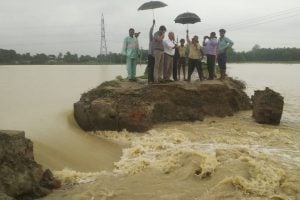
The embankment on the Bagmati has broken as many as 54 times, river expert Dinesh Mishra said, bringing destruction and unpredictable flooding, and there is no guarantee it will not happen again. According to a 2019 Water Resources Department (WRD) report, most embankments on the rivers of north Bihar are breached every year. From 1987 to 2018, 408 breaches were recorded across Bihar’s rivers.
In his book about the Bagmati river, Mishra explains that people have been living in the basin for centuries because of the benefits the river brings to local agriculture. Every year, during the flooding season, the water replenishes the aquifers and spreads silt across the fields, fertilising them. For decades, he has been drawing attention to the risks of building embankments that disrupt the local ecosystem. His book explains: “Silt starts to accumulate between the embankments, which causes the river floor to rise gradually. This in turn raises the water levels, which compels engineers to keep elevating the embankments.”
After the embankment was built, everything changed. Floods have become more destructive, something that had never happened in the years beforeMohan Paswan, resident of Sitamarhi district
Mishra’s analysis is reflected in the experience of villagers in Sitamarhi district, where the Bagmati river was embanked decades ago. Residents Mohan Paswan and Hari Mandal blame the embankment for the drastic loss of agricultural productivity. Not only are the farmers deprived of natural fertiliser, but when the embankment is breached, the subsequent unseasonal flood damages crops, destroys houses and spreads an excessive amount of sand across the fields.
“Our areas were known as a gold mine, with bountiful harvests of different crops after the floods,” Paswan said. “But after the embankment was built, everything changed. Floods have become more destructive, something that had never happened in the years before.”
![The catastrophic floods in Assam in September 2015 [image by Mubina Akhtar]](https://dialogue.earth/content/uploads/2015/10/Assam-floods-300x186.jpg)