![<p>If the Ganga has the legal rights of a person, should people be allowed to bathe in it? [image by: Eric Parker]</p>](https://dialogue.earth/content/uploads/2017/07/Ganga-bathing-Eric-Parker-768x288.jpg)
In March 2017, a court in Uttarakhand, India, ruled that the Ganga and Yamuna rivers and their related ecosystems have “the status of a legal person, with all corresponding rights, duties and liabilities … in order to preserve and conserve them”. But what does this mean and how can a river’s rights be upheld and protected?
ssociate professor of hydroinformatics at the University of Nottingham in the UK, finds that Colombia’s Atrato river, which was awarded rights in May 2017, is a stark reminder that awarding environmental rights is not the same as realising them.
—
Fundamental human rights are now recognised across much of the world. Humans, however, cannot exist without the natural world. So should we also award rights to environmental entities? The idea has gained traction in recent years – and it is rivers that have found themselves at the vanguard of landmark legal developments.
Rivers often have strong cultural and spiritual identities as sacred living entities or life-giving beings. These existential understandings have underpinned legal actions in New Zealand and India that have endowed rivers with rights that are comparable to their human counterparts.
Read more: Can rivers be legal entities?
However, as a river scientist and geographer, it is a case in Colombia that is of particular interest to me. In May 2017, the country’s constitutional court awarded rights to the Atrato, a river that flows through the globally recognised “biodiversity hotspot” of Colombia’s north-western Pacific rainforest.
This ruling is subtly different from the others because the legal arguments emphasise rationalism rather than existentialism. In Colombia, the Atrato river has been awarded rights because of what it provides for human life, not because it should be equated with human life. Its “bio-cultural” rights now include the river’s “protection, conservation, maintenance and restoration”. This places a significant burden on the Colombian state to ensure the rights are enforced, and it demands that local people are empowered to manage their river properly.
Colombia’s political context and its recent civil war makes this particularly challenging. The Atrato is located in the Chocó Department – Colombia’s poorest and one of its most geographically isolated. Despite the 2016 peace agreement between the government and the Revolutionary Armed Forces of Colombia (the Farc), Chocó remains a stronghold for a range of paramilitary and anti-government militia groups who are yet to sue for peace.
Most prominently, this means the militias remain in control of the Atrato basin’s rich deposits of “placer” gold — the gold deposited in river sediment. With the state unable to intervene, illegal mining of this sediment has accelerated unchecked over the past three decades with little effort to mitigate — or even monitor — its environmental impact. The Atrato’s new rights demand it must be protected and eventually restored. But in the absence of comprehensive baseline data, it is hard to know what this means, let alone how it should best be achieved.
Abstract rights … in practice
It is against this backdrop that I travelled to the Atrato basin in August 2017, as part of a small expedition of researchers from British universities and the Chocó Technical University. We were accompanied by lawyers from Tierra Digna, the NGO responsible for advocating for the Atrato. Our objective was to identify how the river’s abstract rights could translate into concrete progress on the ground.
Our focus was on one of the Atrato’s major tributaries, the Rio Quito. Local testimony and recent analysis of satellite imagery indicated that more than 100 kilometres of the Quito’s river channel and floodplain had been almost completely destroyed in less than 20 years.
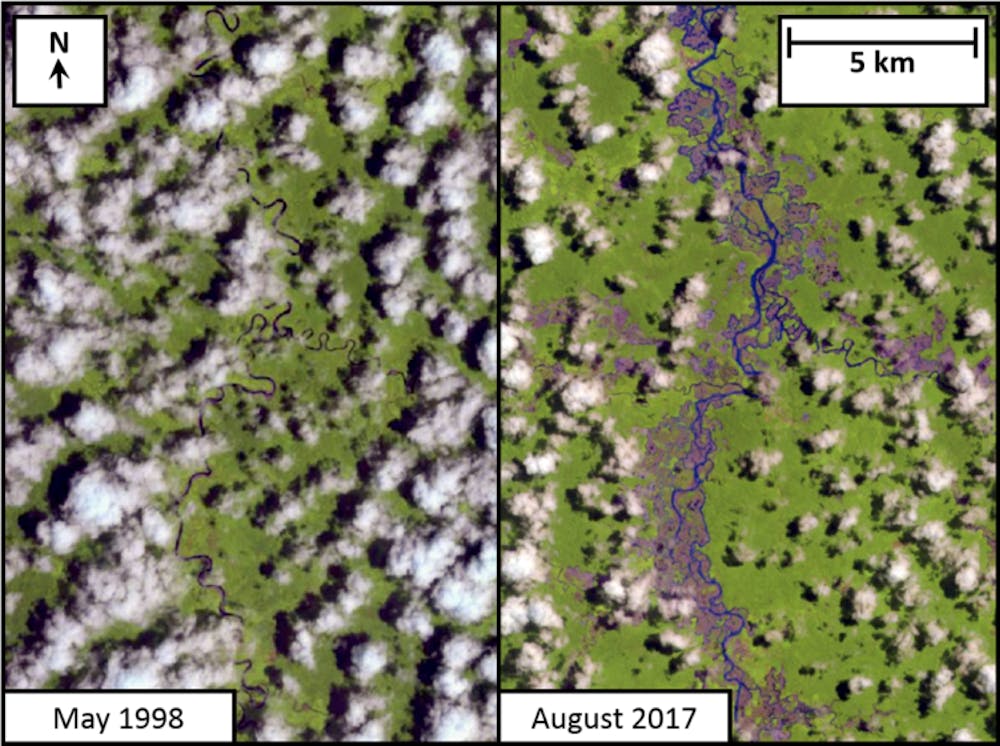
The reality was sobering. River bank deforestation, followed by large-scale mechanised mining, has left several hundred square kilometres of mining waste along the Rio Quito. In some places the ground is heavily contaminated with mercury and plants are unable to re-establish.
Industrial dredgers and excavators have reshaped the river to the point that regular seasonal floods no longer occur, breaking the vital cycle of nutrients and carbon between river and floodplain. As a result, the Quito has become turbid – destroying fish habitats and affecting the quality of people’s drinking water.
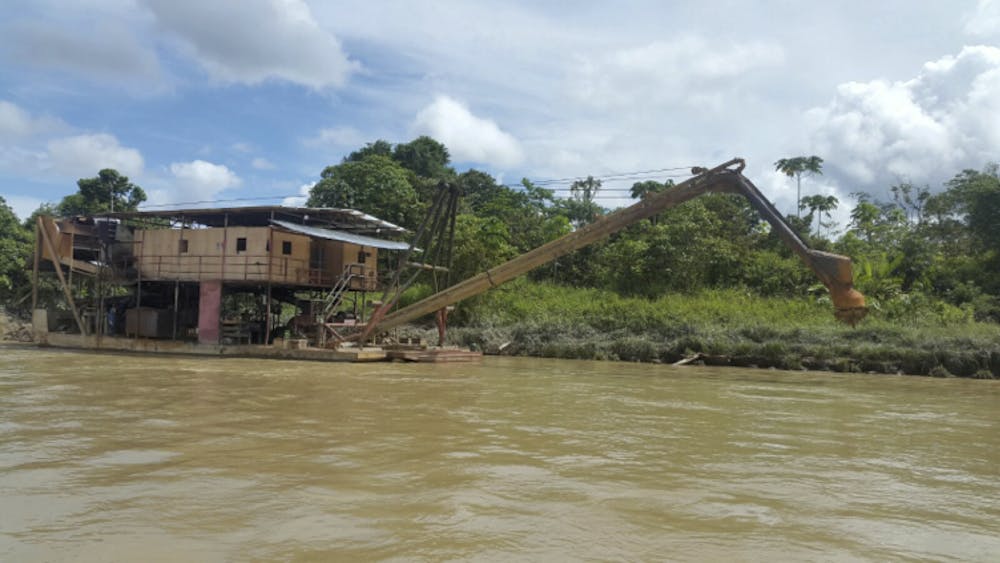
Mining in the Atrato basin has also displaced tens of thousands of Afro-Colombian and indigenous people from their land. Several community leaders who resisted have been injured or killed. Sexual violence experienced by displaced women is a particular problem, and communities have reported birth defects and skin lesions which may be linked to chemical exposure and mercury poisoning.
The Atrato river in general, and the Rio Quito in particular, serve as a stark reminder that awarding environmental rights is not the same as realising them. Such rights do not exist within a vacuum and they will only be fulfilled if political, socio-economic and cultural systems support them.
In the Atrato basin, change could start with effective mapping and monitoring. We need to know where mining contaminants – in particular, fine sediment and mercury – have come from and how much has been released. We also need to understand how gold mining fits into the political economy of conflict and violence in the Department of Chocó. Local communities must also be empowered to be participants in identifying sustainable solutions.
The task is monumental, but if the Atrato river’s rights can be translated into effective action, the river and its communities have the potential to become archetypes for how human and bio-cultural rights can help deliver sustainable futures.
This article first appeared on The Conversation.
We want to hear from you! Tell us what you think about The Third Pole and you could win $100. Take our survey here.