At least three persons were killed, scores of buses, trucks and shops were set ablaze and large parts of Karnataka in southern India were paralysed in the latest bout of violence around the Cauvery river water sharing dispute with Tamil Nadu. Bangalore – Karnataka’s capital and India’s information technology hub – was almost totally shut down for three days. The consequent economic loss has been estimated at INR 25,000 crore (USD 3.74 billion).
The trigger was an order from India’s Supreme Court to the Karnataka state government in early September to release 15,000 cusecs (cubic feet per second) of water from the Cauvery to downstream Tamil Nadu every day till September 20. After two days of violence, the court reduced the figure to 12,000 cusecs a day, while sternly rebuking the Karnataka government for its failure to maintain law and order.
The Cauvery water dispute has a long and bitter history. Its implications now go beyond India. The failure of the authorities to implement orders of statutory tribunals or the judiciary has left India’s neighbours dismayed once again. They want agreements with India on transboundary rivers – especially those in the Ganga and Brahmaputra basins. But they are once again unsure whether India will have the inclination to enter into agreements, or the ability to implement any agreement that may be signed.
There were many water experts from Nepal and Bangladesh gathered in New Delhi for an International River Symposium while the violence over Cauvery was at its height. All were wondering if there was any point in discussing equitable water sharing arrangements or sustainable joint river basin management in the current situation.
One expert from Nepal said, “Let India sort out its own problems first. There is no point in talking to the Indians before they do that.”
Another expert from Bangladesh said, “Now I understand why India could not sign the Teesta agreement despite the best efforts of the central government. India’s federal structure may be good on paper, but it is definitely not to the benefit of Bangladesh.” The signing of the Teesta agreement was stymied at the last moment by the government of West Bengal.
See: Fresh hopes for a Teesta water-sharing pact
Under India’s federal Constitution, water is a state subject, while inter-state and international rivers are central subjects. This has led to much confusion, and constitution reform committees have suggested that water be moved to the “concurrent” list, so that the centre can have a bigger say. But state governments have consistently opposed any such move. With the Bharatiya Janata Party (BJP) – now in power at the centre – professing to make India more federal, there is little possibility of any change in the foreseeable future.
Refusal to share shortage
At the core of the latest violence is the refusal by Karnataka’s politicians to have a more equitable share of Cauvery waters in a season of shortage. This year, India has had a near-average monsoon so far, but the national average masks many local shortages. Over 90% of Karnataka has had deficit rainfall so far in this monsoon season, which usually lasts from mind-June to mid-September.
See: Water levels plummet in Indian reservoirs
The result is that reservoirs in the Karnataka section of the Cauvery basin are as half as full as they should be. It is exactly the same situation in downstream Tamil Nadu, which is in the monsoon rain shadow anyway, and gets most of its rainfall in winter.
In this situation, the Supreme Court effectively ordered the two states to share the pain. Given the record of all powerful political parties in Karnataka – Congress, BJP and Janata Dal (United) – the violence after the court order was perhaps predictable. The Congress is now in power in the state.
Political parties in Tamil Nadu – the All India Anna Dravida Munnetra Kazhagam (AIADMK) and Dravida Munnetra Kazhagam DMK) being the largest – have been just as intransigent. The AIADMK, now in power in the state, did not change its attitude one iota this time.
India’s top expert on the Cauvery dispute, S. Janakarajan of the Madras Institute of Development Studies (MIDS), is convinced that there will be no solution as long as the political parties call the shots. Commenting on the situation two days after the violence broke out, he told thethirdpole.net that farmers in Karnataka were not responsible for the violence, though they were being blamed for it. “This violence is being instigated by political parties that practise vote bank politics, and is being carried out by professional hooligans. Which farmer will set a bus on fire when he knows that means there will be no bus service to his village? Which farmer will come all the way to Bangalore to set shops on fire?”
Farmers’ dialogue the solution
In an effort to find a solution to the Cauvery dispute, MIDS convened a series of dialogues between farmers of Karnataka and Tamil Nadu from 2003 to 2011. Pointing out that there was no violence during this period, Janakarajan said one of the main requirements was to remove the misinformation fed to Karnataka farmers by politicians.
For example, farmers in Karnataka have long been told that farmers in the Cauvery delta (in Thanjavur district of Tamil Nadu) grow three crops a year. But the farmers in the delta do not have water for more than eight months in any year. So they can grow either two short duration crops or one long duration crop.
Also, farmers in Karnataka have been told there is significant unexploited groundwater irrigation potential in Tamil Nadu, but data from the Central Groundwater Board shows that almost all groundwater is being used, and there is considerable overexploitation of groundwater.
As a result of such misinformation, farmers in Karnataka want farmers in Tamil Nadu to shift from rice to less water intensive crops. But what they have not been told is that salinity in the delta makes the soil unfit for most other crops.
It is this kind of misinformation that the meetings between farmers managed to remove, but the politicians put a stop to the initiative. This development has not been lost on water experts from Nepal and Bangladesh either.
Bitter history
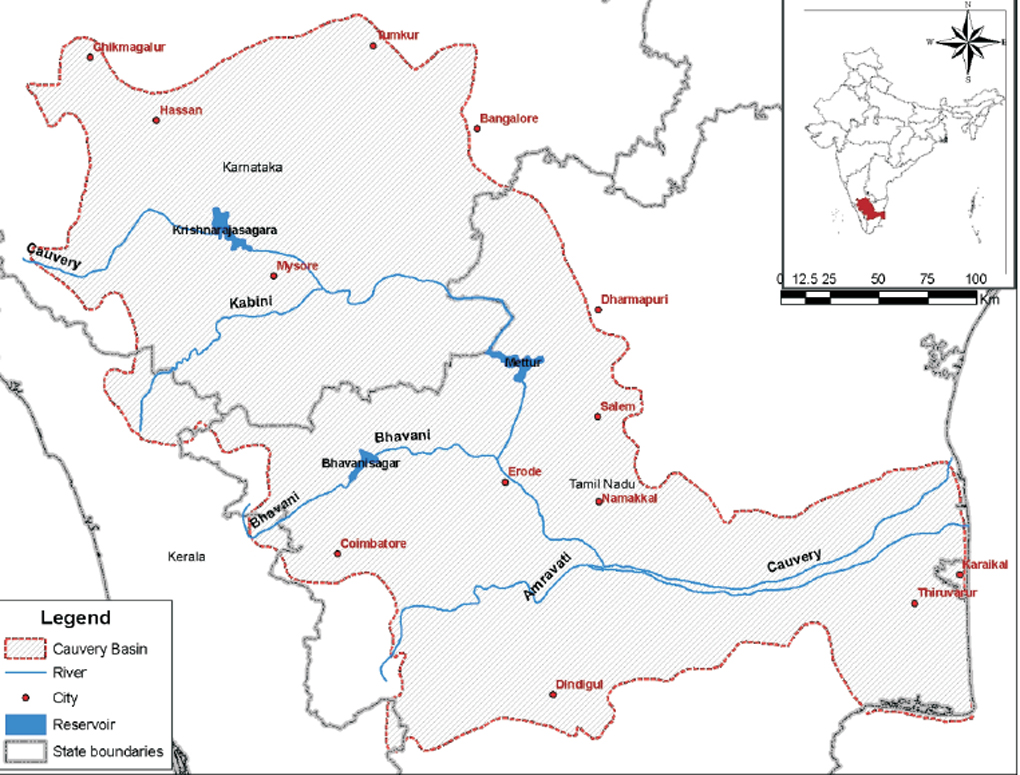
There have been agreements between Karnataka and Tamil Nadu (in the previous incarnations of their governments) over Cauvery waters in 1892 and 1924. The relationship has never been smooth, but the modern history of the dispute can be traced back to 1974, when Karnataka refused to renew the 1924 agreement; instead, it built four reservoirs on tributaries to Cauvery despite the entreaties of the central government and the refusal of India’s then Planning Commission to give any money for it.
After years of turmoil, the Cauvery Water Disputes Tribunal was established in 1990 and gave its final award in 2007, only for both Karnataka and Tamil Nadu governments to appeal against the order in the Supreme Court. The case has been in the court since then, with lawyers for Karnataka arguing for upstream rights, while lawyers for Tamil Nadu invoke the doctrine of prior appropriation, since most of the older dams and irrigation canals are in that part of the basin.
There is no legal solution in sight. Another attempt at a political solution was made with the setting up of the Cauvery River Authority, with the Prime Minister as its chair and chief ministers of all riparian states as members. But neither the authority nor its monitoring committee has been functional much of the time, especially during crises.
Ramaswami Iyer, the doyen of India’s water experts – who died last year – used to say about the Cauvery dispute: there cannot be a hierarchy of rights based on which state is upstream or which state has older irrigation projects. The only option is equitable share of available water.
Janakarajan points out that the Cauvery basin is a water deficit basin, where the total claims of all state governments is nearly double the volume of water available. And that volume is going down due to changes in the coffee plantations that dot the watershed of the Cauvery.
See: Climate change measured in coffee rain.
All experts agree that the solution lies in convening more meetings among the farmers, the primary users of Cauvery water. Some observers feel that such meetings will have to be convened despite covert opposition from political parties.