



Last month, Princess Charlotte, the newest addition to the British royal family, was christened with water brought from the polluted Jordan River, the most holy and contested transboundary river in the Middle East.
It is believed that the tribes of Israel crossed the river to enter the Promised Land after years of wandering in the desert. It is also where it is believed that Jesus Christ was baptised by Saint John.
Today the water may still be considered holy, but it is anything but clean. Polluted with sewerage and industrial waste, it had to be stringently sterilized for the princess. But the half-a-million Christian pilgrims, who flock to the river every year, do not give this a moment’s thought as they dunk themselves straight into the muddy water for the baptism ritual.
The 200 kilometre-long Jordan River passes through a region riddled with geopolitical and religious conflicts forming the border between Jordan and Israel and the Palestinian West Bank.
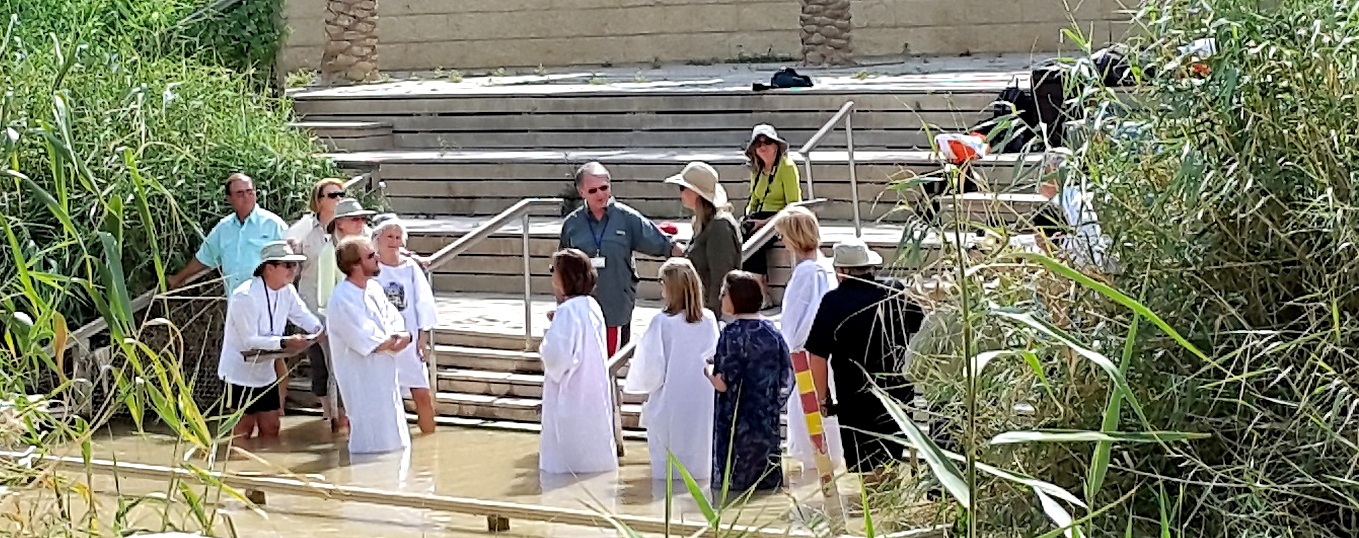
The baptism site on the east bank of the river in Jordan was once a restricted military zone. It has only recently been opened to the public with evidence from archaeological excavations that this was the place where Jesus was baptised. Last year Pope Francis became the third pope to visit since 2000.
Once a river of rapids and cascades, today it has been reduced to a trickle. Since the mid-1960s, 95% of its fresh water has been diverted for irrigation and development projects – half of it by Israel and the other half by Syria and Jordan. And water quality has sharply deteriorated, with raw sewage and agricultural run-off polluting the remaining water.
While this has affected the whole river basin, experts say Palestine has suffered the most, since it never benefited from water diversions. Today, all it gets is the sewage.
But it is not just the river that is ailing. The entire Jordan Rift Valley, located in Israel, Palestine and Jordan across which the river flows, suffers from poverty and neglect, according to Gidon Bromberg, Israeli director of EcoPeace Middle East, a regional environmental group that has been working to revive the river.
“Historically areas in the periphery are always ignored and national investment does not stretch across. But in this case, because each country borders with the enemy, there is complete apathy; no one cares if sewage is dumped,” Bromberg told thethirdpole.net.
Regional cooperation
In June, EcoPeace released a regional master plan for cleaning up the river at a high-level conference attended by 200 people from all three countries. The environmental group’s 180-page plan was produced independent of governments but with the support of government agencies and politicians from all three sides. It recognises the three countries will have to work together to clean up the river and is the first comprehensive blueprint for what this level of cooperation could possibly look like.

The plan outlines 127 interventions for rehabilitating the Jordan River by 2050 at a cost of US$4.58 million. Cleaning up the river and ensuring its health, equitable distribution of the water, introducing modern farming methods and reviving the ecology so that tourism gets a boost, will all give the local economy a shot in the arm.
The most important part of the plan is building wastewater treatment and sewage networks, said Khalil Al Absi, director of the Planning and Regional Water Unit, Jordan Valley Authority. The Jordan Valley is poor and remote and the political situation has made it difficult to build the necessary infrastructure. As a result, homes have no sewerage connections and waste is dumped by the river.
The presence of high-level policymakers from Israel, Jordan and Palestine at the two-day conference at Jordan’s Dead Sea in June was testament to each country’s commitment to giving the Jordan River a new lease of life.
These included Israeli deputy minister for regional cooperation Ayoub Kara, Palestinian Authority deputy minister of agriculture Abdullah Lahlouh and secretary general of the Jordan Valley Authority Abu Hammour Saad. Mayors from all three countries along with water experts from the World Bank and other development agencies were also present.
Lessons for South Asia
In addition, representatives from India and Pakistan attended to understand why cooperation over shared environmental challenges was so important, given that South Asia also faces water stress. Further, the Indus River, which flows across the two countries, has often been a bone of contention. Experts say that if the two nuclear rivals had not signed a water accord, disputes could have led to a water war.
Yet, despite the commitments from all three governments, EcoPeace remains cautious about the future. “We do expect a backlash; there will be condemnations,” said Bromberg.
Bromberg believes the governments of all the three countries are on board for different reasons: “Palestine is on board for political recognition as a riparian to the river; Jordan is desperate for investment in infrastructure and Israel wants regional legitimacy and is under public pressure to release more fresh water into the river,” he said.
But the biggest obstacle comes from ideological and religious extremists on all sides. “They are a minority, but powerful as they spread fear of the other and fear prevents risk taking,” explained Bromberg. He said implementing the plan required building trust and the willingness to share river water and develop a healthy interdependency, rather than dividing water through separate canals and pipes.”
Dr. Anders Jagerskog, specialist in transboundary water governance at the Swedish International Development Cooperation Agency, said the key challenge is to get countries to engage more actively at a political level: “The importance of the plan may not be in the details of it but how it outlines a vision for cooperation in the Lower Jordan River,” he pointed out.
Building bridges
EcoPeace has been working to rehabilitate the Jordan River for decades. It has also been trying to close political divides and raise awareness of shared water problems. In 2000 EcoPeace set up the “Good Water Neighbours” programme, which brought together communities from Palestine, Israel and Jordan in a campaign to clean the river and put pressure on their local decision makers to invest in cleaning up waterways.
It has been an uphill struggle. According to Bromberg, “It took five years of community work before some mayors felt it was politically safe to meet with the mayors from the other side – and then we get a different mayor appointed and we have to start the process all over again. It was often two steps forward and one step backwards.”
Still, the very fact that EcoPeace has managed to put forward a regional plan that has the backing of all three governments holds a lesson for countries that keep bickering over transboundary water resources.