Many people in Pakistan believe that “only if we had more dams” the floods would not devastate us.
But should we further dam our rivers and damn the environment for the sake of a happy, prosperous and a flood-proof Pakistan?
I begin with a few numbers. The average flow in Indus Basin, famously the five rivers, is approximately 180 billion cubic metres (bcm) a year and almost 75% of it flows during the monsoon.
Past civilizations here were built around the flowing waters – and not vice versa. But so called “water experts”, equipped with borrowed money, engineering and technology, now do the complete opposite. Instead of building our modern civilisation around the flowing waters, they built the waters to flow around it. They tried to tame the mighty rivers through the Tarbela and Mangla dams and make deserts bloom with diversion barrages, flood protection dykes, link canals and so forth. They finally tried to tame the Indus which had flowed wildly for the past 40 million years or so. But this has not quelled the floods.
Why we can’t store flood water
Back to the numbers – the Tarbela dam can hold 12 bcm, Mangla 7 bcm, all other smaller ones combined, another 3 bcm. Kalabagh, if it is ever built, would add a modest 6 bcm. But we are up against 135 bcm during the monsoon. And once the dams are filled, the river is wild again. The 1992 floods downstream of Mangla killed over 1,000 people and affected over 4 million more. While we may argue about the pros and cons of dams, at least they can’t stand in the way of floods.
On top of this, dams lose their storage capacity as they fill up with silt and cannot perform as effectively beyond a couple of generations. But worst of all, dams, diversions, and flood protection dykes deprive wetlands, marshes, riverine forest and groundwater dependent ecosystems of water. These natural ecosystems are like sponges, they absorb water during the wet seasons and gradually release it during the dry season and they perform the most important function of breaking the flood peaks during torrential downpours.
In the short term, it may be an advantage to dry up lands along the rivers and put them to “productive” use. And when these low lying areas are protected by dykes we complacently built dwellings and other infrastructure. In the long run, however, loss of these ecosystems means lost capacity of the river basin to absorb water and break flood peaks. Diversion barrages exacerbate silting process in the river channels which results in rising river beds and reduced flow capacity.
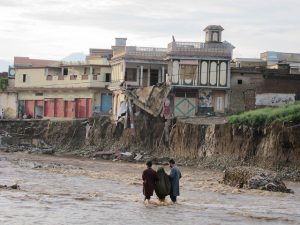
Consequently today, even normal flood events, well within the design capacity of the engineered-system, often spill over the dykes. No wonder the same magnitude of floods in 1929 and 2010 had different consequence such as river avulsions in Sindh.
Perhaps technology and borrowed money gave us more power than our limited knowledge could safely handle. We wrecked our river systems without even knowing. We forgot that a desert is a desert because forces of nature are incessantly at work to expel water from that region, and a river is a river because the forces of nature are continuously pushing the water into this path.
On the one hand, misfortunes befell the poor communities, now stuck in the deserts, when the engineered systems fail to provide them with sufficient water. On the other, ‘floods’ are surrounding people now living in the empty river beds, dried wetlands, and active flood plains, when ‘usual’ waters of monsoon are just passing by.
The concept of fighting and controlling the floods through changing natural systems is out-dated. The world’s leading water experts argue that the “change-fight-control” approach has to gradually, and systematically metamorphose into a “conform-adapt-manage” approach.
Currently, we are sucking our rivers dry by diverting all we can into the agriculture sector, and yet, agriculture demands more water. But to restore our wetlands, marshes, forests and other ecosystems, we need to put the water back into the river. The dilemma is how can we do that without jeopardising the country’s food security and agrarian economy.