



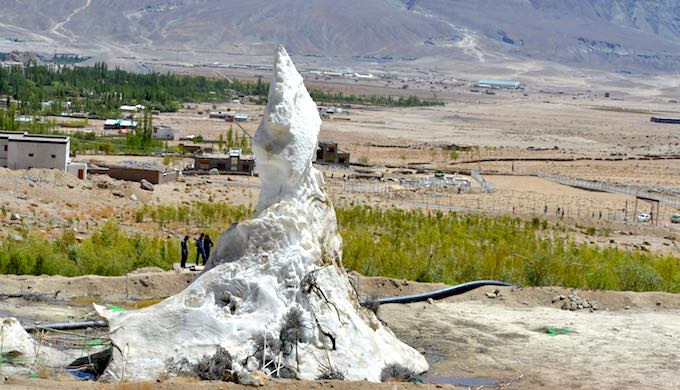
It is early June and the harsh sun beats down in Phyang village in the Ladakh Himalayas of northern India. Yet, two giant artificial glaciers, created in the form of ice stupas by environmental engineer Sonam Wangchuk, still stand tall through the sunny weather. This provides enough water for the village to irrigate their farmland in spring, before the mountain glaciers start melting from late July.
Close to the ice stupas you can hear the gentle dripping of melt water, which flows down through a large pipe connected to a reservoir. The water is then taken to irrigate a large plantation area in the village – an oasis in the dry desert landscape of the Himalayan plateau.
Ice stupas and melting glaciers
In the dry desert of Ladakh, farmers depend on water from melting snow and glaciers. But in recent years there has been very little or no snowfall during the winter. Wangchuk’s invention is seeking to resolve this problem by making water available to farms in spring through artificial glaciers within villages.
Wangchuk shot into prominence by devising a way to create small artificial glaciers, or ice stupas, by freezing stream water during the winter in the form of ice towers up to 50 metres high. His idea, he says, was inspired by the artificial glaciers created by his fellow Ladakhi engineer, 83-year-old Chewang Norphel. Norphel created at heights of 4,000 metres and above, which were very hard for villagers to reach. But Wangchuk found a way of storing water close to the villages. His innovation has not only earned him accolades within India, but globally as well. He was one of five people worldwide to win the Rolex Award in November 2016.
Glaciers in villages
According to Wangchuk, the ice stupas need very little effort and investment and can be used to provide water for agriculture and other uses in early summer.
The ice stupas are formed using glacial stream water carried down from higher ground through buried pipes, with the final section rising vertically. Due to the difference in height, Wangchuk explained, pressure builds up and the water flows up and out of the pipe into sub-zero air temperatures. The water then freezes as it falls to gradually form an ice cone or stupa. In late spring the melt water is collected in large tanks and then fed onto planted land using a drip-irrigation system.
Ice stupas in Ladakh spark conflict
However, the ice stupas are not popular with everyone. The farmers of Phey village downstream say that the water diverted to create the ice stupas deprives them of the water they use for their farms in winter, and which helps recharge the water table.
“They divert all the water of the stream (Phyang Nallah) from November for creating the ice stupas. This is quite dangerous for our farms,” said Sonam Phunsuk of Phey village, who owns several acres of agricultural land. “Every year, we used to put that water on our farms and the wasteland around our village for recharging the groundwater for our use in spring. Diverting the water doesn’t allow us to do so.”
Tsering Motup, another farmer and head of the village, said they have vehemently opposed the diversion of water and have taken the matter to the Leh district administration.
Wangchuk believes their fears are unfounded. “Since it is a new idea, the farmers downstream are afraid that it might hurt their interests. That is why they are opposing the ice stupas,” Wangchuk said. “Generally, new concepts meet resistance until the experts and the administration are able to clear the doubts.”
Finding a solution
The district administration seems to be busy finding a solution. “We will now constitute a committee of experts, which will include hydrologists, glaciologists, government officials and civil society members. We are hopeful that concerns of both the parties will be taken care of,” said Sonam Chosjor, assistant commissioner revenue of Leh district.
Official documents from the office of the deputy commissioner of Leh record the dispute between Phey and Phyang villages over the use of water.
In response to written complaints from the head of Phey village, the deputy commissioner of Leh, Anvy Lavasa, directed that “all the persons directly or indirectly involved with the diversion of water from Phyang Nallah for Ice Stupas shall desist from any act of water diversion,” in a written order on February 16, 2018.
However, the villagers of Phyang, who are benefiting from the water produced by the ice towers, argue that they should be allowed to carry forward the “Go Green Project” with the help of the stupas.
Water for all
In a letter, Wangchuk informed the deputy commissioner that he has a plan to convert both Phey and Phyang villages into a green belt by storing water using ice stupas and reservoirs.
“Phyang Nallah (Phyang stream) has roughly 100 million cubic metres of water flowing through it annually. Of this, both Phey and Phyang village combined use much less than 10 million cubic metres of water over five months (of the farming season),” he has written in the letter. “If we channelize the rest of the wasted water into large lake-sized reservoirs along the hillside on the Phyang desert, then roughly 6 million cubic metres can be stored for later use. Similarly, another 4 million cubic metres can be stored using roughly 50 ice stupas. Yet 80% of the water will [still] go into the Indus.”
In the letter, he explains the wider benefits of his scheme: “Moreover, bringing large-scale water to the desert of Phyang is the only way groundwater and spring sources of Phey village will be recharged. This is particularly important in the face of widespread bore-well drilling in the Phyang desert.”
It remains to be seen how the expert committee responds to Wangchuk’s suggestions. However, most people in Ladakh say that they are proud of Wangchuk for coming up with this wonderful innovation, which holds the promise of water security. The ice stupas have also become a popular tourism attraction. “What he is creating is nothing less than a marvel,” said Tashi Angmo, a government official in the agriculture department.
This article was first published on indiaclimatedialogue.net

![Students of Presentation Convent School Peshawar look at stuffed wild species displayed during their visit to the Wildlife Department of Khyber Pakhtukhwa as part of awareness raising field tour [image by: Adeel Saeed]](https://dialogue.earth/content/uploads/2018/07/Students-at-wildlife-stall-in-abbottabad-300x200.jpg)

![Under Narendra Modi, there has been a renewed focus on building large dams and diverting rivers [Photo shows the Brahmaptura by: INDIA-ACTED-SAMISIVA-130]](https://dialogue.earth/content/uploads/2017/11/37440237726_e8fd1aa6d6_k-300x199.jpg)