


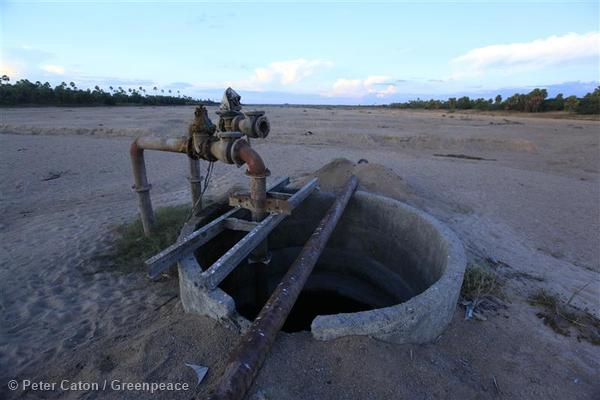
India’s groundwater tables are plunging at an alarming rate with reserves in some states dwindling to critical levels, according to the latest report from the Central Ground Water Board (CGWB) – the apex body under the Ministry of Water Resources.
Over 16% of the country’s groundwater resources are ‘over-exploited’ – mainly in north-western, western and peninsular India. Groundwater extraction in some states –including Delhi, Haryana, Punjab and Rajasthan – has reached 100% (when annual extraction exceeds water availability) which, experts say, will have huge ramifications for agriculture, livelihoods and the whole economy.
Unregulated use has also led to over extraction in Himachal Pradesh and western Uttar Pradesh according to the report. Gujarat, Daman and Diu in the west and Karnataka and Tamil Nadu in the south have also been put on high alert as groundwater extraction has reached over 70% of available resources, putting it on the threshold of ‘critical’. Agriculture is the biggest consumer of groundwater, according to the CWGB, accounting for 91% of withdrawals every year, while domestic and industrial withdrawals account for the remaining 9%.
The situation in the capital city of Delhi is particularly dire, where nearly 500,000 illegal borewells suck up the city’s groundwater. Almost 16% of Delhi’s urban households and 30% of its rural ones don’t have sufficient drinking water throughout the year, according to a National Sample Survey Organisation (NSSO) study.
Weak monsoons due to climate change have further eroded India’s groundwater reserves. “Groundwater mainly depends on rainfall for recharge, so deficient rains mean less groundwater availability. A failed monsoon leads farmers to draw deeper from groundwater to irrigate their crops, which pushes water tables down further,” explained a CWGB official.
The key agricultural states of Punjab and Haryana – which provide food security for the nation – received only half the normal rainfall this monsoon season, a recurrent pattern over the past 16 years. Punjab, according to the Indian Meteorological Department figures, has only seen two normal monsoon rainfalls since 1999. In Haryana, rains have been above normal in just four of the last 16 monsoons.
This trend has dire implications for agriculture which relies heavily on groundwater. “The situation calls for an urgent revamp of groundwater policy,” argued Dr Subodh Wagle, professor of water policy at the Tata Institute of Social Studies, Mumbai. “Despite the 1986 Environment Protection Act, which mandates judicious use of groundwater, the precious resource continues to be depleted in several new areas,” he said.
India is the largest groundwater user in the world, according to the World Bank – using nearly a quarter of the global total. This is partly because of decentralised access to water in the country. India’s12th Five-Year Plan (2012–17) recognises groundwater is being exploited beyond sustainable levels, but policy makers have failed to reverse the trend. With an estimated 30 million groundwater structures in play, India may be hurtling towards a crisis of over-extraction and quality deterioration. “If current trends continue, within 20 years 60% of all aquifers in India will be in a critical condition,” warned the World Bank in a recent report.
Water levels in 56% of wells in the country declined in 2013, compared to the average of the preceding decade (2003-2012), according to the Central Water Resources Board.
Urban sprawl deepens crisis
Unchecked urbanisation has only added to the mess. Construction is driving groundwater extraction in the National Capital Region (NCR), encompassing New Delhi and the surrounding areas. The National Green Tribunal – which provides a forum for environmental protection cases – prohibits the use of groundwater for construction work. Yet, authorities in the nearby Noida city supply cheap water to the construction industry, explained environmentalist and Noida resident Vikrant Tongad, who has been spearheading a local environmental movement. Tongad said there were 330 ongoing building projects in Noida and the surrounding area which have brought the region to the brink of a water crisis.
The Millennial city of Gurgaon, one of India’s fastest growing districts, fares no better. Here, the groundwater table is receding thanks to the hundreds of buildings housing multinational corporations which have mushroomed in a city that barely existed two decades ago. The failure of civic agencies to cope with the city’s exponential population growth has only aggravated the situation.
Solutions lie in agriculture
However, any solution to the country’s complex groundwater crisis will lie in tackling agricultural water use – India’s thirstiest sector. Dr Shashank Shekhar, from the department of geology at Delhi University, advocates a multi-pronged approach. “A large part of the problem in the northern region is caused by the injudicious use of water by the farming community in Punjab,” he said. “The farmers’ erroneous belief that the more they irrigate land, the higher their yields and profits will be, is worsening the situation. Farmers need to be sensitised to the fact that it isn’t excessive irrigation, but efficient irrigation that will give higher yields without draining the water table.”
Authorities also need to look at the excessive cultivation of rice in Punjab, Shekhar added. Rice cultivation – a relatively new trend – is consuming huge amounts of groundwater. “Punjab has always been a wheat-growing state, but farmers are increasingly taking to growing rice which is a water-intensive crop. This is primarily happening due to market dynamics as rice now fetches higher returns for farmers due to increased demand.”
Similarly, in western India’s Maharashtra state, especially in the Deccan Basalt region, water-intensive crash crops like sugar cane and cotton are leeching groundwater reserves. “The inequitable distribution of water from canal/dam water which forces farmers to use up groundwater is largely to blame,” said Shekhar.
Wagle argued informed deliberative processes must be set in motion, involving stakeholders from hamlets to the higher authorities. Tampering with environmental laws (driven by the many vested interests in the political economy) also needs to stop, “otherwise we will witness more and more water conflicts,” he warned.
“The irony is that despite India being one of the world’s most water-rich nations, the government and citizens have blatantly exploited their water bodies and sucked them up dry”, a senior CWPF official told thethirdpole.net.
“The government has only made things worse with its lop-sided policies. If this myopic approach continues, the day isn’t far when neither cities nor villages in India will have any potable water.”
Neeta Lal is a Delhi-based editor and journalist. She has been nominated for this year’s Global Media Summit Award for Editorial Excellence instituted by the BBC, Reuters, Kyodo and Xinhua news agency