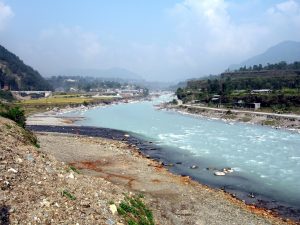
The Indian Prime Minister, Narendra Modi, formally inaugurated the Kishanganga hydropower project in the Indian state of Jammu & Kashmir (J&K) on May 19, 2018, setting off another hectic round of protests by Pakistan. This is not a new dispute. In 1988 Pakistan’s then Commissioner for the Indus Waters Treaty (IWT) first became aware of survey work on a possible scheme to divert waters from the Kishanganga into the Wular lake, and asked India to pause work. Thirty years later the Indus Waters Treaty dispute rolls on, now encompassing both the Kishanganga and Ratle hydropower projects in J&K.
Indus Waters Treaty dispute explained
The first, and only, Court of Arbitration under the Indus Waters Treaty was set up to address the issue in 2010, giving its verdict in 2013, that India could continue to work on the projects, as long as minimum flows were maintained. At the same time the 2013 verdict prohibited India from using drawdown flushing to disperse sedimentation if it led to water levels in the dam falling below Dead Storage Levels.
The IWT divides the six main rivers of the Indus basin into eastern and western rivers. While India has full rights to set up projects on the three eastern rivers, it cannot impede the water flow into Pakistan from the western rivers. Kishanganga is a tributary of the Jhelum, one of the western rivers.
The decision by the Court of Arbitration caused severe unhappiness in Pakistan, not least because it had already started work on the Neelum-Jhelum Project (NJP) situated further downstream. The inevitable lowering of the flow of water in the Kishanganga – which is called the Neelum when it crosses into Pakistani territory – due to the Kishanganga Hydro Electric Project (KHEP) makes the NJP far less viable.
As a senior official in Pakistan’s Water and Power Development Authority (WAPDA) put it, “The Kishanganga project is going to make it impossible for us to run the NJP. The NJP is just downstream of the Indian project, and India is diverting most of the water so that it falls back into the river well below the level of the NJP. So how are we going to get water for the NJP?”
But, as the Court of Arbitration had observed in the 2013 verdict, it was quite clear that during the period 2004-06 India had moved forward on the Kishanganga project, while Pakistan had shown no particular urgency in pursuing the hydropower project on its own side. It would, therefore, have been unfair to halt the construction of the Indian project on the idea that Pakistan had ‘prior’ use of the waters.
Pakistan had argued that the Kishanganga project was not in consonance with the provisions of Annexure D of the Indus Waters Treaty, which deals with “the generation of hydroelectric power by India on the Western rivers”. In it paragraph 15 (iii) states:
Where a Plant is located on a Tributary of The Jhelum on which Pakistan has any Agricultural use or hydro-electric use, the water released below the Plant may be delivered, if necessary, into another Tributary but only to the extent that the then existing Agricultural Use or hydro-electric use by Pakistan on the former Tributary would not be adversely affected.
The Court of Arbitration found this untenable, to Pakistan’s great chagrin. Speaking on the condition of anonymity, a retired official from India’s Ministry of Water Resources stated bluntly, “The Kishanganga project plan pre-dates the Neelum Jhelum plan, so Pakistan shouldn’t have planned its project at that spot in the first place. Anyway, we’re not channelling all the water for the Kishanganga project, and there is enough water flowing freely down the river. And of course, all the water we are channelling for the Kishanganga project is ultimately flowing downstream to Pakistan anyway, since Kishanganga is a run of the river project.”
This has been, though, hard for Pakistan to accept, especially since the water that is being diverted for the run of the river project does not flow back into the same river now. A tunnel channels that water to produce electricity, and then the water is channelled further to flow into the Wular lake, and ultimately to Pakistan through other water courses. Through this method, India is sticking to the commitment made under the IWT. But, apart from the water that is not diverted into the channel, the original river is left dry downstream of the Kishanganga project, making it difficult for Pakistan to run the NJP.
A Pakistani WAPDA official contextualised the problem, saying, “For years and years, every Pakistani paying his electricity bill has paid a cess for the NJP. Now how can we tell the country we cannot build the NJP?”
It is, therefore, unsurprising that Pakistan has pushed for another Court of Arbitration. The last time this happened India moved the World Bank to appoint a neutral expert after Pakistan’s request. This left the World Bank, as the guarantor of the Treaty, in the awkward position of appointing both, or asking one of the countries to desist. At that time, a World Bank spokesperson had told thethirdpole.net, “It is unprecedented in the history of the Treaty that India and Pakistan are initiating separate processes.” Doing so has put the Treaty, often considered one of the most successful in the world, in deep jeopardy.
The role of the World Bank
Extensive negotiations by the World Bank had staved off the crisis earlier, but after the inauguration of the project, Pakistani negotiators had met the World Bank to try and convene another Court of Arbitration. While Indian media has reported that the World Bank had rejected the option, the World Bank itself has emphasised:
As a signatory to the Treaty, the World Bank’s role is limited and procedural. In particular, the role in relation to “differences” and “disputes” is limited to the designation of people to fulfill certain roles when requested by either or both parties.
The World Bank remains committed to act in good faith and with complete impartiality and transparency in fulfilling its responsibilities under the Treaty, while continuing to assist the countries.
It is worth noting that the 2013 judgement by the previous Court of Arbitration, set up bilaterally without the intervention of the World Bank, had also commented on the controversy between the call of a neutral expert versus a Court of Arbitration, stating,
Article IX(2)(a) ensures the appointment of a neutral expert where a Party actually requests the appointment of the same. It does not serve to impose—for its own sake—an additional procedural hurdle to access to a court of arbitration.
Nor can the Court accept that India’s current position in these proceedings, to the effect that the Second Dispute is a matter for a neutral expert, would be relevant under Article IX(2)(a)—even if India were now to request the appointment of such an expert.
The significant difference this time around is that India has, in fact, emphasised from the very beginning that the dispute should be handled by a neutral expert rather than a Court of Arbitration, unlike before, when it had asked for a neutral expert only during the court proceedings.
In the end, though, a treaty only works as long as its participants help make it work. As the World Bank’s latest press release emphasises yet again, the IWT rests almost entirely on the willingness of India and Pakistan to work in a cooperative manner.