



For Mushir Ahmed, this time of year gets so busy that he does not know when the “day ends and night begins”. As a member of the Karachi Municipal Corporation (KMC) for over two decades, just before the monsoon rains each year he leads a team of about 60 people who launch into action ahead of the downpour. The team brings out heavy machinery – excavators, dumpers, tractor-trolleys and even wheelbarrows and shovels – to go around the city and unclog the nearly four-dozen overburdened storm-water drainage systems in Karachi. Each year when it rains, the channels can dispose of the excess water into the Arabian Sea.
This year, however, Ahmed admitted that the municipality is almost three months late on the task. To make matters worse, the rains came early.
“Of the 44 drains, three at Gujjar, Orangi and Mehmoodabad which are 12 kilometres, 10 km and 8 km long respectively, are the most problematic,” said Ahmed, who is director of municipal services. “It can take up to a month to clean each nallah.”
These natural drains are part of a network of 550 big and small storm-water drains which crisscross the sprawling metropolis. Unfortunately, just a few millimetres of rain quickly turn the city into a bathtub.
This year, the rain began on Monday, July 7 and lasted for a couple of hours. A maximum of 43 mm was recorded in Saddar, with 1.2mm in Surjani Town — two different parts of the city. But the mayhem caused, from roads being submerged, sewage spewing out of manholes and power outages in most parts of Karachi to people stuck in traffic jams for hours, resulted in an outburst of anger on social media.
The scenes on television screens were all too familiar. A ragtag army of sanitation workers with brooms, pails and bamboo poles tried to poke at the mouths of drains and manholes, as commuters inched their way and bikers waded waist-deep to drag their lifeless vehicles along.
The downpours are accompanied by tragedy. Between 2014 and 2019, there were over 70 rain-related deaths in Karachi alone; 2018 was an exception, but that was because there was hardly any rain.
On Monday, six deaths were reported in Karachi.
“Even 50 mm to 70 mm of rainfall under an hour triggers urban flooding in Karachi,” Sardar Sarfaraz, the Pakistan Meteorological Department’s Karachi head, told The Third Pole.
Dredging Karachi drainage system
For months, the Sindh government has been working on a plan which it is optimistic about. The authorities claimed to have found a solution to minimising the damage from urban flooding this year.
The local government department, the Sindh Solid Waste Management Board (SSWMB), the KMC and six district municipal corporations have joined forces under a USD 100 million World Bank project to do things differently, said Zubair Channa, who oversees the Solid Waste Emergency and Efficiency Project (SWEEP) project, under the World Bank-funded Competitive and Liveable City of Karachi (CLICK) of which he is the programme director.
Using the existing human resources that every year clean the drains, this time, he said, the government is ensuring the sewage (usually piled on the side of the drains) does not slide back into the drain but reaches its last resting place – a 10-acre plot of land at the 500-acre Jam Chakro landfill site, located about 30 km from Karachi’s city centre.
There is another four-acre plot in the Treatment Plant 1, in the Sindh Industrial Trading Estate (SITE), where some of the sludge will be transported to and put into hundreds of mammoth 40-year-old sludge silos. “These have been cleaned and repaired and ready to put to use,” said Channa. “These tanks will allow the wet sewage to settle in a compartment at the bottom and the top dry portion may be treated and used as manure.”
“The work has just begun. In the last few days, we have dumped more than 100,000 cubic feet of sludge at both sites. As we pick up pace, we intend to touch one million cubic feet per day,” Channa added.
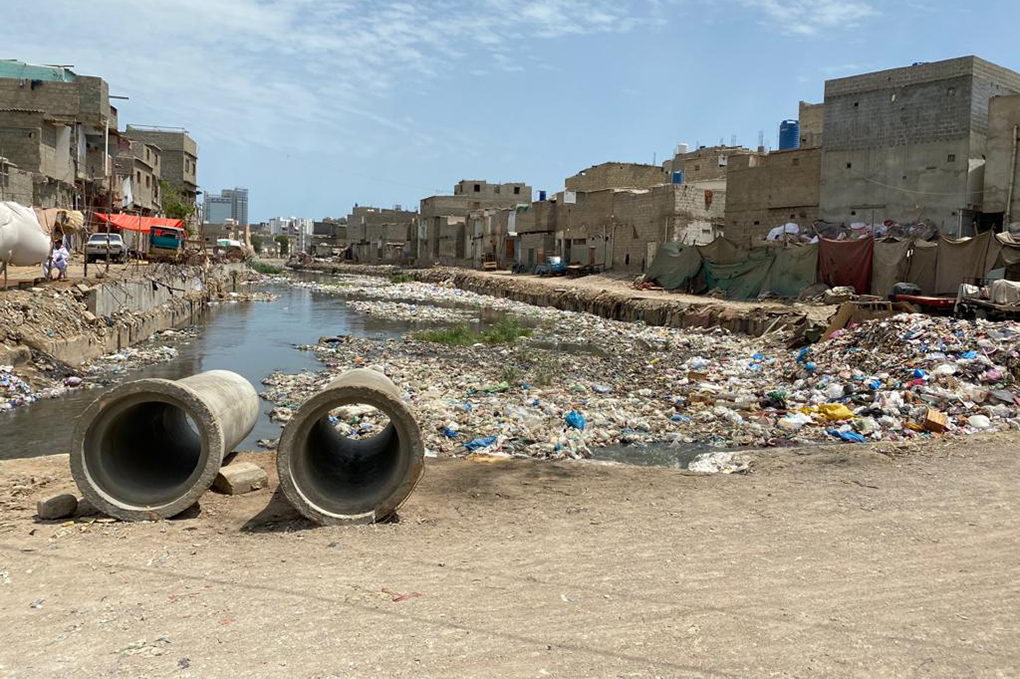
But of all these, it is the sewage by the Karachi Water and Sewerage Board that is the biggest culprit as it is causing silting of the drains, he said.
Speaking to The Third Pole on condition of anonymity, a senior KWSB officer concurred with the KMC’s Ahmed that the water authority was putting sewage in drains that are “technically” meant to drain storm or rainwater.
However, “with no major investment made to either lay the new sewerage system or to rehabilitate the crumbling sewerage infrastructure”, the water authority was compelled to deposit the city’s sewage into these drains.
With a need for “billions of rupees” to separate the water from the sewage lines, another problem is that there is “no land corridor where the KWSB can lay or install new infrastructure”, he pointed out. And where there is land, it would mean digging up roads. “Closing certain arteries to work on sewage lines would be nothing short of a nightmare,” said the KWSB officer.
Bursting at the seams, the mega-city with a population of 13 million is one of the world’s most densely populated urban centres and generates an estimated 13,000 tonnes of rubbish daily – which the SSWMB is unable to collect.
The waste authority claims it is able to collect 70% of it and take it to the two landfills. According to the SSWMB, it is able to dump 6,000 to 7,000 tonnes of Karachi’s garbage at the Jam Chakro landfill and another 1,000 to 2,000 tonnes at the second 500-acre landfill site at Gond Pass, near Hub river. The rest remains strewn around the city.
The role of urban planning
In addition to the sewage and rubbish that choke the drains, haphazard and illegal construction on and along the drains is another major problem that exacerbates urban flooding.
“The real estate developments and other physical works have greatly altered the natural flow pattern of surface water that flows into the city from north and north-east towards the south (sea side),” pointed out Noman Ahmed, professor and dean at the faculty of architecture and management sciences at the NED University of Engineering & Technology in Karachi.
Ecologist Rafi ul Haq said that an urban forest along 26 km of the Lyari river and another along the Malir river would come in the way of the natural flow. “No doubt the city needs green patches, but land-use planning must be carried out so there are no bottlenecks in the free flow of the water to the sea,” he pointed out.
Further, said urban planner Farhan Anwar, most of the open spaces, including parks and green spaces that could have acted as “natural filtration zones” and “drainage basins”, have been “encroached, paved and concretised”, aggravating flooding.
But Karachi is also different in many ways from other cities of not just Pakistan but globally. An anomaly, Noman Ahmed said, the city required “robust” but “unconventional” urban planning. With Karachi accounting for one-third of the population of the south-east province of Sindh, with a highly multicultural mix of residents, he said this representation has never been reflected at the administrative level.
“A lot of Karachi’s problems may get resolved if an informed debate on core management and development issues of the city was held,” he added.
Anwar proposed “demarcation of flood risk zones” and a “vulnerability profile prepared that documented vulnerable people and assets coming within those limits”. So far, only one such study has been carried out – for the Malir river back in 1979 after it flooded the Korangi industrial estate, after which an embankment was constructed.
But with 19 different land-owning agencies in Karachi spread across all three tiers of government, there is a perpetual fight for resources between local, provincial and federal authorities administering this city by the sea.




![Flooding along the Bagmati is an annual phenomenon in Bihar [image: Alamy]](https://dialogue.earth/content/uploads/2020/07/Floods-hit-Bihar-300x197.jpg)