![<p>Srinagar’s iconic Dal Lake has been suffering from neglect for decades, despite many interventions [image by: Faisal Bhat]</p>](https://dialogue.earth/content/uploads/2019/11/LRM_EXPORT_13160263348459_20191121_145924722-3008x2008-1-768x512.jpeg)

Jammu & Kashmir’s second largest lake is on the verge of extinction. Different governments of the erstwhile state pumped millions of rupees to protect it but had failed to restore it to its former glory. The locals believe the funds were misused by the authorities and that the lake has become a money minting machine for many government officials.
Situated in the northeast of Srinagar in Kashmir Valley, the lake once famous for its pristine beauty is losing its charm due to heavy pollution, encroachments, unplanned growth of hamlets and ever increasing human pressure. Dal Lake has shrunk from 2,547 hectares in 1971 to 1,620 hectares in 2008.
The recent Indian government decision abrogating key aspects of Kashmir’s autonomy has led to significant problems with the administration. The state was divided into two Union Territories. Who is managing what is still unclear. This has been reflected in the state of the lake, which has been filling up with weeds and Azolla, a type of aquatic fern, as massive amounts of garbage have been dumped into the lake while municipal services stalled.
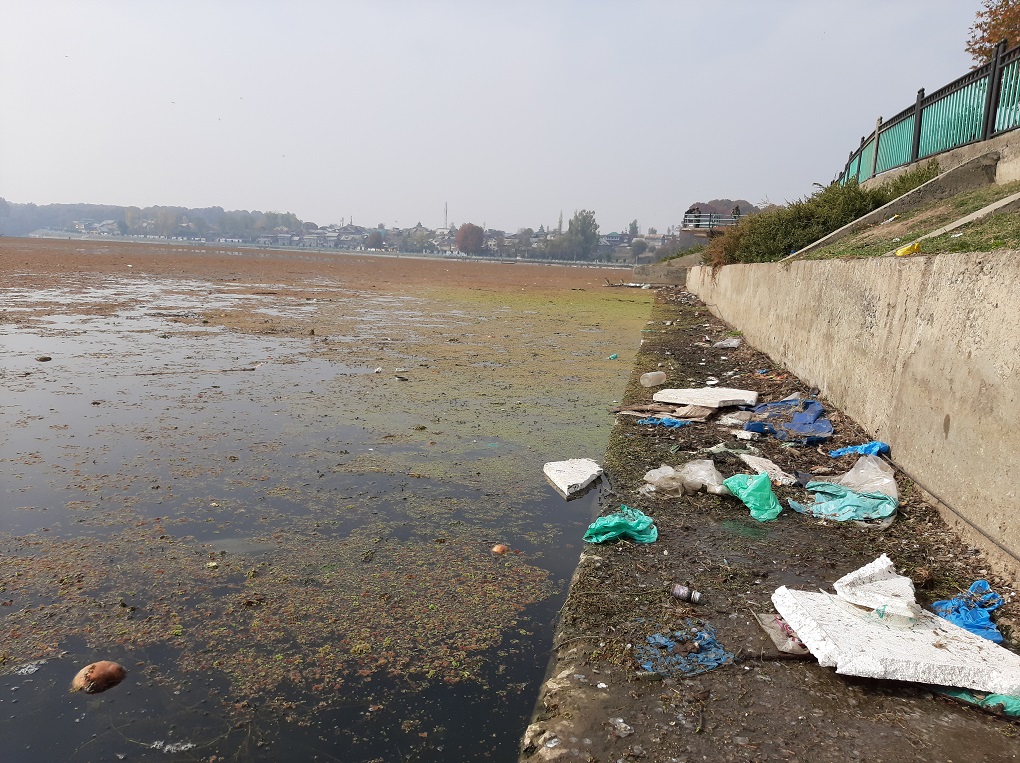
The latest report on water quality assessment of the Dal Lake by the State Pollution Control Board (SPCB) was prepared in September but has not been uploaded to its website. Internet connectivity in Kashmir remains limited. The report states that the main issues related to the lake are the discharge of untreated sewage and waste by people who live in houseboats in the lake, and those who live in adjoining residential areas. Plus, there is excessive weed growth, reduction in water purity and siltation.
The SPCB, which inspects and monitors Dal Lake water at the 17 locations, has not been able to do its work due to the ongoing situation in the valley.
![A thick spread of algae lies over the Dal Lake [image by: Faisal Bhat]](https://dialogue.earth/content/uploads/2019/11/20191105_105138-1.jpg)
Bhat agreed that illegal construction and the encroachments within and around the lake have surged after August 5, the day the erstwhile state was brought under central rule.
In the eye of the world
The Dal became the centre of attention on October 29 when over a dozen Members of the European Parliament visited Kashmir for two days. The delegates went on a boat ride. To give a rosy picture, a part of the lake was cleaned a few days before their arrival.
“The lake authority pumped some machines and cleared a part of Dal that was covered with Azolla and lily pads,” said Mohammad Shaban, a resident of Dal Lake.
![A small patch of Dal lake was cleaned for the visit of the European MEP delegation [image by: Faisal Bhat]](https://dialogue.earth/content/uploads/2019/11/20191105_112007-1.jpg)
This has had a direct effect on the lives and livelihoods of people in Srinagar. “The production of fish and vegetables has decreased, affecting the livelihood of many people,” said Tariq Ahmad Patloo, a social activist who has launched a campaign to save the lake.
He added, “Since August 5, no one from the administration came to clean the lake and now, due to the increasing pollution, it’s posing a threat to the lives of Dal dwellers.”
Not a new problem
In 2002, The Jammu & Kashmir High Court issued a series of directives to preserve the lake. But no single authority was made the responsible party. The Court also appointed a Committee of Experts (CoE), which made several recommendations and submitted its report. The CoE warned that, “If the situation continued with business as usual, the lake will not survive beyond 30 years maximum.” Based on the CoE’s finding, the court stated in December 2018, “The Dal Lake is dying. The pollution load in the lake has reached such alarming levels that unless something is done with urgency and alacrity, it may be impossible to save the lake.”
The court directed the government comply with the recommendations of the CoE, but the government did nothing to implement them.
The single biggest challenge is the dumping of huge amounts of untreated waste. Shakeel Romshoo, the head of the Earth Sciences Department at the University of Kashmir and an expert on Dal Lake, said the western side is the most polluted as it receives untreated sewage. He says this has resulted in the extensive growth of weed which is removed at a huge cost every year.
“The Dal conservation plan was made in the year 2000 and it hasn’t been updated. If you are treating the Dal Lake according to two decades’ old data one can imagine how serious the government is about the restoration of the lake,” Romshoo said. The plan needs to be updated, but even that has not been implemented since August 5, when the autonomy of Kashmir was severely curtailed.
![Weeds and red algal bloom along Dal lake, Kashmir. Stretch from Hazratbal to Boulevard since August 5 [image by: Faisal Bhat]](https://dialogue.earth/content/uploads/2019/11/20191105_105122-1.jpg)
“Our labourers couldn’t do the work due to the uncertain situation. So the work was hit because of the situation. But we doubled the working hours of the staff and now the work has been restarted,” he said.
The sewage issue is a priority. “We are trying to treat it and have installed five sewage treatment plants and 11 intimated (sic) pumps. We are also shifting houseboats to a fixed place where we would provide them with bio-digesters. We will also provide bio-digesters to many households, who are living inside the Dal,” Dar added. The principal issue of waste comes from these areas, he said. “You can imagine we collect one ton of solid waste from the Dal per day and then dispose it properly,” Dar said.
With conflict and politics being highlighted the environmental issues are harder to assess. It is impossible to say whether the political changes will make any difference. Muzaffar Lankar, former Chief Engineer with the Public Health Engineering department, said that the political changes would have little bearing on the issue, and that, “Environmental issues are least connected with changes of government.” What was important was political will, and an assessment by a foreign expert of the situation for comparative insights might help.
Aijaz Rasool, a hydrologist and environmental expert, agreed, “[the conservation of] Dal is an environmental project and it has no connection with the repealing of Article 370.” That is the article in the Indian Constitution which gave special status to Jammu and Kashmir, but has now been repealed by New Delhi. However, Rasool said it is not the laws at the state or central levels that will determine how things work. It needs political will, and it is too early to say if that exists.