


Millions of Indians got soaked in the Holi spirit – literally. They left the taps open – every which way. Not something we can afford to do
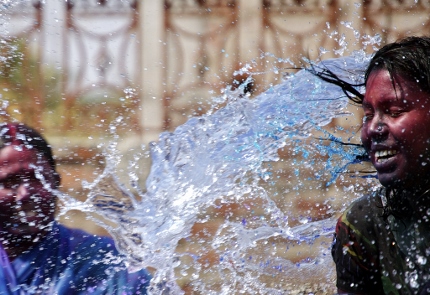
It’s about colour, abandon and unbridled fun. But Holi, the Indian festival that celebrates the advent of spring, particularly in the country’s north, is also a day of wanton wastage of water in an age where literally every drop counts, where conservation must be the mantra.
The clash between tradition and the exigencies of modern-day living is inevitable though unpalatable. That Indians celebrated Holi this year on March 17 – the festival usually falls in February or March depending on the Hindu calendar – just five days before World Water Day was mere coincidence. And another reminder that water is a scarce resource.
That’s a caution, however, that was lost in the clouds of colour and cheerful dunkings as millions got soaked in the Holi spirit – literally. After all, water is as much a part of the celebrations that cut across religion and class as the joyous reds, blues and greens are smeared on each other.
This is the day to celebrate camaraderie and community. It is also when underground and roof tanks get depleted as homes happily line up buckets of otherwise carefully rationed water to douse the unsuspecting. The affluent in their farmhouses fill up swimming pools and those in villages use the local pond for the ritual dunking.
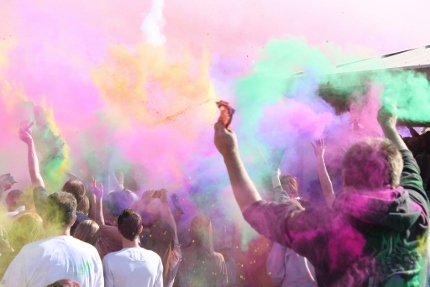
And so it was this Holi too. The tap was open – in every which way. In some gated communities in the upscale New Delhi suburb of Gurgaon, for instance, a hose pipe was left open virtually the entire morning as residents gathered for a communal celebration. Rapid, unregulated development in the corporate hub has seen the water table come down drastically.
Of the many legends surrounding the festival that celebrates the battle of good over evil, one is of the Hindu god Krishna who complains to his mother Yashoda about his dark skin and wonders why Radha, worshipped as his consort, is so fair. Yashoda suggests that he daub Radha with colour – and so was born the festival of colours.
But reality must bite, more so in a country where the per capita availability of water is progressively decreasing as population increases. According to the Indian government, per capita availability of water came down to 1,545 cubic metres by 2011, from 1,816 cubic metres in 2001.
There are no exact estimates of just how much water is wasted during Holi. But some have forwarded a guess.
“The wastage of water is high during the festival. Nearly two crore (20 million) litres of water is wasted in a small city and one can imagine the quantum of loss for a big city like Lucknow,” C.K. Chabbra of the Institute of Environmental Entrepreneurship, Research, Education and Development was quoted as saying about the capital of Uttar Pradesh state.
He added people waste water not only while applying colours but also removing it during extended baths.
Take this forward and you have a grim situation indeed.
The fact is that this is a country under perennial water stress, where many women in villages spend the better part of their day walking to the nearest well to fill up water for their most basic needs, where water is rationed to just 30 odd minutes a day even in posh south Delhi colonies, where potable water is denied to millions.
Some concerned citizens have indeed taken steps to make sure that Holi is not just another day of colossal waste of this precious commodity. “Let’s be responsible citizens and do our part to conserve water by avoiding water-based colours this Holi,” said an appeal from the Volunteers for a Better India.
Industry, too, has stepped in. Several television production houses, for instance, made sure Holi sequences for daily soaps were shot in a couple of days instead of stretching for a week to conserve water. Some also went dry.
“Normally, Holi is stretched for over a week in TV soaps. And the entire essence of playing colours is not there, since you have to get drenched every day. It is good that we have shot with dry colours this year, since it saves gallons of water…,” television actor Rashami Desai told a reporter.
All of this is welcome. But still not enough. Efforts to increase awareness must be stepped up. Will next Holi see heightened awareness and a change of heart?