Editor’s Note: The Indus River and its tributaries are essential for the existence of Pakistan. British engineers built the world’s largest canal irrigation system in Sindh in the lower Indus in the 1840s. Many more dams, barrages, weirs and canals were built after the exit of the British Raj in 1947. The result was that the river’s flow was so disrupted, the Indus did not even reach the sea for many years.
Then came the disastrous floods of 2010, which led to almost 2,000 deaths and exposed how the development model being followed along the Indus was unsustainable. Months after the floods, noted geographer Daanish Mustafa and eminent risk and hazard analyst David Wrathall wrote a detailed critique of the prevailing development model in Pakistan and how it exacerbated damage from the floods. Read their three-part series published by The Third Pole from that time here, here and here.
Mustafa now revisits the topic with a new two-part series in the wake of Pakistan’s devastating 2022 floods, making a fervent plea to policymakers to move away from colonial mindsets on water. Read the second part here.
The damage from the great Pakistan floods of 2022 is as much steeped in how we think about water as it is in climate change and meteorology. It is an established principle within hazards research that a physical event only becomes a hazard when it comes into contact with vulnerable populations. Vulnerability is as embedded in developmental choices as it is in the political economy of everyday life.
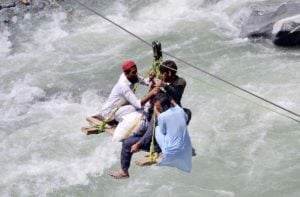
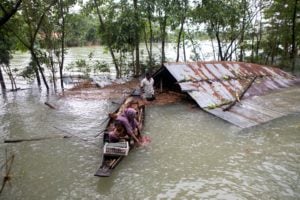
The 2022 Pakistan floods have so far inundated an area roughly the size of Britain; affected 30-50 million people; and led to the deaths of more than 1,100 people. The damages suffered so far are not solely a function of the physical events of extraordinary monsoons. They are equally a function of infrastructural and engineering choices driven by certain developmental imaginaries, which are certainly not indigenous to Pakistan. The need to decolonise water in Pakistani policy and public imagination is urgent.
What does decolonisation mean? To my mind, it means that there are many ways of knowing the world in addition to the dominant Western way of knowing. Taking account of those different ways of knowing, doing, imagining the past and future will enrich human life and emancipate, instead of sticking to the singular way of knowing. It does not replace science; it enriches it by bringing in the diversity of human experience.
Let a thousand streams of thought flow
So, what does decolonising water mean? What does it mean in the context of the Pakistan floods of 2022? 150 years ago in colonial India, of which Pakistan was a part, thinking about water was locked into a modernist view of water as a ‘resource’, to the exclusion of its multiple values within local cultures.
The modernist view treated water as simply a resource for irrigation, water supply and sanitation. The aesthetic, cultural, spiritual, and ecological values that local societies ascribed to water were simply occluded by this view. Under modernity, rivers were a giant plumbing system carrying cubic metres of water, and were expected to stay within the imposed iron limits of average flows.
Climate change is happening and under it, past expectations of averages and normality are simply not going to hold
But experientially for the local societies in Pakistan/India, average flows were meaningless, as were cubic metre numbers. To them, rivers were living entities with their moods and regimes, with no two days the same. People lived and interacted with rivers like they lived and interacted with their families. The vernacular knowledge, however, was as much underpinned by empirical observations and understanding of hydrology, geomorphology and meteorology as its modern counterparts; except that it articulated that knowledge in terms of a living, sentient nature instead of an inanimate physical entity subject to human constructs and principles imposed upon it.
Learn to embrace uncertainty
Floods are part of the natural rhythms of a river, as are extreme rainfall events. They do not care about staying within the statistically derived limits of average flows and precipitation that modern humans have come to expect of them.
Decolonising water will mean decentring the modern expectations of average volumetric flows for rivers and centimetres of rainfall, and recentring vernacular experience of uncertainty, dynamism and hazardousness in thinking, policy and practice about water.
No scientist worth their salt will ever ascribe any specific event only to climate change. Climate models will tell many different stories about what the future will look like. But one thing every climate scientist will agree upon. Climate change is happening and under it, past expectations of averages and normality are simply not going to hold.
In such a scenario, decolonising water becomes doubly urgent, to bring back the habits of mind and practice that have helped humans become the most successful species on the planet. Science and the decolonising water agenda converge under climate change.
Since colonial times, the expectation that rivers will have average annual flows, or that rains will be within normal monthly parameters, has driven very expensive and unsustainable engineering practices and infrastructural development in the Indus Basin. This year, as mountain streams flooded, they swept away the hotels and residential buildings that were built up in Pakistan’s mountainous tourist destinations. Down south in Balochistan and Sindh, intensive rains and resultant runoff swept away more than 30 dams and inundated thousands of square kilometres of land.
As the water flowed towards its natural drainage in the Indus River in Sindh, its flow was interrupted by artificial embankments in the form of levees along the river, and road, railway and canal berms in the low-lying flat relief of the Indus plains. As of early September 2022, millions are still stranded on elevated roads and canal banks in Sindh and Balochistan, on the very bunds that are keeping impounded the water that is drowning their homes and land.
Decolonised water offers an effective critique of modern water. But does it offer any promise of relief and future protection to the millions in Pakistan? That will be subject of my next article in this two-part series.
This series was initiated through conversations with the Decolonising Geography educators collective and was first published on the website decolonisegeography.com