For more than 100 years the Māori, the indigenous people of New Zealand, demanded legal personhood for Te Awa Tupua. But the country’s parliament only recognised it in 2017. Te Awa Tupua is not human or a human creation, like the corporate entities that enjoy many of the same rights as people. Te Awa Tupua is a verdant ecosystem, comprised of the spectacular 290-kilometre Whanganui river and “all its physical and metaphysical elements”. And its legal recognition is buoying a global movement to protect rivers and freshwater ecosystems by recognising the “rights of nature”.
Our new report, produced in collaboration with the Cyrus R. Vance Center for International Justice, finds that courts, legislatures and indigenous authorities are increasingly recognising such natural rights, with a growing emphasis on rivers. Important judicial and legislative developments took place in 2019 and 2020 in Bangladesh, Colombia, Uganda, Brazil and the United States, among other jurisdictions. In September, environmental groups called on Ecuador’s highest court to enforce constitutional rights of nature to protect an incredibly biodiverse freshwater ecosystem from mining. In the United States, several indigenous groups have recognised the rights of rivers, including the Yurok with respect to the Klamath river and the Nez Perce general council on the Snake river.
In South Asia, earlier this year Bangladesh’s highest court affirmed that all rivers in the country are “living entities” and appointed a government agency to act as their guardian. In India, in March 2020, the Punjab and Haryana High Court passed an order declaring Sukhna lake in Chandigarh city a living entity, with similar rights as a person. These decisions followed a remarkable ruling in 2017 by the Uttarakhand High Court in India recognising the legal personhood of the Ganga and Yamuna rivers; a ruling later stayed by the Supreme Court of India.

Released on the heels of a United Nations summit focused on the alarming loss of global biodiversity, our report offers insight into how emerging legal precedent on the rights of nature can offer significant remedy. And that remedy can’t come soon enough.
Rivers are the lifeblood of the planet. We rely on them for drinking water, fishing, agriculture and recreation. Many rivers are also considered sacred. Rivers flow not only with water but with life, nurturing a magnificent array of fish, birds and other species, from the headwaters to the ocean. As the Uttarakhand High Court declared in its 2017 ruling, rivers “are breathing, living, and sustaining the communities from mountain to sea”.
But we are killing our rivers. Pollution, dams and the climate crisis have left waterways in a perilous state. According to the World Wildlife Fund, two out of every three people experience a freshwater shortage for at least one month every year, and populations of freshwater animals have declined by more than 80% since 1970. Clearly, our existing legal frameworks to protect rivers are failing.
See: The dilemma of rights to nature
Unfortunately, the precipitous decline of rivers is entirely predictable. Most legal systems treat rivers as mere human property, with no rights of their own. Our current economic system in many respects incentivises the wanton exploitation of rivers – including their water, species and ecosystem functions – in order to maximise profits. Environmental laws offer some protections, but they fail to challenge this paradigm or address the root causes.
See: An equation to restore river basins in South Asia
See: Room for the river: Mitigating flood risk in South and Southeast Asia
Treat rivers and forests as ‘legal persons’
Instead of seeing water and rivers as commodities to be owned and exploited, a rights of nature framework acknowledges that nature has its own interests which must be respected by humans. Importantly, it allows legal actions to be brought directly on behalf of rivers themselves, not merely as entities owned by human beings. By recognising rights of nature, courts and legislatures can help preserve natural ecosystems for future generations and for everyone who relies on them.
Although they may seem novel, the rights of nature fit comfortably in modern legal systems. The law has always recognised the existence of non-human legal “persons”. If corporations and ships can be legal persons, there is no reason why a river or forest cannot. We can also create new categories of rights-holders altogether.
Like corporations, ships or children, rivers can have designated guardians to represent their interests. As far back as 1972, William Douglas, a United States Supreme Court justice, suggested that “those people who have a meaningful relation to that body of water — whether it be a fisherman, a canoeist, a zoologist, or a logger” could be recognised as representatives of a river.
Today, that suggestion has become a reality. Courts and legislatures around the world have recognised or created bodies that can speak on a river’s behalf. Te Awa Tupua is represented by a group of guardians appointed by the government and local Māori. In Colombia, the Constitutional Court has created a comprehensive governance structure for the Atrato river, which is charged with conservation, maintenance and restoration. And in Bhutan, the Royal Court of Justice recently devised new rules allowing environmental cases to be brought by individuals acting as “trustees of nature”. Our research shows that all over the world, rights of nature are not just an idea: they are a concrete reality.
The rights of nature movement is being led by a vibrant coalition of lawyers, activists and scientists. Indigenous groups and concepts have been crucial to its development. Te Awa Tupua was created as part of a treaty settlement negotiated by Māori people, and the Atrato river case was driven by the indigenous and Afro-descendant communities that have relied on the river for hundreds of years. Western legal systems could learn much from indigenous legal systems. Concepts such as Māori kaitiakitanga (stewardship) and Andean sumak kawsay (living well) reflect a worldview in which humans owe obligations to their natural environment. By enshrining these principles in formal and customary law, indigenous systems have long recognised our shared dependence on nature. Rights of nature offer an opportunity for other legal systems to learn from this insight.
As rights of nature laws and policies proliferate, a coalition of leading environmental organisations, scientists, politicians, indigenous leaders and others are advancing a Universal Declaration of the Rights of Rivers, which describes the basic rights all rivers should be entitled to. It will serve as a legislative starting point for governments that wish to pursue legal recognition of the rights of rivers. Already, Jorge Octavio Villacaña Jiménez, a politician in Oaxaca, Mexico, is proposing state-wide rights of rivers legislation inspired by the declaration, and many are soon to follow.
See: Rights without institutions are no rights at all
Rights of nature are no panacea. Restoring our long-neglected rivers will require extensive and immediate measures by governments, courts, companies and civil society. But rights of nature provide a framework for radical action. They translate our ethical and spiritual obligations into legal systems and establish far-reaching enforceable rights and duties. Recognising nature’s legal personality is something we owe to future generations and to the environment.
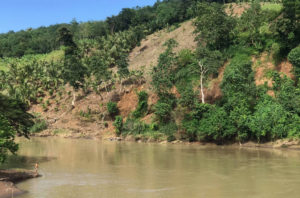

![Official figures state around 73.5% of the Madhupur Saal Forest land had been converted to different commercial purposes. The lucrative profit of mono-crop cultivation has led people to clear forest lands for banana and pineapple cultivation [image by: Prakash Bhuyan]](https://dialogue.earth/content/uploads/2020/11/13-300x240.jpg)