


![<p>One of the many ancient rock carvings that will be submerged by the Diamer Basha dam in Gilgit-Baltistan, Pakistan [Image by: Gulraiz Ghouri]</p>](https://dialogue.earth/content/uploads/2020/08/Gilgit-Baltistan-ancient-rock-carvings-2400x1600.jpg)

“There is an open-air museum in the Chilas valley,” said Aftab Rana, president of the Sustainable Tourism Foundation Pakistan (STFP). He was referring to a mountainous area of Gilgit-Baltistan in northern Pakistan, where the cliffs and boulders are festooned with tens of thousands of petroglyphs – ancient carvings made when drawings are etched into rocks.
The Chilas valley has one of the largest known numbers of rock engravings. Many are located on the banks of the Indus river, clustered around old roadways, river crossings and settlements. They are difficult to reach – a factor that may have helped preserve them. But soon, that will no longer be the case.
This is the area where the Diamer Basha dam is being built on the Indus under the supervision of Pakistan’s Water and Power Development Authority (WAPDA). The eight million acre-foot, 272-metre-high reservoir will generate 4,500 megawatts of hydroelectric energy and irrigate 1.2 million acres of agricultural land. Its construction means that most of the area’s magnificent heritage will soon be underwater.
See: Pakistan breaks ground for dream dam project at Diamer
See: Diamer Basha project needs independent seismic experts
Rana, who as a young man frequently visited the area to look at the carvings, expressed concern about their future to The Third Pole. But, he said, “I am hopeful that [Prime Minister] Imran Khan’s government will not ignore the conservation of this important rock art heritage.”
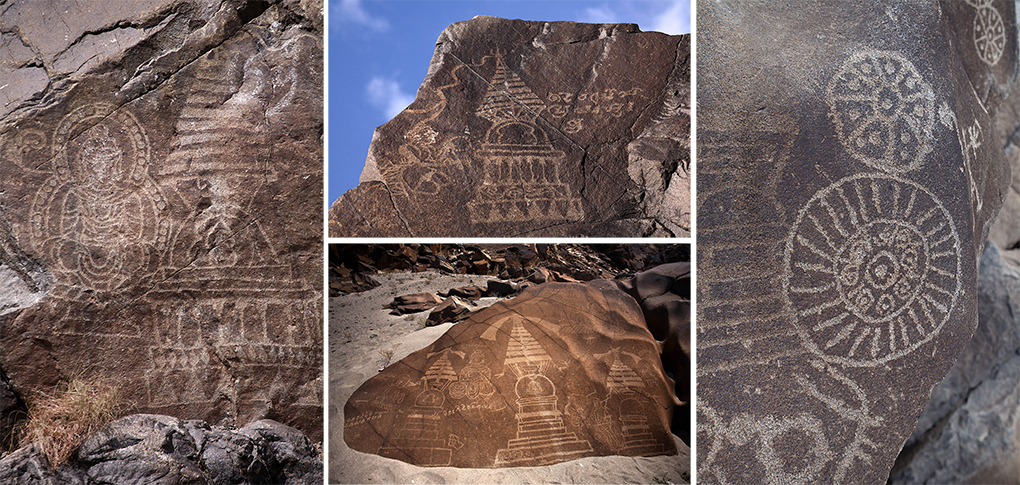
Before the 1980s and the completion of the Karakoram Highway, getting to the area was hard and few academics had studied the ‘rock museum’. However, with improved access, scholars documented 50,000 carvings and 5,000 inscriptions, dating them from 8,000 BCE up to the 16th century CE and the advent of Islam in the area.
Over the ages, both peaceful travellers and invaders from Central Asia left their mark on the region, following routes along the upper Indus and its adjoining valleys. As a branch of the Silk Road, the roads were used by merchants, pilgrims and artisans from the north or the Indian subcontinent.
Feryal Ali-Gauhar, lead consultant for cultural heritage management at Diamer Basha dam, said, “The significance of these carvings and inscriptions for Pakistan is extremely important in that it reveals to us the evidence of the many tribes and groups and even individuals that have travelled through our far north, leaving behind cultural traces which form part of our heritage.”
A survey conducted by the STFP found that most of the carvings depict single animals, ‘triangular men’, images of Buddha, Buddhist stupas (burial mounds) and hunting scenes.
Mueezuddin Hakal, an assistant professor at the Taxila Institute of Asian Civilisations of Quaid-i-Azam University in Islamabad, said that people “involved in this international activity wrote their diaries on rocks”, expressing “their aesthetics propagating particularly their belief in Buddhism”. He added that there are messages in Brahmi (an ancient Indian language), Sogdian (from ancient Iran), Tibetan, Hebrew, Chinese and Bactrian Script (from north Afghanistan).
![Two of the ancient rock carvings that will be submerged [Images by: Mueezuddin Hakal]](https://dialogue.earth/content/uploads/2020/08/Diamer-Basha-Rock-Carvings-by-Moezzuddin-Hakal-2-together-e1601046541537.jpg)
Ali-Gauhar stressed the importance of conservation, as “heritage is a non-renewable resource, and once lost, cannot be reproduced”.
WAPDA has written a Cultural Heritage Management Plan. This sets out how it will preserve the rock carvings and inscriptions, set up a museum and promote cultural tourism in Gilgit-Baltistan.
The document detailing the plan is not yet public. However, Ali-Gauhar outlined it to The Third Pole.
In total, 35,000 rock carvings will be affected by the construction of the Diamer Basha dam. Of these, 5,000 will be scanned by a 3D camera. The 5,000 carvings were selected by Harald Hauptmann, the former head of the Pak-German Archaeological Mission and a professor at Heidelberg University, who died in 2018. The data will be stored in archives and used to make full-scale replicas of the carvings for display in the museum.
The majority of the original carvings will be submerged when the reservoir is built. “Cutting the carvings from the cliff faces and boulders upon which they are carved is not an option as this will totally destroy the carvings due to the fragile nature of the rock, which is igneous and is already profoundly weathered,” said Ali-Gauhar.
The submerged carvings can be treated with a protective coating. Depending on the clarity of the water, Ali-Gauhar said, it is possible people will still be able to view the carvings underwater.
“Since a Chinese company has been contracted for the building of the dam, it is possible to seek assistance from the Chinese government to help us to build a dome-like structure above the most important carvings,” she said, citing Baiheliang, an archeological site that was submerged when the Three Gorges Dam was built. It is protected by an arch-shaped glass covering filled with purified water. The underwater museum means visitors can descend and view the original inscriptions.
Resilient ethyl silicate was used to reinforce the carved stone at Baiheliang, and polyester adhesive-bonded fabric to protect the inscriptions from erosion. Ali-Gauhar said WAPDA will seek the assistance of Chinese experts in protecting the rock carvings in the Diamer Basha dam area.
Carvings outside the reservoir will be protected with a chemical coating to shield them from wind, water and the sun.
Ali-Gauhar added that “a rapid assessment will have to be carried out to upgrade the existing plans,” the last of which was submitted in 2016. “A lot of changes have occurred in the past four years and WAPDA needs to move very quickly,” she said. For example, archaeological excavations that have found evidence of Buddhist settlements and monasteries must be carried out before any construction work on the dam begins.
The carvings are not on the United Nations Educational, Scientific and Cultural Organisation (UNESCO)’s World Heritage List, which gives sites certain legal protections. Jawad Aziz, national professional officer (culture) for UNESCO Pakistan, said the carvings are “priceless and irreplaceable assets of Gilgit-Baltistan, and have a great potential for promoting tourism and generating economic benefits for the local people.”
He said, “UNESCO remains committed to safeguard the cultural heritage of Pakistan and is currently planning to mobilise resources to engage local community through awareness raising and provide technical support to the government of Gilgit-Baltistan for protection and promotion of its cultural heritage.”
Scholars respond
Mian Attique Ahmad, an archaeologist, is director of the Information and Cultural Department of Punjab and secretary general of the Museums Association of Pakistan. He said he agreed with the plans for the preservation of the rock carvings.
He added that the technology exists to relocate these rocks, giving the examples of a mosque in Turkey and Egyptian temples during the construction of the Aswan dam, which were moved to other sites.
Christian Luczanits, a senior lecturer in Tibetan and Buddhist art at the School of Oriental and African Studies in London, described the submerging of the carvings as “a great loss for Pakistan”. He added that “fortunately they are well documented and the information they contained will at least be partially preserved.”
Jason Neelis, chair of the religion and culture department at Wilfrid Laurier University in Canada, questioned the estimated number of carvings that could be impacted by flooding in the dam basin, as he said not all the sites in the basin have been extensively documented.
Hakal urged the government of Pakistan to involve institutions such as University of Peshawar, Hazara University and the Taxila Institute of Asian Civilisations in conducting further in-depth research.
Tourism can still thrive
Ali-Gauhar said that it is “possible to manage this important cultural and historical heritage so that local and international tourists can benefit from the understanding of the ancient images and inscriptions.”
The Cultural Heritage Management Plan includes the restoration of Chilas Fort, a 19th-century edifice built by the British that has been acquired by WAPDA.
A museum and archive will be established there. Tourist trails and facilities will be set up, with employment opportunities for the local community as guides.
Ali-Gauhar said Gilgit-Baltistan’s department of culture and the Directorate of Archaeology and Museums for the province of Khyber Pakhtunkhwa were consulted and approved of the plan.
Aftab Rana, of the STFP, said he was keen for the government to establish a rock art museum-cum-garden in Chilas or at Gilgit. He said this could become a tourist attraction and source of economic activity for the region, as well as a focal point for researchers, writers and scholars.
Photographer Gulraiz Ghouri’s work can be found here


![Residents of Thakurbari place sand-filled bags on the Koshi riverbank in an effort to save the riverbank and their homes from floodwaters [Image by: Birat Anupam]](https://dialogue.earth/content/uploads/2020/08/Nepal_Floods_2020_Koshi_1-300x199.jpg)


![Kaavan at the Marghazar Zoo in November 2019 [Image by: Muhammad bin Naveed]](https://dialogue.earth/content/uploads/2020/08/Kaavan_by_Muhammad_Bin_Naveed._Photo_taken_Nov_30_2019-300x169.jpg)