![<p>The limited water in the Teesta as it exits Sikkim and enters West Bengal [image by: Jayanta Basu]</p>](https://dialogue.earth/content/uploads/2017/06/DSCN6556-768x576.jpg)

The marked reduction in the water flow of the Teesta during non-monsoon months has led to a major strain in Bangladesh-India ties. It has led to the question – why has the water flow gone down?
In the first part of this investigative report, the role of hydropower projects was examined in detail.
See: Where are the Teesta waters?
But hydropower projects are not the only reason for the diminished flow. There are other major causes.
The canal effect
Figures show that the water flow in the Teesta started going down significantly from the late 1970s. The mean average discharge of water was reduced by about 63%, from 541 cubic metres per second (cumec) in 1979 to 200 cumec in 1999. The minimum discharge – in summer months – shrank by as much as 90% some days. The figures suggest that the diminishing flow really began in 1979-80, when the minimum discharge plummeted to 195 cumec from 361 cumec in the previous year.
Downstream of Gajaldoba barrage, this flow was diminished further after the barrage became fully operational in the mid-1990s.
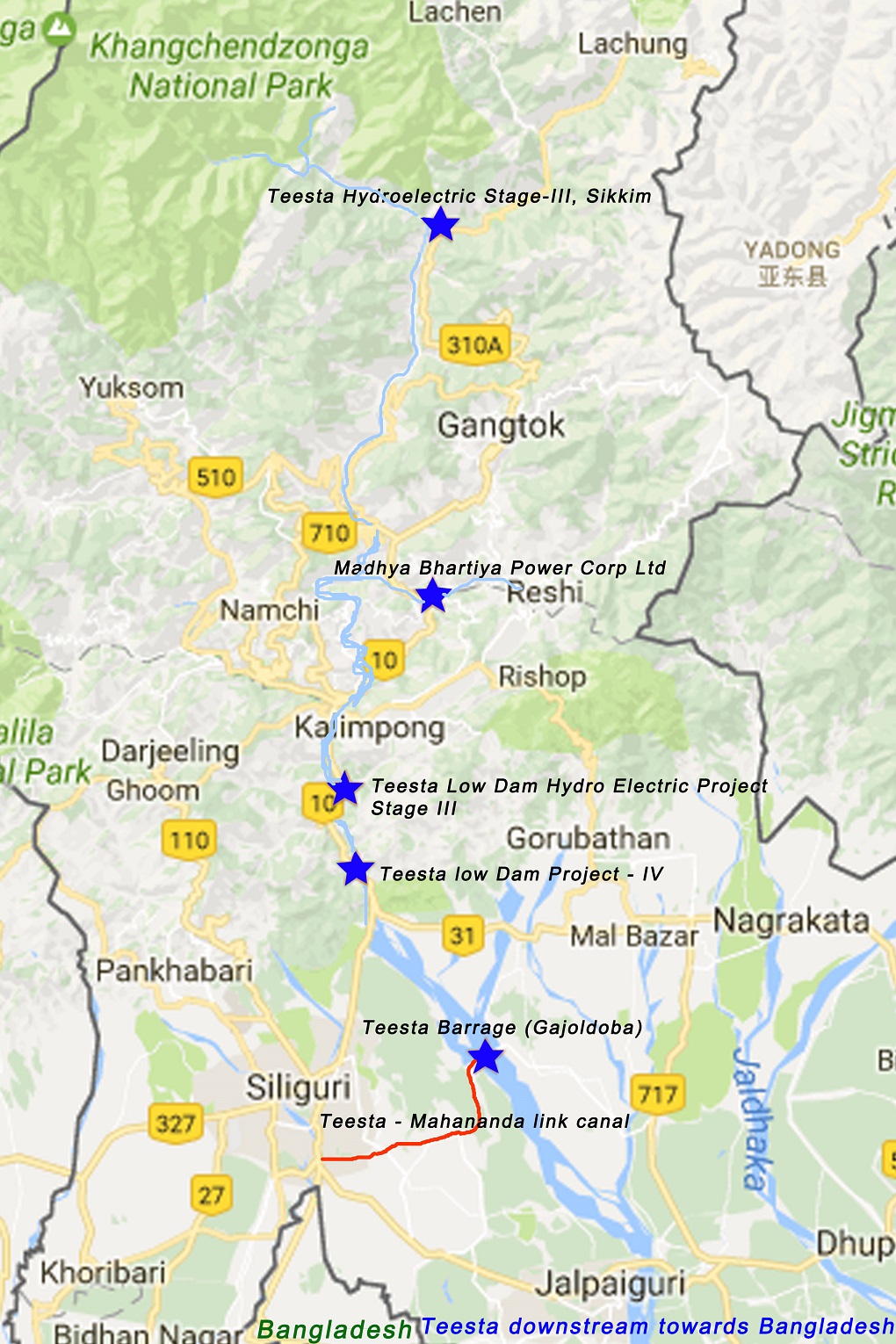
The hydropower projects started much later, so they cannot be the only reason for the diminished flow. The canal at the barrage, taking the waters of the Teesta to the Mahananda, is definitely a factor.
“Around mid-nineties the minimum flow from upstream during the lean months was often 100 to 110 cumec; we normally used to keep 80% and released 20% downstream,” P.K. Basu, retired irrigation engineer in West Bengal government, told thethirdpole.net. He was one of the key officials entrusted with running the Gajaldoba barrage in its early years.
“With reference to the last 15 years, there is declining trend of annual discharge and severe water scarcity can be perceived during non-monsoon (months) due to high demand and declining supply,” said geographer Kausik Ghosh. “Clearly the situation has gone from bad to worse in the last few years as one can notice vast stretch of dry land on the river just downstream of Gajaldoba barrage.”
As per 2010 data, every year West Bengal has been channelling around 10% of Teesta water through the Teesta-Mahananda link canal. “West Bengal could have drawn more water if its irrigation network was completed,” Basu said. “Though the main canals were completed, but due to the land acquisition policy of the present government, hardly any new irrigation network could be created. As a result, though the Teesta-Mahananda link canal has the capacity to carry around 330 cumec, hardly 190 cumec is taken when there is sufficient water. In the lean season, it must be far less.”
“During the driest months of the lean season, West Bengal has to hold back most of the water and channel it thorough the link canal otherwise not only will agriculture over a vast area be affected, but even Siliguri may be affected as much of its drinking water comes from this canal,” observed ecological economist Nilanjan Ghosh. Siliguri is the second largest city in West Bengal.
Only two out of the 45 gates in the Gajaldoba barrage were open in early June, thethirdpole.net found out.
The climate change effect
The hydropower projects and the diversion of water through the Mahananda link canal are not the only reasons for diminished water flow in the Teesta. In the non-monsoon months, there is less water in the river in the first place. According to Basu, regular studies by scientists from the central and Sikkim governments have shown this is due to the receding of the glaciers that feed the Teesta.
Glacier retreat is one of the major impacts of climate change.
Animesh Bose, an environmentalist working in the Himalayas for many years, and a member of the Himalayan Nature and Adventure Foundation, referred to a 2007-08 study report of the Ministry of Environment, Forests and Climate Change, which said that out of the 34 main glaciers contributing to water flow in the Teesta, 23 showed trends of retreat while eight were found advancing and the other three glaciers remained unaltered. “While in 1990, 34 glaciers used to cover an area of 305 sq. km, in 2004 the glacial cover on the Teesta basin was reduced by four sq. km,” Bose added.
As a result, the volume of water flowing down the Teesta from Sikkim to West Bengal has been declining consistently. According to data sourced from the Irrigation and Waterways department of West Bengal government, in 2001 the Teesta-Mahananda link canal received 120 cumec on average, which went down to an average of 50 cumec in 2010.
The result downstream
A study carried out by geographer Ghosh – Planform Pattern of lower Teesta River after the Gajaldoba Barrage, published in the Indian Journal of Geography and Environment in 2014 – shows that mean annual discharge received at the barrage has gone down nearly one-third, from 725 cumec in 1993 to 480 cumec in 2010. “I have found that the river has significantly braided – generation of multiple channels in intertwined manner – in recent times, which indicates that the volume of upstream water has gone down, leading to high sedimentation and, hence, braiding of the river,” Ghosh told thethirdpole.net.
All residents met during the trip up and down the banks of the Teesta confirmed that this braiding is a relatively recent phenomenon.

Jeta Sankrittayan, head of the economics department in North Bengal University in Siliguri and a man who has been working on Teesta issues for decades, also said, “Visual assessment shows that the river water has definitely gone down in recent years.”
As the water flow decreases, the demand for Teesta water in West Bengal is increasing. The river remains the main source of water in the northern part of the state. “Teesta water, through the Teesta-Mahananda link canal, caters to the paddy and other cultivation, tea gardens and as well as to Siliguri for drinking water,” said environmentalist Bose.
“There has been increasing pressure as the command area for irrigation is consistently increasing but we have inadequate water in link canal. Hence a high-power state committee has restricted the irrigation area to about 52,000 hectares now; which is nearly one-twentieth of the initial plan of irrigation,” said a senior official in the state government.
Without getting all the players on board, there seems little chance of finding a sustainable solution to this problem.