


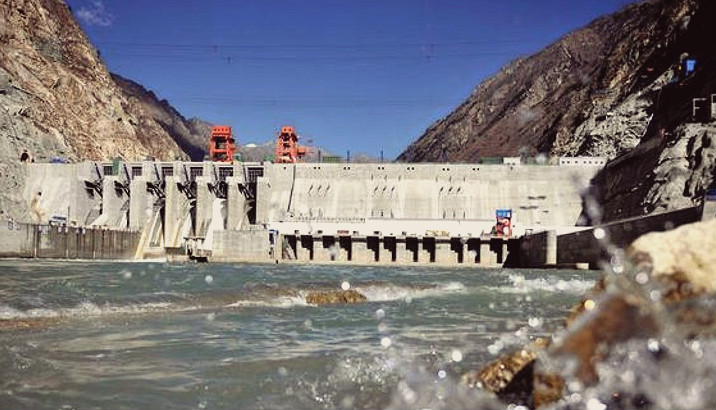

The sounds of concern and assurance were familiar. As China completed building the 510 MW Zangmu hydropower station in Tibet this October, large sections of the Indian media expressed concern about the dam impeding water flow to downstream Brahmaputra. Almost on cue, Indian government officials said they were in touch with their counterparts in China. Simultaneously, a Chinese foreign ministry spokesperson pointed out that Zangmu was a run of the river project, so it would not hold back any water.
The assurances are correct as far as they go, but they do not go far enough. Run of the river projects do not hold back water, but they hold back silt, and this has serious impacts on fertility downstream.
In a run of the river project, a dam is built to divert the water from the river into a tunnel. The dam usually diverts anything between 70 and 90% of the water, depending on the environmental clearance obtained.
This silt-laden water is first taken to a settling tank, so that the silt can settle down to the bottom. The last thing a hydropower engineer wants is silt in the water – it breaks the edges of the turbine blades. The silt-free water is then led down a long tunnel, at the end of which it falls vertically on the turbine blades. The turning of the turbine produces electricity. The water is then led back to the river.
So it is true that no water is held back in a run of the river project. But the same cannot be said about the silt that had settled down to the bottom of the first tank. It is flushed out onto the riverbed, just downstream of the dam wall.
The question is – is the water that is allowed to run free of the dam in the first place enough to carry a significant portion of this silt downstream? In most cases, the answer is no.
A crucial issue
This issue becomes crucial because it is the silt that renews the fertility of the soil downstream. The Hindu Kush Himalayas are the youngest mountain range in the world; the rivers flowing down from it have replenished soil fertility in some of the oldest farmed regions on earth – across Asia. The Ganga-Brahmaputra-Meghna delta is almost entirely made up of this silt.
This carriage of silt by the rivers is now under threat with the spate of run of the river projects being carried out and planned by China and India, an issue that has been brought centre-stage by the completion of the Zangmu project.
The Chinese government has announced four more run of the river projects on the Yarlung Tsangpo – as the Brahmaputra is called during its passage through Tibet. More are planned on the river’s tributaries. On top of that, there are as yet unconfirmed reports of a plan to build a series of cascade dams at the great bend that the Brahmaputra makes as it starts flowing south-west and into Arunachal Pradesh in India.
India’s dams go ahead without clearance
The Indian government has plans for 168 large, medium and small run of the river projects in the Brahmaputra and its tributaries to produce 57,000 MW. These include the 2,000 MW Lower Subansiri hydroelectric project, though that has been stalled for years by public protests. They also include the 3,000 MW Dibang project in Arunachal Pradesh, which was reportedly cleared under instructions from the Prime Minister’s Office last year, though the environment ministry had earlier refused permission because it may endanger a reserve forest downstream.

See India’s gives green light to build country’s largest dam
See also Experts call for major redesign of India’s largest dam
As some of these projects start being built and come online, the effect on silt flow is showing already. The Brahmaputra has always been a river that floods. The new thing is that now as the floodwaters recede, they leave behind sand instead of silt. This sudden drop in fertility is leading to distress and migration from the areas where the Brahmaputra leaves the mountains and enters the Assam valley.
See Constant floods leave Assamese children easy prey for human traffickers
This is becoming a serious problem in India and downstream Bangladesh, where the 2,900-km Brahmaputra – locally called the Jamuna – is eroding banks as it always has, but not building them as it did in the past.
Issue in focus
All this is now in focus due to the completion of the Zangmu project, built at a cost of 9.6 billion yuan (US$1.52 billion). The money came from China Huaneng Group, the country’s biggest power firm. Huaneng will operate all six units of the plant. The first unit began generation in 2011.
As the completion announcement led to familiar sounds of consternation in the Indian media about potential blockage in water flow, Chinese foreign ministry spokeswoman Hua Chunying said, “China pays great attention to the issue of source water protection for downstream regions. Experts from both sides have also been in close contact. We are also willing to fully consider India’s relevant concerns and continue to stay in close contact with India about this.”
Not a word about the silt from any side.
China and India do have an agreement on the Brahmaputra, but that is only for sharing water flow information during the monsoon. They have agreed to step up cooperation on disaster management and other issues in the basin, but as yet there is no sign of any concrete step up.